How Much Is a Coach Bag | The Real Cost Behind the Label
This post contains affiliate links. As an Amazon Associate, we earn from qualifying purchases.
A Coach bag’s price comprises three numbers: the cost to make it, the cost to buy it new, and the eventual cost to keep it. The retail price you see, anywhere from $150 to over $500, covers premium materials and skilled labor, but massive regional markups in Asia can double it, and a single repair for a broken zipper or torn leather can add another $100 to $900 to the total cost of ownership.**
That gap between the US retail price and the price in Tokyo or Singapore is where the real story is. It’s not about quality differences. It’s about geography and distribution. A bag that costs $450 in New York can list for over $1,000 in Hong Kong. Savvy shoppers now use international forwarding services to bypass those markups, treating a Coach purchase as a global logistics puzzle as much as a fashion choice.
What follows is the breakdown most reviews skip: the verified production cost estimates, the exact regional price disparities documented in 2026, and the repair bill scenarios that turn a $300 bag into a $1,200 commitment. By the end, you’ll be able to look at any Coach price tag and know exactly what you’re paying for, and what you might still owe later.
Key Takeaways
- The direct cost to manufacture a Coach bag like the Mini Jamie Camera Bag is estimated between $55 and $85, with materials and skilled labor as the largest components.
- Regional price differences are extreme; a Coach Tabby Shoulder Bag 26 retails for about $450 in the US but can cost ¥105,000 (approx. $1,000) in Tokyo, a markup of over 120%.
- Repair costs are a significant, often overlooked part of ownership. Basic fixes start at $40, but leather restoration or rare hardware replacement can exceed $1,000.
- Shipping an internationally purchased bag requires calculating volumetric weight, not just actual weight; a medium-sized box (35cm x 25cm x 15cm) is standard for a shoulder bag.
- The choice between full-grain leather and coated canvas directly impacts long-term durability and potential repair costs, with leather demanding more upkeep.
The Three Price Tags Every Coach Bag Actually Has
Most people see the sticker price and think that’s the whole story. It’s not. To understand what you’re really spending, you need to separate the cost into three distinct layers: what it costs to build, what it costs to buy, and what it costs to maintain. Each layer has its own variables, and missing any one of them gives you an incomplete picture.
A detailed cost breakdown for a model like the Mini Jamie Camera Bag estimates direct production expenses between $55 and $85 per bag. This includes premium materials ($20–$40), skilled assembly labor ($20–$30), and quality control and packaging ($5–$10).
The first layer is production. This isn’t the brand’s secret; it’s basic manufacturing economics. For a Coach bag, the largest chunks are materials and labor. Top-tier leather, durable hardware, and signature coated canvas aren’t cheap. Then, artisans cut, stitch, and assemble each piece. This hands-on factory work costs more than fully automated processes. Marketing, retail space, and corporate overhead come later and inflate the final retail price, but the foundation is that $55–$85 in direct costs.
The second layer is the retail price you encounter. This is where geography plays a brutal game. Coach practices regional pricing, meaning the same bag has a different MSRP in different countries based on local markets, taxes, and distribution costs.
| Bag Model | US Retail Price (2026) | Asia Retail Price (2026) | Markup |
|---|---|---|---|
| Coach Tabby Shoulder Bag 26 | ~$450 | ~¥105,000 (Tokyo) | ~120%+ |
| Coach Brooklyn 39 | ~$495 | ~$5,200 HKD (Hong Kong) | ~35%+ |
| Coach Quilted Tabby 20 | Varies (Outlet discounts) | Full boutique price (Singapore) | Up to 50% |
This table isn’t theoretical. These numbers are pulled from retailer and forwarder blogs documenting real 2026 price comparisons. The gap represents the difference between an accessible luxury purchase and a major investment.
The third layer is total cost of ownership, and this is the one that surprises new buyers. You aren’t just buying a bag. You’re buying its future maintenance. A broken zipper pull, a torn lining, or scuffed leather edges are inevitabilities. The next section covers why that maintenance bill varies so wildly.
What You’re Really Paying For: Materials and Labor
Forget the brand cachet for a minute. The physical object in your hands costs what it costs because of what it’s made from and who put it together. Two bags that look similar on a shelf can have wildly different underlying values based on these choices.
The biggest differentiator is material. Coach uses two primary types: full-grain leather and signature coated canvas. Full-grain leather is the top layer of the hide. It’s durable, develops a patina, and ages with character. It’s also more expensive and requires specific care. Signature coated canvas is a fabric base with a PVC coating. It’s scratch-resistant, lightweight, and uniform in appearance. It’s generally less costly to produce and easier to maintain.
Your choice here dictates the bag’s longevity and its repair profile. Leather can be re-dyed and refurbished. Canvas can be cleaned, but a deep scratch or tear is often a death sentence for that panel.
Labor is the other half. These bags aren’t stamped out by machines alone. Stitching handles, setting hardware, and aligning patterns is skilled work. This craftsmanship is a selling point, but it’s also a cost driver. It’s why a simple leather clutch involves more expense than a synthetic one. When you look at a detailed evaluation of luxury tote bags, this craftsmanship is a core part of the assessment.
Where this goes sideways: Assuming a higher retail price in one country means better quality. The Coach Tabby 26 sold in Tokyo for ¥105,000 is identical to the one sold in New York for $450. The premium is purely geographic, not qualitative.
The hardware, zippers, clasps, the iconic “C” logo, is another cost center. Branded, custom-cast metal pieces cost more than generic pulls. This matters later. If that unique clasp breaks, you can’t pick up a replacement at a craft store. You’ll need an authorized part, which is why repairs for hardware issues are among the most expensive.
The Hidden Cost Nobody Talks About: Repairs
A new bag is a promise. A used bag is a history. Between those two points are repairs. This is the most frequently omitted part of the cost conversation, and it’s where the real financial commitment becomes clear. Treating a luxury bag like a disposable fast-fashion item is a mistake. You either maintain it, or you watch it deteriorate.
Repair costs don’t scale neatly with the bag’s original price. A $300 bag can need a $400 repair. The bill is driven by three things: the material damaged, the complexity of the fix, and the rarity of the parts.
- Minor Repairs ($40 – $150): Restitching a loose seam, replacing a standard zipper slider, or cleaning surface scuffs. This is maintenance, not restoration.
- Moderate Repairs ($150 – $350): Replacing a full zipper assembly, repairing a torn lining, or working on a section of damaged canvas. This involves more labor and specific parts.
- Major Restoration ($400 – $900+): Full leather panel replacement, color matching and re-dyeing an entire bag, or replacing custom, discontinued hardware. This is artisan-level work. As noted in repair guides, costs can exceed $1,000 for high-end pieces if rare hardware or custom stitching is required.
The material choice you made upfront comes back here. Leather repair is an art. Matching the color, texture, and finish of an aged panel is difficult and time-consuming. A simple edge coat repair might be $50. Refinishing a full flap could be $300. Canvas repair is often less about fixing and more about replacing, which can be slightly more predictable but still costly.
Before you buy any bag, think about its repair-ability. Does it have common hardware? Is the lining a standard fabric? A bag with unique, proprietary components is a future liability. This is a key consideration in any review of designer tote bags, where daily use inevitably leads to wear.
How to Shop Smart: Navigating Global Prices and Shipping
 Knowing about the price gaps is one thing. Acting on that knowledge is another. If you’re looking at a specific model like the Coach Tabby 26 or the Brooklyn 39, buying from the US market and shipping internationally is a legitimate strategy to save hundreds. It’s not complicated, but it requires understanding a few logistics rules.
First, you need a reliable parcel forwarding service. These companies provide you with a US address. You order your bag to that address, and they forward it to your home country. They handle customs documentation. The best ones offer consolidation, letting you combine multiple purchases into one shipment to save on shipping fees.
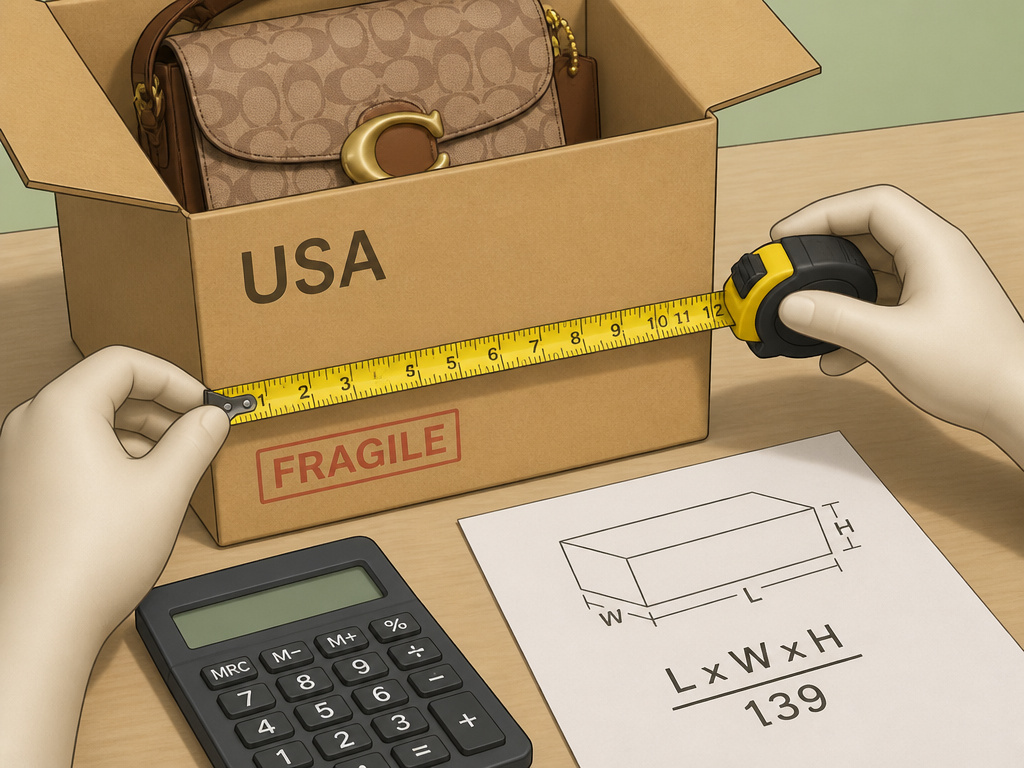
The critical calculation is shipping cost, which is based on volumetric weight, not just the bag’s actual weight. Carriers charge based on the space a box takes up. A typical box for a shoulder bag like the Tabby 26 measures about 35cm x 25cm x 15cm. You use the formula (Length x Width x Height / 139) to get the volumetric weight in pounds. If that number is higher than the actual weight, you pay the volumetric rate.
Common mistake: Forgetting about import taxes. Your home country will charge duties and taxes (like Singapore’s 9% GST or Japan’s 10% consumption tax) on the bag’s declared value plus shipping costs. A good forwarder will calculate this estimate for you before you ship.
Here’s a quick reference for what to expect when importing a bag:
| Consideration | What It Means for Your Cost |
|---|---|
| Volumetric Weight | Often the charging method; a structured bag in a large box costs more to ship than a flat, soft one. |
| Import Duties & Taxes | Mandatory fees levied by your country. Calculate them as a percentage of (Item Cost + Shipping + Insurance). |
| Service Fees | The forwarder’s charge for receiving, packing, and handling your package. |
| Insurance | Optional but recommended for high-value items. Adds 1-3% to the total cost. |
This process turns buying a bag into a tactical project. The savings are real, often 30% to 50% compared to local boutique prices, but they aren’t automatic. You have to run the numbers. For those interested in bags that can also handle a laptop, the same principles apply when sourcing the best designer laptop totes from overseas.
Frequently Asked Questions
Are Coach bags cheaper at the outlet?
Yes, but with a caveat. Coach Outlet stores and the Coach Outlet US website sell specific, made-for-outlet lines. These bags often use slightly different materials (like thinner leather or more canvas) and may have simpler hardware than the main boutique collection. The discounts are real, but you’re not getting the exact same boutique bag for less. It’s a different product tier.
Is it worth repairing an old Coach bag?
It depends entirely on the repair cost versus the bag’s value and sentiment. For a classic, full-grain leather style in good structural condition, a $200 repair that gives it five more years of life is a solid investment. For a heavily damaged coated canvas bag where repairs approach the cost of a new outlet bag, it’s often not economical. Always get a formal estimate first.
Why are Coach bags so expensive in some countries?
Three reasons: tariffs and import taxes, higher costs for retail space and operations in premium shopping districts, and regional pricing strategies. Brands often set higher MSRPs in markets where consumers are perceived as willing to pay more for luxury goods and where operational costs are high. The price difference isn’t due to higher quality.
How can I tell if a Coach bag is a good investment?
“Investment” in bags rarely means financial profit. It means cost-per-use and longevity. A good investment is a versatile, well-constructed bag in a durable material (like full-grain leather) that you will use regularly for years. It fits your lifestyle, matches your wardrobe, and is built well enough to withstand repairs. The most curated selection of premier luxury bags focuses on these timeless, durable qualities.
What is the most expensive part of a Coach bag to fix?
Leather restoration and custom hardware replacement are the cost leaders. Matching and re-dyeing a large section of leather requires skill and time. Replacing a unique, branded clasp or zipper pull often means sourcing a part from Coach, which is expensive. A full hardware set replacement on a high-end piece can easily cross the $1,000 threshold.
The Bottom Line
So, how much is a Coach bag? The answer is a formula, not a number. Start with the base production cost of materials and labor. Add the retail markup, which fluctuates wildly depending on your continent. Then, reserve a hidden fund for repairs, because leather wears and zippers fail. Smart shopping means looking past the local boutique price. It means checking US retail tags, understanding forward shipping logistics, and choosing materials based on how they’ll age. Ultimately, the real cost is the total amount you’ll spend from the moment you decide you want it to the day it’s no longer usable. Calculate that, and you’ll know exactly what the bag is worth to you.