Learn How to Pack a Carry On Suitcase Efficiently & Wisely
This post contains affiliate links. As an Amazon Associate, we earn from qualifying purchases.
To pack a carry on suitcase, you match your bag to your airline’s exact size limit, build a capsule wardrobe around a neutral color palette, and use a structured packing formula like 5-4-3-2-1. The goal is to fit everything into a single bag that measures no more than 22 x 14 x 9 inches for most U.S. Airlines, with a total weight under 35 pounds.
The 22 x 14 x 9 inch rule is a ceiling, not a guarantee. A bag that squeezes into the sizer at the gate might not actually fit in the overhead bin of a regional jet, where space is genuinely limited. That’s where the packing strategy comes in, it’s the difference between forcing the bin shut and having room to spare.
What follows: the three specs that actually matter (and one that doesn’t), two packing formulas that work for trips from three days to two weeks, and the one tool that solves the plus-size traveler’s real problem.
Key Takeaways
- Airlines enforce the 22″ x 14″ x 9″ dimension on regional jets. Your bag must fit the sizer on a Delta Connection or United Express flight, or it gets gate-checked.
- Weight limits are rare for U.S. Carriers but strict for international ones. Delta doesn’t publish one; Frontier enforces 35 lbs; British Airways allows 51 lbs.
- The 5-4-3-2-1 method is for trips over five days. It structures your packing around 5 tops, 4 bottoms, 3 shoes, 2 layers, and 1 set of accessories.
- Compression packing cubes are the solution for bulkier clothing. They can reduce the volume of a pair of jeans by half, making a week’s worth of plus-size outfits fit in a standard carry-on.
- An empty carry-on is a hazard. The FAA specifically warns that loosely packed items can shift and fall from overhead bins during flight or an emergency evacuation.
The Three Specs That Actually Matter (And One That Doesn’t)
Your first job is to know your airline’s rules. This isn’t a suggestion. On a crowded regional jet, the gate agent will measure every oversized bag.
The Federal Aviation Administration states that carry-on items which may fall from overhead bins can injure you or other passengers during flight or in the event of an emergency evacuation. Proper stowage means the bag fits securely without force.
The 45 linear inch rule is a helpful guideline, but it’s the individual dimensions that get checked. You need to know both.
| Airline | Carry-On Dimensions (H x W x D) | Weight Limit | The Fine Print |
|---|---|---|---|
| Delta, United, American | 22” x 14” x 9” | Not specified | The standard U.S. Rule. Includes wheels and handles. |
| Southwest Airlines | 24” x 16” x 10” | Not specified | The most generous major U.S. Carrier. |
| Frontier Airlines | 25” x 16” x 10” | 35 lbs | Strictly enforced at the gate with sizers and scales. |
| Hawaiian Airlines | 22” x 14” x 9” | 25 lbs | Weight is checked for inter-island flights. |
| British Airways | 22” x 17.7” x 9.8” | 51 lbs | International carriers often have higher weight allowances. |
The dimension that doesn’t matter as much for domestic U.S. Travel is the weight limit, unless you’re flying Frontier, Hawaiian, or most international carriers. For Delta, JetBlue, and United, if you can lift it into the bin yourself, you’re usually fine. The real constraint is physical space.
Common mistake: Assuming your “standard” 22-inch roller will fit every plane. Delta’s policy explicitly says passengers on Delta Connection flights with 50 seats or less are only permitted a personal item. That’s not a suggestion; it’s a capacity limit. If you’re flying from a small city on a regional jet, your carry-on bag might be gate-checked regardless of its dimensions.
Always check your itinerary for “Operated by” lines. That tells you the aircraft type and the real carry-on size restrictions you’ll face.
The 5-4-3-2-1 Packing Formula (And When to Use It)
A packing list is just a list. A formula is a system. The 5-4-3-2-1 method gives you a scaffold so you don’t overpack by accident.
Here’s how it breaks down for a 7-10 day trip: * 5 Tops: Mix of short-sleeve, long-sleeve, and one nicer blouse or button-down. * 4 Bottoms: Two pants (one jeans, one lightweight), one skirt, one shorts. * 3 Shoes: One worn on the plane (usually bulkiest), one walking sneaker, one casual/dress shoe. * 2 Layers: A cardigan and a packable jacket. * 1 Set of Accessories: Belt, scarf, jewelry that all work with your color palette.
This formula forces a capsule wardrobe. Every top must work with at least two bottoms. The single color palette, think navy, grey, white, and tan, is what makes it possible.
I won’t recommend the 5-4-3-2-1 method for a three-day weekend. It’s overkill. For a short trip, the 2-5-1 method (2 bottoms, 5 tops, 1 outer layer) is leaner and faster.
The magic isn’t in the count. It’s in the mixing. A cream linen shirt becomes a beach cover-up, a museum layer, and a dinner top when tied at the waist. That’s how you get 14 outfits from 10 pieces, like the Reddit user planning a week in Spain.
Where this goes sideways: Choosing a “statement piece” that only works with one outfit. If a floral skirt only pairs with the white tank you packed, you’ve wasted space. That skirt should also work with your denim shorts and your linen trousers. Test your combinations on your bed before anything goes in the bag.
How to Pack for Plus-Size Travel (The Compression Cube Fix)

“One pair of my jeans takes up the entire carry-on.” That’s a direct quote from a plus-size traveler on Reddit, and it’s the reality most packing guides ignore. The problem isn’t overpacking; it’s physics. Larger garments simply consume more volume.
The solution isn’t a bigger bag, it’s a better packing tool. Compression packing cubes use a two-zipper system to squeeze air out of your clothes. A pair of jeans that normally fills a quarter of your suitcase can be compressed to half its thickness.
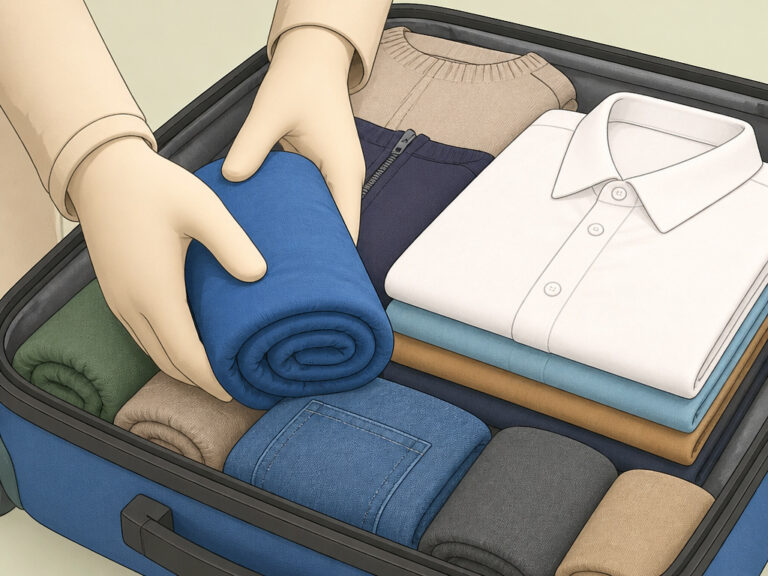
- Roll, don’t fold. Rolling jeans and sweaters first reduces wrinkles and creates a smoother bundle for the cube.
- Pack the cube tight. Fill the compression cube to its full capacity before sealing it. Loose fabric won’t compress well.
- Zip from the air valve. Close the main zipper, then zip the compression zipper slowly, pushing air out through the one-way valve as you go.
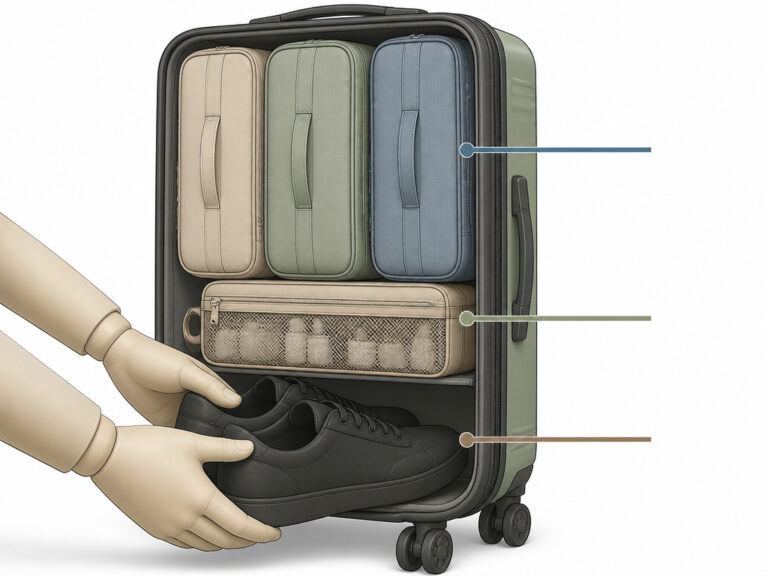
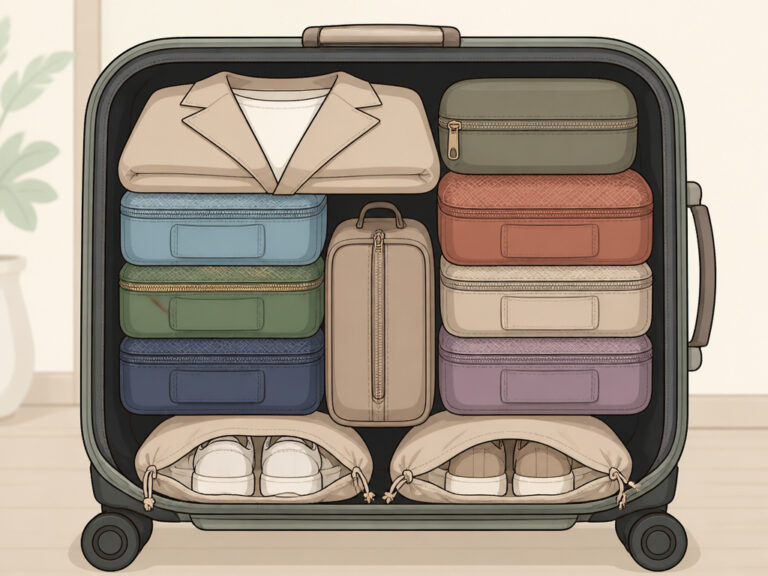
- Place cubes vertically. Stand the compressed cubes upright in your suitcase, like files in a drawer. This uses the bag’s depth more efficiently than stacking.
This approach addresses the core complaint. It’s not about bringing less; it’s about making what you bring fit. With two compression cubes, a week’s worth of plus-size outfits can fit within standard carry-on luggage dimensions.
The other pro move: wear your bulkiest items on the plane. Your heaviest jeans, your jacket, your chunkiest shoes. They don’t get weighed or measured if they’re on your body.
The Right Bag and Tools for the Job

Your packing strategy is only as good as your container. A hard-shell spinner that claims 22 inches might actually measure 23 inches including the wheels. That one inch is the difference between the bin and the cargo hold.
For maximum flexibility, a soft-sided backpack like the Aer Travel Pack 3 or the Patagonia Black Hole MLC 45L often beats a roller. Soft sides can conform slightly to a full overhead bin, and they’re easier to lift. The Travelpro Platinum Elite 21” is the roller standard for a reason, its dimensions are verified to comply, and it’s built for gate-check abuse if necessary.
Your toolkit: * Compression Packing Cubes (Eagle Creek or Amazon Basics): Non-negotiable for organization and space savings. * A 1-quart clear toiletry bag: TSA’s liquid rule is 3.4 ounces per container, all fitting in one quart-sized bag. * A foldable tote or backpack: Stuff this in your main bag on the way out. Use it as a souvenir carrier on the way home, acting as your personal item. * A mini digital luggage scale: Crucial for international flights or budget carriers like Frontier that enforce carry-on weight limits.
Easy to miss: The personal item loophole. If your main bag is packed to the gills, your personal item (a backpack under the seat) should carry your flight essentials, tablet, snacks, medication, a change of socks, not extra clothing. That space is your emergency buffer, not overflow storage.
Step-by-Step: Packing Your Carry-On in 10 Minutes

This sequence saves time and guarantees everything fits.
- Check your airline’s rules. Confirm your carry-on size and weight limit 24 hours before packing. This is your final spec.
- Lay out your capsule wardrobe. Use the 5-4-3-2-1 formula as a guide. Eliminate any item that doesn’t mix with at least two others.
- Roll everything. Roll all tops, bottoms, and underwear tightly. This prevents creases and packs denser than folding.
- Load compression cubes. Pack cubes by category (e.g., all tops in one cube). Compress them fully.
- Place cubes vertically in bag. Stand the cubes in your suitcase. Put heavier cubes (jeans, shoes) near the wheels.
- Fill dead space. Stuff socks, underwear, or a belt roll into shoes and corners.
- Pack toiletries last. Your quart bag goes in the lid pocket or an exterior compartment for easy security pull-out.
- Weigh your bag. Use your luggage scale. If you’re over, remove one layer or one pair of shoes.
- Do the sizer test. Measure your bag with a tape measure. Include wheels and handles. If it’s over, you must repack.
- Prepare your personal item. Load your passport, tablet, charger, and a reusable water bottle here. Keep it light.
Skipping step 8 is how you get hit with a $100 overweight fee at the Frontier counter. Skipping step 1 is how you watch your bag disappear down the jet bridge on a regional flight.
Frequently Asked Questions
What if my carry-on is too heavy at the airport?
Wear your heaviest layers immediately. Put your jacket on, change into your bulkiest shoes. Move dense items like books or a camera from your carry-on bag to your personal item (which is rarely weighed). As a last resort, some airports have repacking stations where you can discard or mail items home.
Can I bring a purse and a carry-on?
Yes, for almost every airline. Your purse is considered your one personal item. Your carry-on suitcase is your one overhead item. The purse must fit under the seat. A large tote purse might be scrutinized if it looks like a second carry-on.
How strict are airlines about carry-on size?
Extremely strict on budget airlines (Frontier, Spirit, Ryanair) and on regional jets (Delta Connection, United Express). They use sizer boxes at the gate. Major U.S. Carriers (Delta, American, United) are stricter on full flights when overhead space runs out. Your bag is most likely to be measured when boarding group 4 or 5 is called and bin space is scarce.
What is the 3-1-1 rule?
It’s the TSA rule for liquids in carry-ons. Each liquid container must be 3.4 ounces (100ml) or less. All containers must fit inside one clear, quart-sized plastic bag. One bag per passenger. This applies to creams, gels, aerosols, and pastes. Solid deodorant and powder are fine.
How do I pack suits or dresses without wrinkles?
Use a garment folder or a simple dry-cleaning bag. Lay the suit jacket or dress inside the plastic bag, then fold it gently. The plastic layer between folds reduces friction, which is what causes creases. Unpack and hang it in a steamy bathroom as soon as you arrive.
Before You Go
Packing a carry-on suitcase is a logic problem with physical constraints. The answer is always specific: your airline’s dimensions, your trip’s length, your body’s needs.
Start with the hardest limit, usually the 22 x 14 x 9 inch box for a regional jet. Build a capsule wardrobe from there, using a formula to stop overpacking before it starts. Finally, deploy compression cubes to win the volume battle. That sequence works for three days or three weeks.
The real win isn’t avoiding a baggage fee. It’s walking off the plane and straight to the curb while everyone else crowds around the carousel. That’s the feeling you’re packing for.