How to Pack a Suitcase with a Lot of Clothes | Maximize Space
This post contains affiliate links. As an Amazon Associate, we earn from qualifying purchases.
To pack a suitcase with a lot of clothes, sort everything by category before it touches the case, roll soft wrinkle-resistant items, fold structured pieces flat, and load heaviest items like shoes at the bottom near the wheels. Use packing cubes for organization, not magic compression, and follow the 75% fill rule for compression zippers to avoid lumps. This method is built on weight distribution and garment-specific techniques, not just stuffing more in.
Most guides tell you to roll or fold. The real decision is which garment gets which treatment, and what that choice does to the case’s balance point. A 900-gram pair of hiking boots misplaced at the top turns a wheeled suitcase into a teetering mess before you even leave the driveway.
What follows is a system, not a list of tips. It covers the pre-pack sort that cuts your load by a third, the hybrid roll-and-fold method that matches technique to fabric, and the load order that uses real item weights to keep the bag stable. You will also get the honest math on packing cubes, the one rule for international weight limits that is never on your ticket, and how to leave room for the trip back without a second bag.
Key Takeaways
- Sort clothes into visible category piles before packing; this single step cuts the “maybe” pile by half.
- Roll soft items like t-shirts and underwear for compression; fold structured items like dress shirts and blazers to preserve shape.
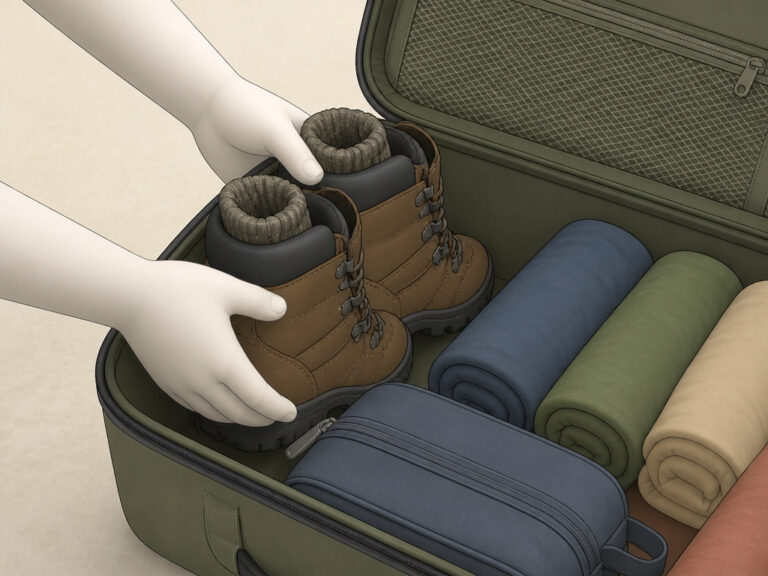
- Place the heaviest items, shoes (350g to 900g each) and toiletry kits, at the bottom near the wheels to keep the suitcase balanced when upright.
- Packing cubes add about 150g for a set and organize better than they compress; use compression bags only for bulky insulated layers like fleece jackets.
- Check the operating carrier’s weight limit for every leg of your trip, not the limit on your original ticket, to avoid surprise overweight fees.
The 5-Minute Pre-Pack Sort (This Cuts Your Load)
Open your suitcase last. Your first move is to lay every potential item on a bed, floor, or rack. Packing directly into the case hides volume until the lid won’t close, and the fix then is a panicked removal of whatever is on top, not the item that never should have made the cut.
Sort into piles by category: tops, bottoms, underwear and socks, sleepwear, outerwear, toiletries. Create a “maybe” pile for everything you’re unsure about. The rule for the maybe pile is simple: cut it in half before anything goes near the suitcase. An item you haven’t worn on the last three trips doesn’t earn a spot on this one.
This visual inventory lets you build outfit families around a core color palette. Two neutral bottoms that pair with every top create more combinations than seven mismatched pieces. This is the foundation of efficient clothes packing techniques, turning a large pile into a coordinated, smaller one.
Roll or Fold: What Goes Where

Rolling and folding are not competing religions. They are different tools for different fabrics. Using both correctly in the same suitcase is what beats defaulting to a single method.
The 75% rule for compression cubes: Fill the main compartment to 75%, then use the compression zipper. Overfilling creates uneven pressure, you get lumps and bumps that make the cube impossible to stack. If you can’t zip the compression layer flat, remove one layer of clothes.
Roll the soft, wrinkle-resistant pieces. T-shirts, underwear, socks, leggings, and gym clothes compress into tight cylinders. Rolling eliminates the dead air pockets that folded rectangles leave in a suitcase’s corners. Stand these rolls on their ends like files in a drawer; every item is visible without digging.
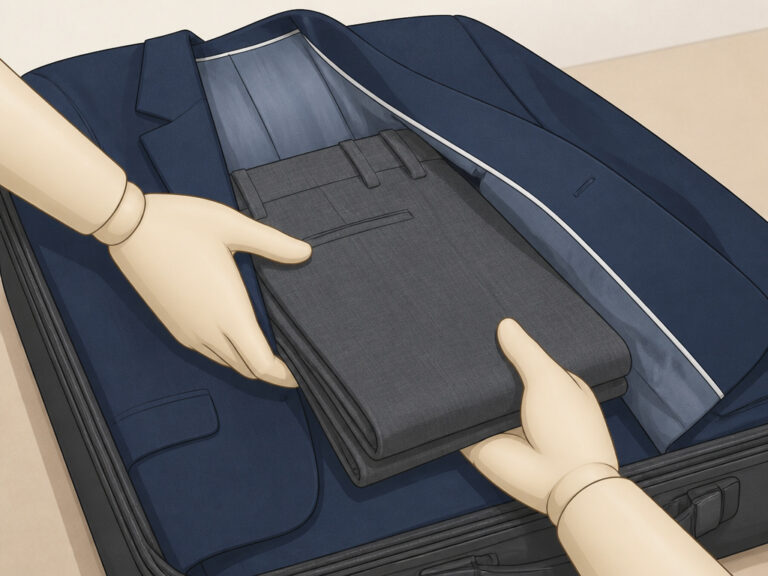
Fold the structured pieces flat. This is how you pack shirts or blazers. Button-downs, dresses, anything with a collar or a tailored seam holds its shape better with as few folds as possible. Use tissue paper or a dry-cleaning bag between layers, the slick surface lets fabric slide instead of crease when the case is compressed shut. For packing pants like trousers or chinos, a flat fold often beats a roll at the knee.
The hybrid approach is mandatory. Committing to only rolling will crease a dress shirt at the shoulders. Committing to only folding wastes the space-saving potential of your soft knits. Match the technique to the garment’s structure.
| Garment Type | Best Technique | Why It Works |
|---|---|---|
| T-shirts, Undergarments | Tight Rolling | Eliminates air pockets, creates compact cylinders that fill irregular gaps. |
| Dress Shirts, Blazers | Flat Folding | Preserves collar and shoulder structure; minimizes sharp crease lines. |
| Jeans, Chinos | Flat Fold or Half-Roll | Heavy fabric can be folded; rolling can create a bulky center log. |
| Dresses, Skirts | Depends on fabric | Knit dresses roll; structured sheaths fold. See our guide on packing a dress for specifics. |
| Sweaters | Flat Fold (Bulky) | Rolling heavy knits can stretch the neckline; folding distributes weight evenly. |
Load Order: Heavy at the Bottom, Structured on Top

Where an item sits is a balance equation. Heavy items belong at the bottom, near the wheels. This keeps the suitcase stable when you wheel it or stand it upright, and it prevents heavy objects from shifting onto and crushing lighter clothing during transit.
The table below uses sourced weights, not guesses. A “pack heavy things low” rule means nothing if you don’t know what actually qualifies as heavy.
| Item | Typical Weight | Where It Goes | Why |
|---|---|---|---|
| Hiking Boots | 900 g | Bottom, against the wheel wall | The single heaviest anchor; lowers the case’s center of gravity. |
| Sneakers / Dress Shoes | 600-700 g | Bottom, soles facing the side | Weight stays low; sole grime stays off clean clothes. |
| Toiletry Kit (grouped) | ~450 g | Low-middle, kept upright | Low leak risk here; easy to pull out for security screening. |
| Packing Cube Set (3-5) | 150 g | Wherever its category goes | Adds organization weight without changing the load logic. |
| Rolled Clothing | Varies | Middle, filling gaps | Malleable items conform around the solid heavy base. |
| Folded Structured Pieces | Varies | Top | Least pressure on top keeps hard creases to a minimum. |
After building this base, your packing a suitcase process is just filling the architecture. Place your packed cubes or rolled bundles in the middle. Your folded blazer or dress shirt gets the top layer, a protected spot. For a pack a carry-on scenario, this order is even more critical, every ounce of balance counts when you’re hauling it through a terminal.
The 75% Rule for Compression Cubes (and When to Skip Them)

Packing cubes are not magic. A typical 3-5 piece set weighs 150 grams. They earn that weight through organization, corralling categories so a suitcase doesn’t devolve into a single wrinkled mass. Their space saving comes from eliminating air gaps, not from physically shrinking fabric.
Compression cubes have a second zipper to force out air. They can reduce a clothing bundle’s volume by 20 to 30%. The catch is the 75% rule: fill the main chamber only three-quarters full before engaging the compression zipper. Overstuffing leads to uneven, lumpy cubes that don’t stack and strain the zipper.
Where this goes sideways: Stuffing a compression cube to 100% before zipping. The compression layer can’t flatten, pressure points create permanent wrinkles on the clothes inside, and the cube becomes a rigid brick that wastes space instead of saving it.
Compression bags are a different tool. Lighter at about 100 grams for 2-3 bags, they excel at one job: removing the loft from bulky insulated layers. Smashing a puffy down jacket or a fleece recovers real volume. For a beach trip with t-shirts and shorts, a compression bag has nothing worthwhile to compress. Bring the cubes, skip the bags.
The default pick: A set of standard packing cubes like those from Eagle Creek or AmazonBasics for organization. Add a single compression cube for your bulkiest category (like sweaters) if traveling to a cold climate, and obey the 75% fill rule.
Packing for the Return Trip (The Expandable Gusset Trick)
You leave with a perfectly packed case. You return with souvenirs, a new sweater, and shoes that now smell of city streets. This is where an expandable suitcase gusset or a simple packing strategy saves the trip home.
Fly out with the suitcase’s expandable zipper closed and your cubes compressed. On the return, open the gusset. Those extra two inches absorb the new items. Designate one cube as “dirty” from the start, worn clothes go in immediately, sealed away from clean items. Your packing for two weeks system must include this return buffer.
Common mistake: Trying to fit everything back into the same compressed space you arrived with. You end up sitting on the lid, stressing zippers, and mixing clean with dirty. Open the expansion, use the dirty cube, and load the souvenir on top.
If you’re flying a budget carrier with a strict carry-on weight limit (like Frontier or Spirit), weigh your full cube set before you pack. That 150-gram cube set is 0.33 pounds, on a 15-pound limit, that’s a material difference. A luggage scale costs less than one overweight fee.
International Travel: The Two Rules Nobody Tells You
The sort-roll-load method doesn’t change for an international flight. Your pre-flight checklist does.
- Weight limits are not universal. Your ticket may say 50 lbs (23 kg) for the long-haul leg. The regional budget carrier for your connection in Europe or Asia might cap checked bags at 20 kg. The operating carrier’s limit is the one that matters at the check-in counter. Check it for every leg before you zip the case.
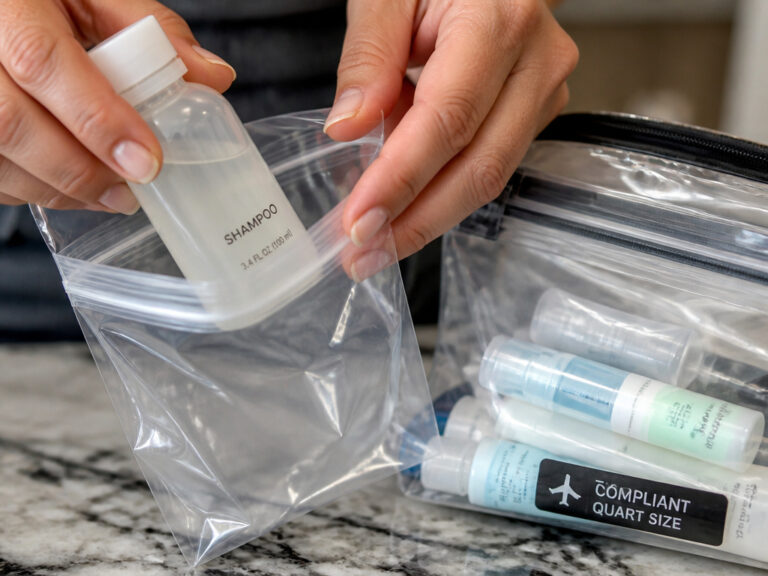
- What must stay with you. Your carry-on must hold passport, visas, medications in original packaging, one full change of clothes, and all lithium batteries. Loose lithium batteries are forbidden in checked luggage. Follow the TSA 3-1-1 rule for liquids: containers of 3.4 oz (100 ml) or less, all in a single quart-size bag.
This is the non-negotiable layer of packing efficiently. Technique saves space, but protocol avoids a $100+ overweight fee or a confiscated power bank.
Frequently Asked Questions
Do packing cubes actually save space?
They save space by eliminating air pockets and organizing categories to prevent shifting, which creates wrinkles. Standard cubes don’t physically compress fabric much. Compression cubes with a second zipper can reduce volume by 20-30% for suitable garments, but you must follow the 75% fill rule to avoid lumps.
Is it better to roll or fold clothes in a suitcase?
It’s not a choice of one over the other. Roll soft, wrinkle-resistant items like t-shirts and underwear for maximum compression. Fold structured items like dress shirts, blazers, and trousers to preserve their shape and avoid sharp creases. Most suitcases need both methods.
How do you pack heavy clothes in a suitcase?
Place the heaviest items, typically shoes (600-900g per pair) and a toiletry kit (~450g), at the bottom of the suitcase, directly against the wheel wall. This positions weight low for stability and prevents heavy objects from crushing lighter clothing packed above.
How can I make sure my suitcase isn’t overweight?
Weigh your suitcase at home before leaving using a luggage scale. Remember that packing cubes add weight (a 3-5 set is ~150g). Crucially, check the baggage weight limit for the operating carrier of each flight leg, especially on international itineraries with regional connections, as limits can drop from 23 kg to 20 kg.
The Bottom Line
Packing a lot of clothes isn’t about force. It’s about sequence. Sort visually first, match the roll-or-fold technique to each garment’s fabric, and let item weights dictate your load order from the bottom up. Use packing cubes to maintain that order, not to perform miracles. Finally, know the real rules for the return trip and for international weight limits, those are what turn a good pack into a stress-free one. Now zip it shut. It should close on the first try.