Learn How to Pack Carry On Luggage and Avoid TSA Pitfalls
This post contains affiliate links. As an Amazon Associate, we earn from qualifying purchases.
To pack carry on luggage, follow four core rules: verify your airline’s specific size and weight limits, separate all liquids into a single 1-quart bag with 3.4-ounce containers, organize clothes with a rolling or bundling method inside packing cubes, and place heavy electronics and any items needed for security screening in an easy-access top layer. The most common mistake is treating the overhead bin like a checked bag, overstuffing triggers gate checks and security delays.
The difference between a smooth boarding process and a frantic gate-side repack isn’t luck. It’s a specific sequence of checks that starts with your airline’s published dimensions, not a generic guide. Get the size wrong by an inch, and your bag becomes a checked item with a fee. Pack your liquids wrong, and you’re that person holding up the line while a screening officer rifles through your toiletries.
What follows is the mechanical breakdown most packing lists skip: the exact dimensions for major US carriers, the science behind why rolling clothes works on some fabrics but not others, the TSA’s real screening triggers, and the one organizational trick that cuts your unpacking time in half at the hotel.
Key Takeaways
- Always check your specific airline’s carry-on size and weight limits, the standard 22″ x 14″ x 9″ is not universal, and Frontier’s 35-pound weight limit is a hard cap enforced at the gate.
- Use packing cubes with compression zippers, not just regular organizers. Compression cubes can fit 30% more into the same space by removing dead air, which is the real enemy of a full bag.
- Your liquids bag must be quart-sized, transparent, and resealable. Containers over 3.4 ounces (100ml) will be confiscated, even if they’re only half-full. This rule is based on container capacity, not actual volume.
- Place all electronics and any item with a lithium battery in an easy-access top layer. TSA requires you to remove large electronics for separate screening; burying your laptop adds minutes per person in line.
- Never pack valuable documents, prescription medications, or a single change of clothes in your checked bag. If the airline gate-checks your carry-on, you’ll want those essentials with you in your personal item.
The 4-Step Packing Method That Saves Space
Forget folding. The goal is to fill every cubic inch without creating pressure points that bulge the bag and break the zipper. Start with a verified, empty bag that meets your airline’s carry-on size limits. The process is mechanical.
Step 1: Layer the Bottom with Packing Cubes
Roll your sturdiest items, jeans, chinos, sweaters, tightly and pack them into a compression cube at the very bottom of the suitcase. Rolling eliminates folds and uses the cylindrical shape to fill gaps. Compression cubes then squeeze out the remaining air. This creates a flat, solid base.
Common mistake: Folding jeans flat. A folded stack creates a rigid block that wastes the curved space at the bag’s edges and makes the middle bulge upward.
Step 2: Fill the Cavities with Soft Items
Once your base cube is in, you’ll have cavities around its edges and in the suitcase’s corners. This is where socks, underwear, and soft t-shirts go. Bundle them into a second, smaller cube or simply use them as filler. They conform to any shape and provide cushioning.
Step 3: Create a Flat Top Layer for Wrinkles
Dress shirts, blouses, and dresses should be the last clothing items packed. Use a folding board or the bundle wrapping method, then place them flat on top of the packed cubes. The clothing below acts as a firm, wrinkle-resistant platform. A dry-cleaning bag placed over this layer reduces friction and further prevents creases.
Step 4: Top It Off with Your “Security Bin”
The very top of your bag should be reserved for what you’ll need at the security checkpoint. This includes your quart-sized liquids bag, your laptop, and any other large electronics. Pack them last so they are the first items you can remove. This isn’t just about convenience; it’s the difference between a 30-second bin preparation and a two-minute unpacking struggle that annoys everyone behind you.
Bottom line: Bottom layer is rolled and compressed, middle layer fills gaps, top layer stays flat, and the very top is for security screening.
What Not to Pack (And Why It Matters)
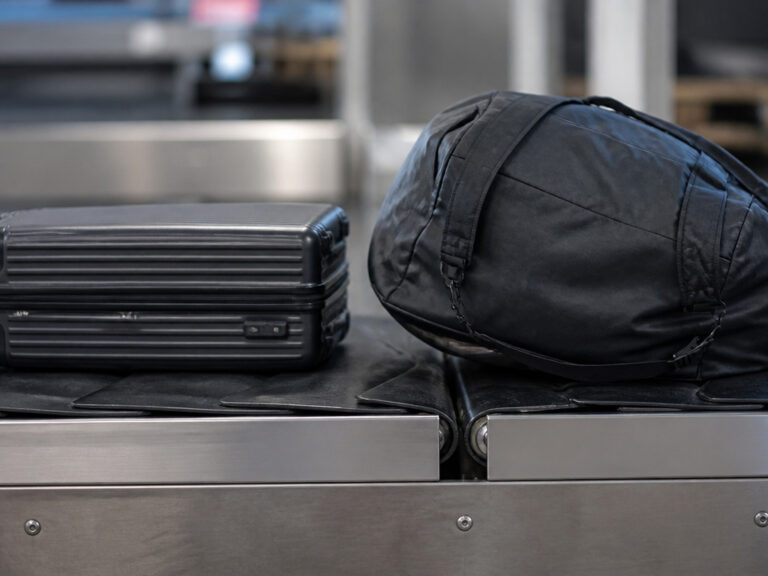
A carry-on isn’t just a small suitcase. It’s a bag that must pass through an X-ray machine and fit under a seat in a pinch. Some items are banned outright; others will just make your journey miserable.
| Item Category | Why It’s a Problem | The Consequence |
|---|---|---|
| Large Liquids | Containers over 3.4 oz (100ml) violate the TSA liquid rules. | Confiscation at security. You lose the item and delay the line. |
| Loose Powders | Quantities over 350ml (like bulk protein powder) require additional screening. | Secondary bag search. Your entire carry-on gets hand-inspected, adding 10-15 minutes. |
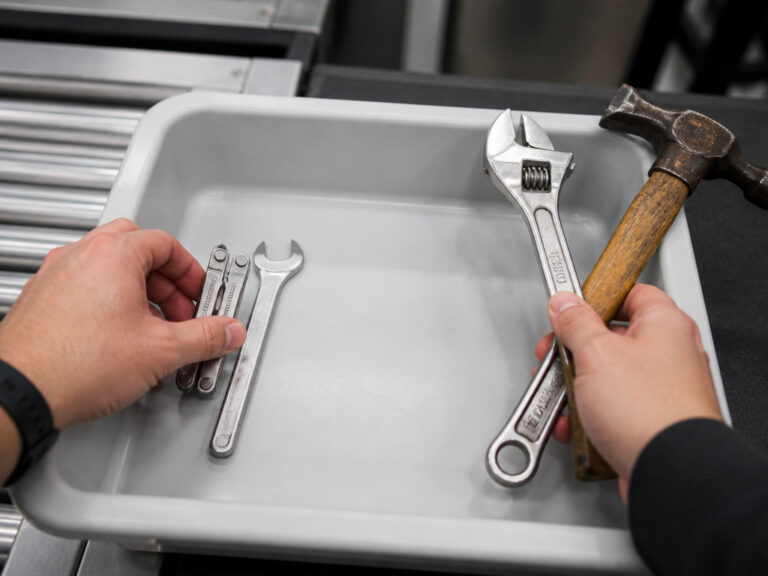
| Sharp Objects | Scissors over 4 inches, knives, tools. | Immediate confiscation. Could lead to a more detailed inspection or even a fine. |
| Spare Lithium Batteries (unprotected) | Loose batteries can short-circuit, causing fire risk. | Item removed, possible bag search. Batteries must be in original packaging or a case. |
The TSA prohibited list is extensive, but the everyday traps are in the “gray area” items. A full-size aerosol deodorant is over the liquid limit. A corkscrew with a small blade is considered a sharp object. A realistic toy gun will get you pulled aside. When in doubt, check the official TSA carry-on size restrictions FAQ and the comprehensive prohibited items list.
Where this goes sideways: Packing a cherished souvenir snow globe. It’s a liquid inside a fragile container. It will be confiscated, and you’ll watch it get tossed in the bin.
Your allowed items are far more numerous. Solid food, electronics, books, and most personal care items are fine. The key is format: solid deodorant is fine, gel deodorant must follow the 3-1-1 rule. Knowing the difference is your first line of defense.
How to Pack Liquids, Aerosols, and Gels (The 3-1-1 Rule)
The rule is simple: 3.4-ounce (100ml) bottles, 1 quart-sized bag, 1 bag per passenger. The execution is where people fail. The bag must be transparent and resealable, a ziplock freezer bag is the standard. Every container inside, even if it’s half-empty, must be 3.4 ounces or less by capacity.
- Gather all potential LAGs: This includes toothpaste, shampoo, conditioner, lotion, mouthwash, perfume, and even creamy makeup like foundation.
- Check every container’s label: The limit is based on the capacity printed on the bottle, not how much is inside. A 6-ounce bottle that’s only 1/4 full is still prohibited.
- Transfer or buy travel sizes: For items you use daily, invest in reusable TSA-approved bottles and fill them from your large containers at home.
- Bag it visibly: Place the sealed quart bag in an external pocket or the very top of your carry-on. You must be able to remove it without unpacking your entire bag.
The liquid limit has exemptions for medically necessary liquids, baby formula, and breast milk. These are allowed in reasonable quantities, but you must declare them at security for separate screening. Don’t mix these exempt items in your quart bag; keep them separate and inform the officer.
Packing Electronics and Valuables

Your laptop, tablet, camera, and power banks are not just valuable; they’re regulated. The FAA carry-on baggage tips and IATA passenger baggage rules strictly require spare lithium batteries and power banks to be in your carry-on, never checked. Their fire risk is higher in the pressurized cargo hold.
- Laptops & Large Tablets: Must be removed from your bag and placed in a separate bin for X-ray screening. Pack them in a sleeve without metal snaps for easiest removal.
- Power Banks & Spare Batteries: Must be carried on. Check their watt-hour (Wh) rating; most consumer models under 100Wh are fine, but anything larger may need airline approval.
- Cables & Adapters: Bundle them with a rubber band or cable tie. Loose cables look like tangled wires on an X-ray, which can prompt a bag search.
- Valuables (Jewelry, Documents, Cash): Always keep these on your person or in your personal item under the seat. Overhead bins are not secure, and gate-checked bags can be misplaced.
The one thing you should never check? Your car keys and house keys. If your checked bag is lost, you’re now locked out of your home and your car. They stay with you.
Choosing Your Bag and Checking Dimensions
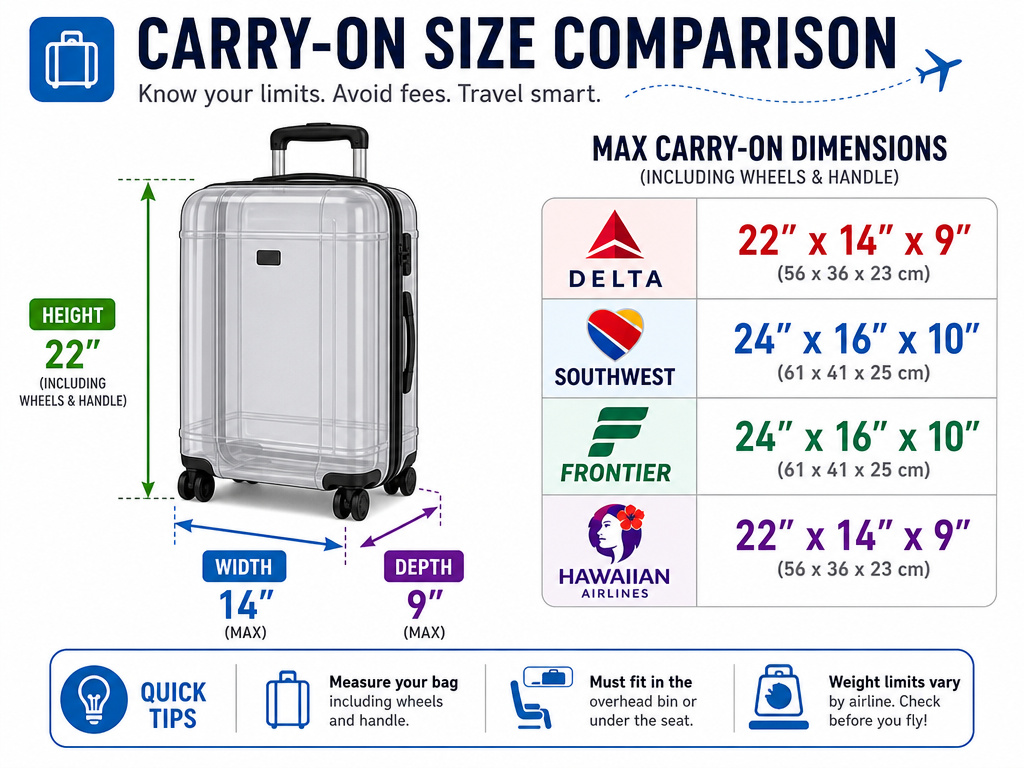
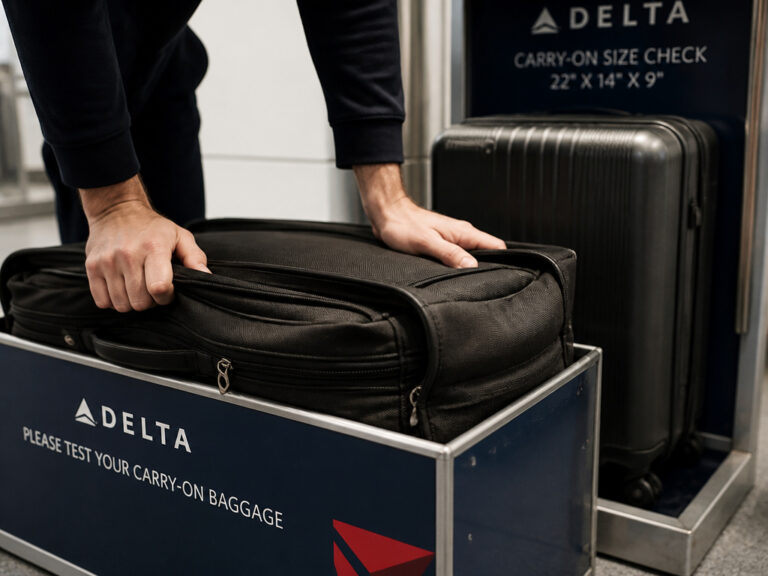
The “standard” 22″ x 14″ x 9″ carry-on size is a common guideline, but it’s not law. Airlines enforce their own rules. Frontier allows bags up to 25″ x 16″ x 10″. Southwest is more generous at 24″ x 16″ x 10″. Many international carriers, like Ryanair, have much stricter, smaller sizer boxes.
| Airline | Carry-On Dimensions (Inches) | Weight Limit (lbs) | Notes |
|---|---|---|---|
| Delta, American, United | 22 x 14 x 9 | Usually none | The most common US standard. Includes wheels and handles. |
| Southwest | 24 x 16 x 10 | None | A more generous “standard,” good for softer duffels. |
| Frontier | 25 x with 16 x 10 | 35 | Strictly enforced; bags are often weighed and sizer-boxed at the gate. |
| Hawaiian | 22 x 14 x 9 | 25 | One of the few US carriers with a hard domestic weight limit. |
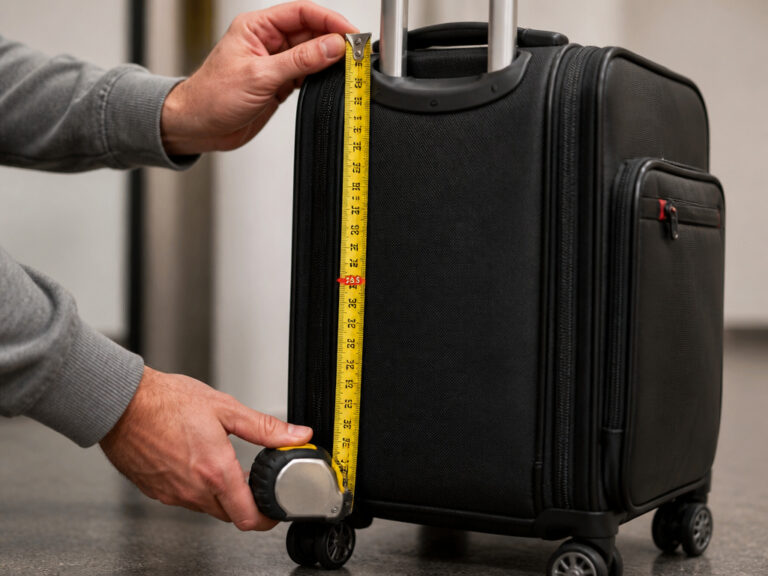
Before you buy a bag or start packing, go to your airline’s website and find their official baggage policy page. Don’t rely on third-party summaries, as rules change. Then, measure your bag correctly: include every protrusion, the wheels, and the handle. A bag that’s 21.5″ without the wheels but 23″ with them fails.
Easy to miss: Airlines like Allegiant and Spirit often charge a fee for any overhead bin carry-on. Their “personal item only” fare means your bag must fit under the seat. Know your fare class.
If you’re flying on a small regional jet (a Delta Connection flight with 50 seats or less), assume you will have to gate-check your roll-aboard. Pack accordingly, with essentials in your personal item.
Frequently Asked Questions
Can I bring food in my carry-on?
Yes, solid food is generally allowed. Sandwiches, fruit, snacks, and baked goods are fine. Spreads like peanut butter or jam fall under the 3-1-1 liquid rule if they are spreadable at room temperature. A whole cooked turkey is technically allowed, but be prepared for questions and additional screening.
What if my carry-on is overweight?
If your airline has a weight limit and your bag exceeds it at the gate, you have two choices: pay a hefty fee (often more than checking a bag would have cost) or hastily repack. To avoid this, weigh your packed bag at home using a bathroom scale. The heaviest items are usually shoes and electronics.
Are packing cubes worth it?
Absolutely, but not all cubes are equal. Standard cubes just organize. Compression cubes have a second zipper that squeezes the air out, truly saving space. They are the single most effective tool for fitting more into a carry-on packing list. They also keep your clothes organized when you arrive, so you’re not digging through a piled mess.
Can I bring a razor or a curling iron?
Disposable razors and cartridge razors are allowed. Safety razors where the blade is removable are prohibited. A curling iron or flat iron is allowed in carry-on luggage. Hairdryers are also fine. There are no heating element restrictions.
What about medication and medical supplies?
Medication is exempt from the liquid rule. You can bring liquid prescription medication in quantities greater than 3.4 ounces, but you must declare it at security for inspection. Syringes are allowed with documented proof of medical need (like the medication vial with your name on it). It’s wise to keep these separate from your toiletries.
Before You Go
Packing a carry-on isn’t about stuffing in as much as possible. It’s a logistics puzzle with fixed boundaries: your airline’s size box, the TSA’s 3-1-1 rule, and the physical space under seat 12C. Start with the hardest limits, your airline’s specific dimensions and weight, then build your packing strategy outward from there. Use compression packing cubes as your foundation, isolate your liquids and electronics for easy access, and never, ever put your critical documents or a single outfit anywhere but on your person. The goal isn’t just to avoid fees. It’s to walk through the airport, through security, and onto the plane without once having to stop and rearrange your life from a suitcase on the floor.