What is Hand Luggage? Carry-On Rules & Limits Explained
This post contains affiliate links. As an Amazon Associate, we earn from qualifying purchases.
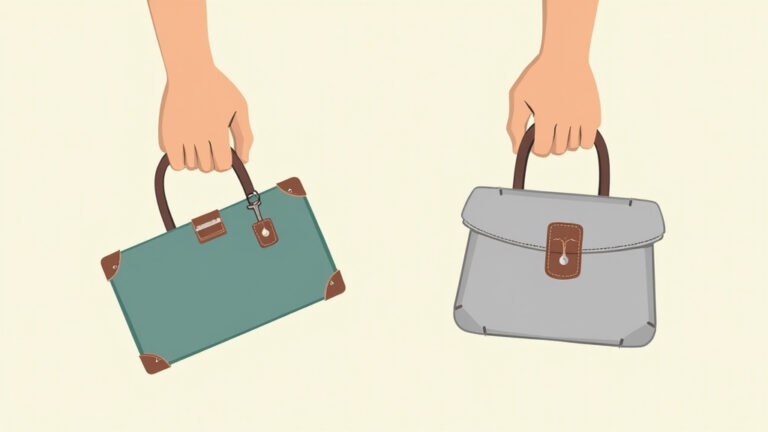
Hand luggage is the bag you keep with you in an airplane’s passenger cabin, stored either under the seat in front of you or in an overhead bin. It’s also called a carry-on. The standard size guideline is 22 x 14 x 9 inches, but your specific airline’s rules are the only ones that matter.
Most people think the biggest carry-on mistake is overpacking. It’s not. The real mistake is assuming all airlines use the same rulebook. You can follow the IATA guideline perfectly and still get flagged at the gate because Ryanair’s sizer is half an inch narrower. That gate check fee stings more when you’re already running late.
This guide breaks down what hand luggage actually is, the hard limits you must follow, and the stuff you absolutely cannot pack. We’ll cover how to check your airline’s specific policy, the difference between a carry-on and a personal item, and what happens when your bag is just a little too big.
Key Takeaways
- Your airline’s posted carry-on dimensions and weight limit override any general guideline. Check them 24 hours before your flight.
- Pack all lithium batteries and expensive electronics in your hand luggage. Checked baggage holds are not temperature-controlled and baggage handling can destroy devices.
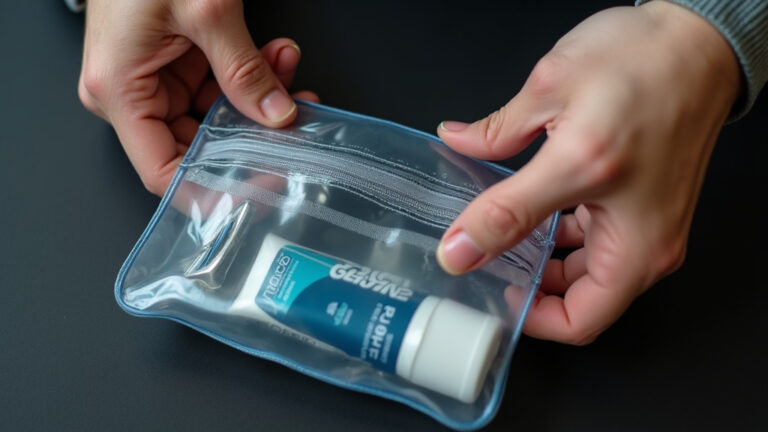
- The 3-1-1 rule for liquids is a global security standard: containers must be 3.4 ounces (100ml) or less, all fitting inside one quart-sized, clear, resealable bag.
- Budget airlines like Spirit and Frontier are strict on sizer enforcement and charge high fees for non-compliant bags at the gate, not the check-in counter.
- A personal item (backpack, purse, laptop bag) must fit under the seat. If it doesn’t, the crew can force you to check your main carry-on for free.
What Exactly Is Hand Luggage?
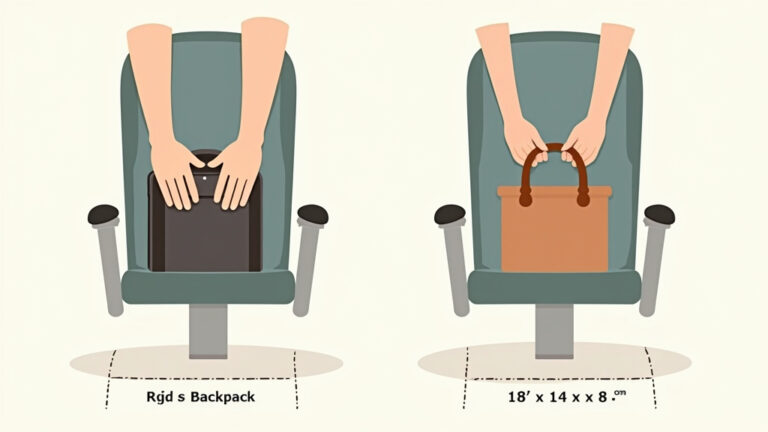
Hand luggage is any bag you bring into the airplane cabin instead of checking into the cargo hold. You are responsible for it from curb to seat. The terms “hand luggage,” “cabin baggage,” and “carry-on luggage” all mean the same thing. Your main carry-on goes in the overhead bin. A smaller “personal item” like a backpack or purse goes under the seat in front of you.
This setup exists for two practical reasons. First, it gives you immediate access to essentials like medication, a change of clothes, or a laptop during the flight. Second, it theoretically speeds up deplaning since you walk off with your bag. The reality is more crowded overhead bins and boarding delays, but the principle remains.
The International Air Transport Association (IATA) publishes a recommended maximum size for hand luggage of 56 x 45 x 25 cm (22 x 18 x 10 in). This is a guideline for airlines, not a regulation. No airline is required to follow it.
Airlines create their own rules for a simple mechanical reason: overhead bin dimensions vary by aircraft model. A regional jet’s bins are smaller than a wide-body Airbus A350’s. The airline’s published size limit is the one that guarantees your bag will fit in the smallest bin on their fleet. Weight limits are about crew safety – a 40-pound bag falling from an overhead bin can cause serious injury.
TL;DR: Hand luggage is your in-cabin bag. Its size and weight are dictated by your specific airline’s aircraft and safety policies, not a universal standard.
What Are the Standard Hand Luggage Size Limits?
The standard doesn’t exist. This is the first truth every traveler learns the hard way. The IATA guideline of 22 x 18 x 10 inches is a polite suggestion. Your airline’s website holds the actual law.
You will encounter two types of measurements: maximum dimensions and linear inches. Maximum dimensions are the classic height, width, and depth check. Linear inches is the sum of those three numbers. A bag measuring 22 x 14 x 9 inches has linear dimensions of 45 inches (22+14+9). Many U.S. carriers use a 45-inch linear limit for standard economy carry-ons.
Budget airlines are the strictest. They use revenue from baggage fees as a core part of their business model. Agents at the gate have a financial incentive to catch oversized bags. Full-service airlines are often more lenient on size if the flight isn’t full, but they will always enforce weight limits for safety.
| Airline Type | Typical Size Limit (H x W x D) | Typical Weight Limit | Enforcement Style |
|---|---|---|---|
| U.S. Full-Service (Delta, United) | 22″ x 14″ x 9″ | 35–40 lbs | Gate agents may waive size if flight has space; weight is checked at check-in. |
| U.S. Budget (Spirit, Frontier) | 22″ x 18″ x 10″ (sizer dimensions) | 35–40 lbs | Rigid. Bag must fit in sizer with no forcing. Fees applied at gate. |
| European Budget (Ryanair, easyJet) | 55cm x 40cm x 20cm | 10 kg (22 lbs) | Very rigid. Sizer used at gate for non-priority passengers. |
| International Long-Haul | Varies; often 21.5″ x 15.5″ x 9″ | 15 kg (33 lbs) | Weight is strictly enforced at check-in due to aircraft balance. |
Common mistake: Measuring your bag without the wheels and handles – the sizer at the gate includes them. If your bag is 21.5 inches tall without wheels, but 22.5 inches with them, it fails. You pay.
Always measure your packed bag from the floor to the top of the retracted handle, and include the wheels in the depth. A soft-sided duffel can often be squeezed into a sizer, but a hard-shell spinner cannot. That’s why experienced travelers on tight-budget airlines choose soft bags.
How Strict Are Weight Limits?
Weight limits are binary. A scale reads a number, and that number either passes or fails. There is no “squeezing” a heavy bag onto the plane. Exceeding the weight limit risks a fee at check-in, or worse, being forced to check the bag at the gate for free because it’s a safety hazard for the flight crew to lift.
The reason is physics and union rules. Flight attendants are not required to lift bags above a certain weight to prevent injury. If your bag is too heavy for them to safely stow, it gets tagged and sent below. You don’t pay a checked bag fee in this scenario, but you also lose access to your belongings and risk delays at baggage claim.
Full-service airlines often have scales at the check-in counter. Budget airlines might only weigh bags that look suspiciously heavy or during peak travel times. The risk calculation is yours. I once watched a passenger at a Frontier counter repack their suitcase on the floor because it was two pounds over. They moved shoes to their personal item. It worked.
TL;DR: Weight limits are non-negotiable for crew safety. Repack at home or be prepared to pay a fee or check the bag.
Carry-On vs. Personal Item: What’s the Difference?
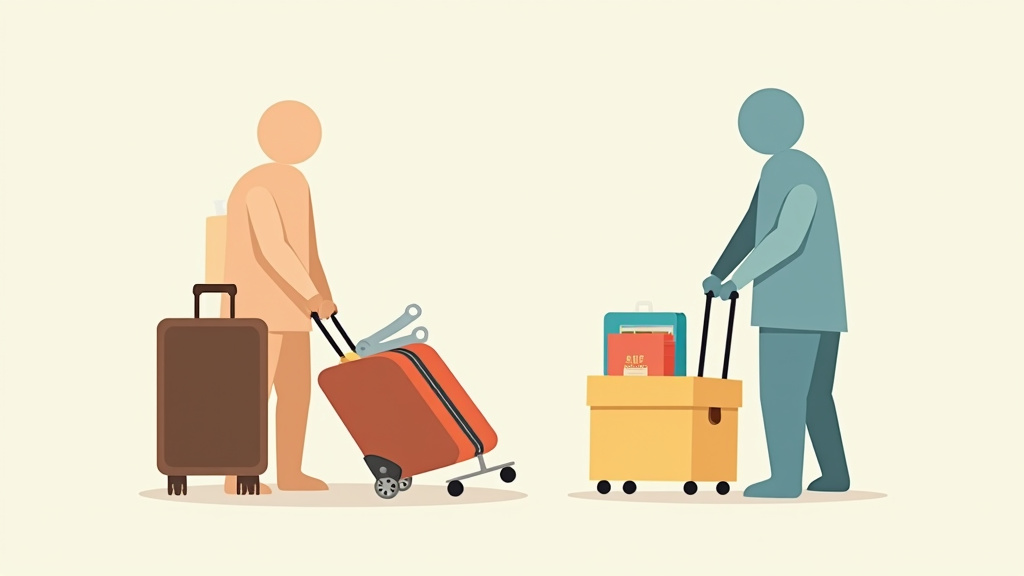
This is the most profitable confusion in aviation for budget carriers. Your ticket usually allows one carry-on (hand luggage) for the overhead bin and one personal item for under the seat. The personal item is not a second small suitcase.
A personal item must fit completely under the seat in front of you without blocking your legroom or protruding into the aisle. Standard dimensions are around 18 x 14 x 8 inches, but again, check your airline. Spirit’s personal item sizer is famously tiny. A stuffed backpack that fits under a Delta seat might not fit under a Spirit seat.
Common personal items include:
* A laptop backpack or small daypack
* A purse or handbag
* A briefcase
* A small duffel bag
I used a standard 25-liter hiking backpack as a personal item for years on major airlines. The first time I flew Frontier, it wouldn’t slide into their sizer. The gate agent made me check my carry-on roller bag for $99. The backpack became my only bag for all future budget flights.
The personal item is your lifeline if the overhead bins fill up. On a full flight, the crew will gate-check later boarding groups’ roller bags for free. If your essentials are in your under-seat bag, you walk off the plane without waiting at the carousel. This is not a minor point. It changes how you pack.
What Can and Can’t Go in Your Hand Luggage?
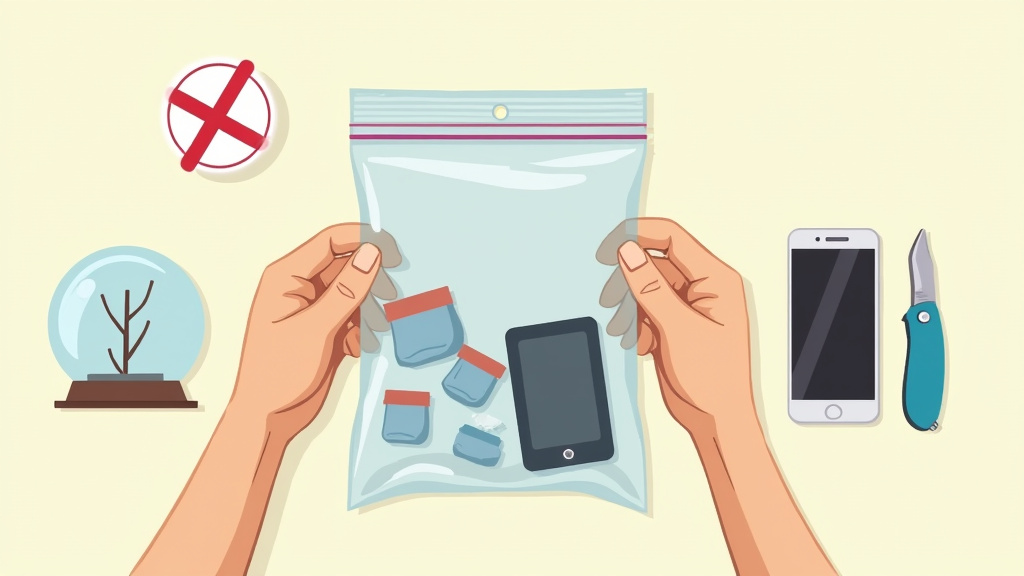
Security regulations are universal, but airlines add their own twists. The Transportation Security Administration (TSA) sets the baseline rules for U.S. flights, which most countries mirror closely.
You MUST pack these in your hand luggage:
- Lithium batteries (spares, power banks, e-cigarettes). This is a fire safety rule. A battery fire in the cargo hold is catastrophic and undetectable. In the cabin, crew can reach it with a fire extinguisher.
- Expensive electronics (laptops, cameras, tablets). Checked baggage gets thrown, stacked, and exposed to temperature extremes.
- Critical medication and documents. Never check anything you cannot replace or survive without for 24 hours.
You CANNOT pack these in your hand luggage:
- Liquids over 3.4 ounces (100ml). This is the 3-1-1 rule: containers 3.4oz or less, all fitting in one quart-sized bag, one bag per passenger.
- Sharp objects (knives, box cutters, razor blades, some tools). A standard disposable razor is fine; a utility knife blade is not.
- Sports equipment that can be used as a bludgeon (bats, clubs, hockey sticks).
- Most tools over 7 inches in length. A small screwdriver is usually okay; a crowbar is not.
- Flammables (lighter fluid, strike-anywhere matches, spray paint).
The forgotten items are what get people. Snow globes seem harmless, but if they contain more than 3.4 ounces of liquid, they’re confiscated. That jar of artisan jam from your vacation? It’s a gel. A can of spray deodorant is an aerosol. Peanut butter? The TSA classifies it as a gel. If you can spill it, spread it, spray it, pump it, or pour it, it’s likely under the 3-1-1 rule.
Common mistake: Putting a power bank in checked luggage – TSA screening may catch it, but if they don’t, you’ve violated a critical safety rule. The airline can remove your bag from the cargo hold, delaying the flight. Always keep power banks in your carry-on.
For the most current and detailed list, always check the official TSA rules for pins on backpacks and prohibited items page before you pack. Their “What Can I Bring?” tool is updated regularly.
What Happens If Your Bag Doesn’t Comply?
 **
**
The consequence depends on where you get caught and by whom.
At the Check-in Counter: The agent will likely tell you your bag is too heavy or too large. You have three choices:
1. Pay an overweight/oversize fee (often $100-$200).
2. Repack on the spot, moving weight to your personal item or a companion’s bag.
3. Check the bag for the standard checked baggage fee.
At the Security Checkpoint (TSA): They don’t care about size or weight. They care about contents. If you have a prohibited item, they will confiscate it. You do not get it back. You can surrender it, return it to your car, or mail it to yourself from an airport service if available. For liquids over 3.4oz, they toss them in the bin.
At the Gate: This is the most expensive scenario. If the gate agent determines your bag is too large for the overhead bin, they will “gate-check” it. On a full-service airline, this is often free. On a budget airline like Spirit or Frontier, this is a gate check fee that can be double the cost of checking the bag at the counter. They charge a premium for the inconvenience and because they can. You must pay to board the flight.
The agent will tag your bag and take it from you on the jet bridge. You pick it up on the jet bridge after landing or at baggage claim, depending on the airport. Your carefully packed laptop and medication are now inaccessible for the flight.
This is why knowing your Spirit Airlines backpack fees or Frontier Airlines backpack policy before you get to the airport is not just advice – it’s a financial necessity.
How to Choose the Right Hand Luggage Bag
The bag itself is a tool. You pick the right one for the job. For frequent flyers on mixed airlines, a soft-sided bag with slight compression give is the most versatile. For dedicated road warriors on one airline, a hard-shell that exactly matches their dimensions is fine.
Soft-sided Duffels & Backpacks:
- Pros: More forgiving in size sizers, often lighter weight, easier to stuff under a seat.
- Cons: Less protection for fragile items, can be awkward to carry if heavy.
- Best for: Budget airline travelers, those who need to maximize space, short trips.
Hard-shell Spinner Suitcases:
- Pros: Excellent protection, easy to maneuver in airports, professional appearance.
- Cons: Rigid dimensions – if it doesn’t fit the sizer, you’re done. Often heavier empty.
- Best for: Travelers on full-service airlines with consistent size limits, business travel, trips with fragile items.
Hybrid Bags (Soft body with frame):
- Pros: Some compression give with more structure than a pure duffel, often have better organization.
- Cons: Can be the heaviest option, sometimes the worst of both worlds.
- Best for: Travelers who want organization but need a little flexibility.
The material choice matters less than the published dimensions. Check the manufacturer’s specs, then subtract an inch from each measurement to account for bulging when packed. A “22-inch carry-on” that measures 22 inches when empty will be 22.5 inches when full. That half-inch is the difference between the overhead bin and a $99 fee.
For a deep dive on selecting a bag that can also serve as a backpack as a personal item on strict airlines, the principles of weight distribution and compartment design become critical.
The 5-Step Pre-Flight Hand Luggage Checklist
Don’t wing it. Run through this list 24 hours before your flight.
- Verify Your Airline’s Policy. Go to the airline’s website, find the “Baggage” or “Travel Info” section, and read the carry-on dimensions and weight for your specific fare class. Bookmark it.
- Measure and Weigh Your Packed Bag. Use a tape measure. Include wheels and handles. Use a luggage scale or bathroom scale (weigh yourself holding the bag, then without it).
- Apply the 3-1-1 Rule. Gather all liquids, gels, creams, and pastes. Ensure each container is 3.4oz/100ml or less. Place them all in a single quart-sized, clear, resealable plastic bag.
- Secure Lithium Batteries. Ensure all spare lithium batteries and power banks are in your carry-on. Install any devices containing batteries (laptop, camera) so they can be easily removed for security screening.
- Plan Your Personal Item. Pack your in-flight essentials (meds, headphones, tablet, charging cable, a snack) and any critical valuables in your under-seat bag. Assume your overhead bag might get gate-checked.
Missing step one invalidates all the others. I learned this flying back from a tool show with a sample cordless drill. My usual carry-on was fine on the way out with a major carrier. The return was on a budget airline with a smaller sizer. I had to pay to check the bag and then argue with security about the drill’s lithium-ion battery, which thankfully was under the watt-hour limit. The IATA baggage rules and advice page is the best source for global battery regulations.
Frequently Asked Questions
Is a backpack considered hand luggage?
backpack is almost always considered a personal item, not your main hand luggage, as long as it fits under the seat. However, if it’s your only bag and you put it in the overhead bin, it becomes your carry-on. You cannot then also bring a roller bag. Understanding your carry-on backpack rules for your specific airline is key.
Can I bring a handbag and a carry-on suitcase?
Yes, in nearly all cases. The handbag is your personal item, and the suitcase is your carry-on hand luggage. The handbag must fit under the seat. This is standard for full-service airlines. Always double-check with budget carriers, as some ultra-low-cost airlines only include a personal item for the base fare.
What is not allowed in hand luggage?
Sharp objects (knives, scissors over 4 inches), most tools, sporting goods (bats, clubs), firearms, explosives, and flammable items are prohibited. Liquids over 3.4 ounces (100ml) are not allowed unless medically necessary. For a complete list, check the TSA website or your departure country’s security authority.
Why do airlines have different hand luggage sizes?
Airlines use different aircraft with different overhead bin dimensions. Their size limit is designed to ensure a bag fits in the smallest bin on their fleet. Weight limits are for crew safety and aircraft loading calculations. Stricter limits on budget airlines also function as a revenue source.
Can I bring food in my hand luggage?
Yes, solid food is generally allowed. However, spreads, dips, sauces, and soups are subject to the 3-1-1 liquids rule. If you can spill it or spread it, security may treat it as a liquid or gel.
What happens if my hand luggage is too heavy?
If your bag is over the weight limit at check-in, you will typically be charged an overweight fee, which can be $100 or more. You may be asked to remove items or transfer them to another bag. At the gate, an overweight bag may be taken and checked for free for safety reasons, but you risk delays retrieving it.
Before You Go
Hand luggage is about control. You control what you pack, you control access to your stuff, and you control whether you walk off the plane or wait at baggage claim. That control comes with a responsibility to know the rules. The single most important action is to look up your airline’s specific carry-on policy the day before you fly. Print it or save a screenshot.
Assume nothing. Your favorite 22-inch spinner might be 23 inches with its wheels. Your toiletry bag might have a 4-ounce shampoo bottle you forgot about. The gate agent’s job is to find those discrepancies. Your job is to make sure they don’t exist. Pack your lithium batteries and valuables in your carry-on every single time. Use a personal item you can live out of for 24 hours. That’s how you travel with your hands on your bags, not your head.
{
“@context”: “https://schema.org”,
“@type”: “HowTo”,
“name”: “How to Pack and Prepare Your Hand Luggage for a Flight”,
“totalTime”: “PT20M”,
“tool”: [
{
“@type”: “HowToTool”,
“name”: “A compliant carry-on suitcase or bag”
},
{
“@type”: “HowToTool”,
“name”: “A quart-sized, clear, resealable plastic bag”
},
{
“@type”: “HowToTool”,
“name”: “A luggage scale or bathroom scale”
}
],
“step”: [
{
“@type”: “HowToStep”,
“name”: “Check your airline’s specific size and weight rules”,
“text”: “Visit your airline’s website and look for ‘carry-on baggage’ or ‘hand luggage’ policy. Note both dimensions and weight limits, which vary widely.”
},
{
“@type”: “HowToStep”,
“name”: “Measure and weigh your bag at home”,
“text”: “Use a tape measure to check height, width, and depth, including wheels and handles. Weigh the packed bag to ensure it’s under the limit.”
},
{
“@type”: “HowToStep”,
“name”: “Pack liquids in a 3-1-1 compliant bag”,
“text”: “Place all liquids, gels, and aerosols in containers of 3.4 ounces (100ml) or less inside a single quart-sized, clear, resealable bag.”
},
{
“@type”: “HowToStep”,
“name”: “Place lithium batteries and valuables in your hand luggage”,
“text”: “Pack all spare lithium batteries, power banks, and expensive items like laptops, cameras, and medication in your carry-on, not checked bags.”
},
{
“@type”: “HowToStep”,
“name”: “Organize for security screening”,
“text”: “Place your liquids bag and any large electronics in an easy-to-reach top compartment or outer pocket to speed up the TSA checkpoint.”
}
]
}
{
“@context”: “https://schema.org”,
“@type”: “FAQPage”,
“mainEntity”: [
{
“@type”: “Question”,
“name”: “Is a backpack considered hand luggage?”,
“acceptedAnswer”: {
“@type”: “Answer”,
“text”: “backpack is almost always considered a personal item, not your main hand luggage, as long as it fits under the seat. However, if it’s your only bag and you put it in the overhead bin, it becomes your carry-on. You cannot then also bring a roller bag. Understanding your carry-on backpack rules for your specific airline is key.”
}
},
{
“@type”: “Question”,
“name”: “Can I bring a handbag and a carry-on suitcase?”,
“acceptedAnswer”: {
“@type”: “Answer”,
“text”: “Yes, in nearly all cases. The handbag is your personal item, and the suitcase is your carry-on hand luggage. The handbag must fit under the seat. This is standard for full-service airlines. Always double-check with budget carriers, as some ultra-low-cost airlines only include a personal item for the base fare.”
}
},
{
“@type”: “Question”,
“name”: “What is not allowed in hand luggage?”,
“acceptedAnswer”: {
“@type”: “Answer”,
“text”: “Sharp objects (knives, scissors over 4 inches), most tools, sporting goods (bats, clubs), firearms, explosives, and flammable items are prohibited. Liquids over 3.4 ounces (100ml) are not allowed unless medically necessary. For a complete list, check the TSA website or your departure country’s security authority.”
}
},
{
“@type”: “Question”,
“name”: “Why do airlines have different hand luggage sizes?”,
“acceptedAnswer”: {
“@type”: “Answer”,
“text”: “Airlines use different aircraft with different overhead bin dimensions. Their size limit is designed to ensure a bag fits in the smallest bin on their fleet. Weight limits are for crew safety and aircraft loading calculations. Stricter limits on budget airlines also function as a revenue source.”
}
},
{
“@type”: “Question”,
“name”: “Can I bring food in my hand luggage?”,
“acceptedAnswer”: {
“@type”: “Answer”,
“text”: “Yes, solid food is generally allowed. However, spreads, dips, sauces, and soups are subject to the 3-1-1 liquids rule. If you can spill it or spread it, security may treat it as a liquid or gel.”
}
},
{
“@type”: “Question”,
“name”: “What happens if my hand luggage is too heavy?”,
“acceptedAnswer”: {
“@type”: “Answer”,
“text”: “If your bag is over the weight limit at check-in, you will typically be charged an overweight fee, which can be $100 or more. You may be asked to remove items or transfer them to another bag. At the gate, an overweight bag may be taken and checked for free for safety reasons, but you risk delays retrieving it.”
}
}
]
}