Carry-On Weight Limits : Airline Rules & How to Avoid Fees
This post contains affiliate links. As an Amazon Associate, we earn from qualifying purchases.
Carry-on luggage weight limits are set by individual airlines, not by the TSA, and they vary wildly from no limit at all to as little as 15 pounds. For most major U.S. domestic carriers like American, Delta, and Southwest, the official rule is a size-based “lift test”—if you can heft it into the overhead bin, it flies. International and budget airlines are the strict enforcers, with common limits like British Airways at 51 lbs, Hawaiian at 25 lbs, and Frontier at 35 lbs.
The universal mistake is assuming one rule fits all. You see a traveler confidently rolling a 24-inch spinner toward the gate, its wheels groaning. They breezed through Denver last month. Today, they’re flying Condor to Frankfurt. The agent points to the scale. The digital readout flashes 31 lbs against a 17.6 lb limit. That’s a $150 surprise, paid in cash at the counter, with everyone in line watching.
This guide breaks down exactly who weighs, who doesn’t, and how to pack so you never get that tap on the shoulder.
Key Takeaways
- Major U.S. airlines (American, Delta, United, Southwest, JetBlue, Alaska) have no published weight limit for carry-ons. Their real rule is the “lift test”: you must be able to safely lift and store your bag unaided.
- International and budget carriers almost always have strict weight limits, commonly between 15 lbs (7 kg) and 51 lbs (23 kg). Always verify your specific airline’s policy before you pack.
- Size is the non-negotiable universal limit. The standard domestic carry-on size is 22″ x 14″ x 9″ including wheels and handles. International standards are often smaller, around 21.5″ x 15.5″ x 9″.
- Fare class dictates your rights. Basic economy tickets, especially on international routes, frequently strip away the free carry-on allowance. Air Canada’s North American basic economy fare, for example, no longer includes a carry-on as of 2025.
- The TSA’s 3-1-1 liquid rule and power bank restrictions are separate from airline limits. You must comply with both sets of rules. The EU’s 100 ml liquid limit has been reinstated after a brief relaxation.
What’s the Real Carry-On Weight Limit? (And Why It’s So Confusing)
There is no single answer. The confusion stems from a fundamental division of responsibility. The Transportation Security Administration (TSA) governs what can be inside your bag for security. The individual airlines govern the physical bag itself—its size and weight—for safety and operational reasons. This means you must satisfy two different masters with two different rulebooks.
Carry-on weight and dimension limits are established by each airline to ensure safe stowage in overhead compartments and under seats, to manage loading times, and to standardize baggage handling. The International Air Transport Association (IATA) suggests a typical size of 56 cm x 45 cm x 25 cm (22 in x 18 in x 10 in) and a weight often starting around 5 kg (11 lbs), but these are guidelines, not regulations.
TL;DR: Airlines make the weight rules for their own planes; the TSA makes the security rules for all planes. You need to check both.
The Domestic “Lift Test” vs. The International Scale
On U.S. soil, the culture is generally lenient. If you fly American, Delta, United, Southwest, JetBlue, or Alaska, you won’t find a number on their websites. The official policy is functional: your bag must fit in the sizer at the gate, and you must be able to lift it into the overhead bin without assistance. This is the “lift test.”
The moment you book an international ticket, the game changes. Carriers based outside the U.S., and even U.S. carriers on international routes, are far more likely to impose and enforce a hard number. Budget airlines everywhere are the strictest of all. They view baggage as a primary revenue stream.
| Airline Type | Typical Weight Attitude | Enforcement Point | What Happens If You’re Over |
|---|---|---|---|
| Major U.S. Domestic | No published limit (“lift test”) | Gate, if bag looks obviously heavy | May be forced to gate-check for free |
| U.S. Budget (Frontier, Spirit) | Strict published limit (e.g., 35 lbs) | Ticket counter & gate | Hefty fee (often $50-$100) at gate |
| International Full-Service | Published limit (e.g., 51 lbs on BA) | Check-in & gate | Can be forced to check, may incur excess baggage fee |
| International Budget / Regional | Very strict low limit (e.g., 15-18 lbs) | Check-in, gate, boarding | High fee or refusal to board until bag is checked |
Common mistake: Assuming your domestic carry-on is fine for an international connection on the same airline — the weight limit for the international leg applies, and you’ll be weighed at the first check-in point.
2025 Airline Carry-On Weight Limits: A Real-World Table
Forget what you heard last year. Policies shift. This table reflects the landscape as of early 2025. Always, always confirm on your airline’s website before you fly.
| Airline | Carry-On Weight Limit | Key Notes & 2025 Changes |
|---|---|---|
| American Airlines | No weight limit | Must fit in sizer (22″ x 14″ x 9″) and pass lift test. |
| Delta Air Lines | No weight limit | Size limit: 22″ x 14″ x 9″. Focus is on safe self-stowage. |
| Southwest Airlines | No weight limit | Size limit: 24″ x 16″ x 10″ – slightly more generous. |
| United Airlines | No weight limit | Size limit: 22″ x 14″ x 9″ for most cabins. |
| Alaska Airlines | No weight limit | Must fit in sizer (22″ x 14″ x 9″). |
| JetBlue | No weight limit | Size limit: 22″ x 14″ x 9″. |
| Frontier Airlines | 35 lbs | Strictly enforced. Size: 24″ x 16″ x 10″. Fees apply at gate. |
| Spirit Airlines | 40 lbs | Size: 22″ x 18″ x 10″. Fees are high if you don’t pay in advance. |
| Hawaiian Airlines | 25 lbs | Size: 22″ x 14″ x 9″. A notable U.S. carrier with a strict limit. |
| British Airways | 51 lbs (23 kg) | Size: 22″ x 18″ x 10″. One of the most generous weight limits globally. |
| Lufthansa | 17.6 lbs (8 kg) | Size: 21.5″ x 15.5″ x 9″. Typical strict European standard. |
| Air France | 26.4 lbs (12 kg) | Size: 21.7″ x 13.8″ x 9.9″. Varies by cabin class. |
| Air Canada | Varies by fare | BASIC ECONOMY WARNING (2025): No free carry-on for North America & sun routes. Personal item only. Standard fares: 22 lbs (10 kg). |
The variation is staggering. A bag that is perfectly fine for a flight from Chicago to Phoenix on American could cost you $75 on a Frontier flight of the same distance. Understanding these airline weight policies is the first step to avoiding fees.
How to Find and Decode Your Airline’s Policy
Don’t rely on third-party summaries, including this one, for your final check. Go to the source. Here’s the exact drill.
- Go to the airline’s official website. Not a travel blog, not an online agency.
- Search for “carry-on baggage” or “baggage fees”. This is usually under “Travel Info” or “Manage Travel.”
- Find the table or list for your specific fare class. This is critical. A “Basic Economy” ticket has different rules than “Main Cabin” or “Economy Standard.” The carry-on weight policies for a discount fare are almost always more restrictive.
- Note both size and weight. They are usually listed together. Size can be in linear inches (L+W+H) or specific dimensions.
- Check for route-specific exceptions. Flights to or from certain regions (like Asia or on small regional jets) can have different rules.
If the website says “weight not specified” or “must be stowed by passenger,” you’re likely looking at a lift-test airline. If you see a number like “10 kg” or “22 lbs,” that’s your hard ceiling.
The Tools and Tricks to Guarantee Compliance
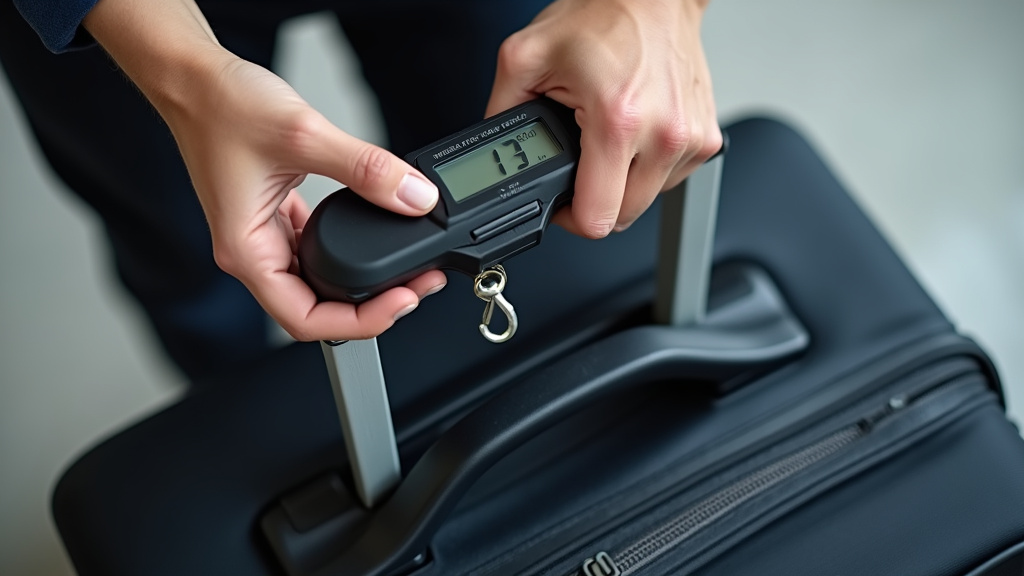
You need two tools: a tape measure and a luggage scale. The tape measure is for the standard carry-on size check. The luggage scale is for the weight. Guessing is how you fail.
The Home Weigh-In: Don’t Skip This
Pack your bag completely. Attach the luggage scale’s hook to the bag’s handle, lift, and note the weight. If you’re over, you have two choices: remove items or shift them.
The Weight-Shift Strategy:
- Heavy items go in your personal item. Laptops, cameras, hardcover books, and power banks are dense. Your personal item (backpack, purse, tote) almost never has a weight limit, only a size limit requiring it to fit under the seat.
- Wear your heaviest clothing. Boots, jackets, and jeans are heavy. Wear them on the plane.
- Ditch redundant items. Do you need three pairs of shoes? That hardcover novel? Be ruthless.
I learned this the hard way on a trip to Iceland. My carry-on was a sturdy roller packed for a week. It weighed 28 lbs. I was flying Icelandair, which has an 18 lb limit. At the Keflavik check-in counter, I had to open the bag on the floor, frantically stuffing my heavy sweater and hiking boots into my already-full backpack to avoid an €80 fee. It was a stressful, public scramble. Now I weigh first.
The Size Check: Wheels and Handles Count
This is where the 24-inch suitcase myth dies. A typical 24-inch spinner measures about 24″ x 16″ x 10″. That’s already over the standard 22″ x 14″ x 9″ limit before you even account for the expansion zipper. When the agent asks you to place it in the sizer, you must fit the entire bag, including wheels and handle, within the box. An overstuffed pocket or a protruding telescopic handle will get you flagged.
Common mistake: Buying a “carry-on” suitcase based on its marketing name without verifying its actual external dimensions — always measure it yourself empty.
When Size and Weight Intersect: Personal Items, Liquids, and Power Banks
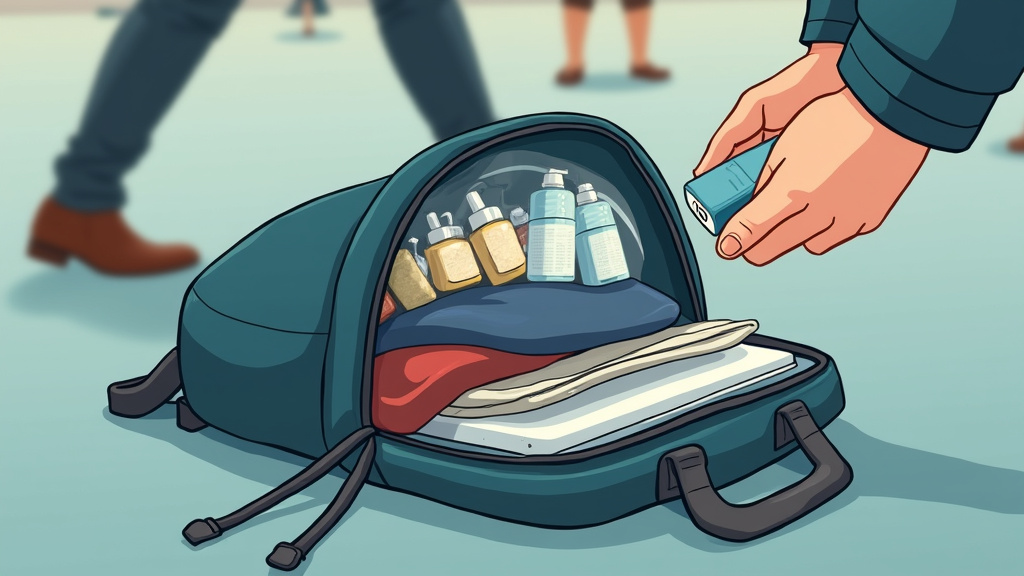
Your carry-on allowance is usually two pieces: one overhead bag and one under-seat personal item. The personal item is your secret weapon for managing maximum carry-on weight.
The Personal Item Loophole:
- No Weight Limit: Airlines almost never weigh your personal item.
- Size is Key: It must fit under the seat. A stuffed-to-the-brim hiking backpack might not.
- Use It For: Laptop, tablet, camera, documents, medications, a change of clothes, and your quart-sized liquid bag.
The 2025 Liquid and Power Bank Update:
- Liquids: The TSA’s 3-1-1 rule (containers 3.4 oz or less, in one quart bag) remains. Importantly, the European Union and UK have reinstated the 100 ml limit after technical issues with new scanners. Assume the strict rule is in effect everywhere.
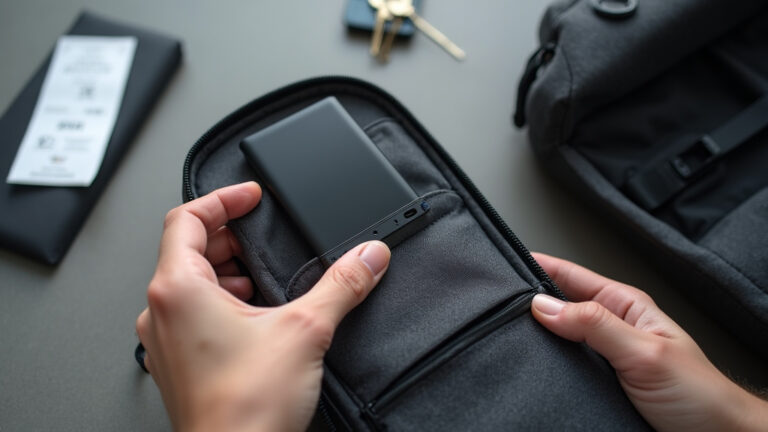
- Power Banks: This is a major new enforcement area. Airlines like Eva Air, China Airlines, and many others now ban power banks from checked luggage and overhead bins. They must be in your personal item or pocket, with use during flight prohibited. This is a safety rule to keep them accessible and within sight.
These airline baggage policies around hazardous materials are non-negotiable and enforced at security, separate from airline check-in.
What If Your Bag is Overweight at the Airport?
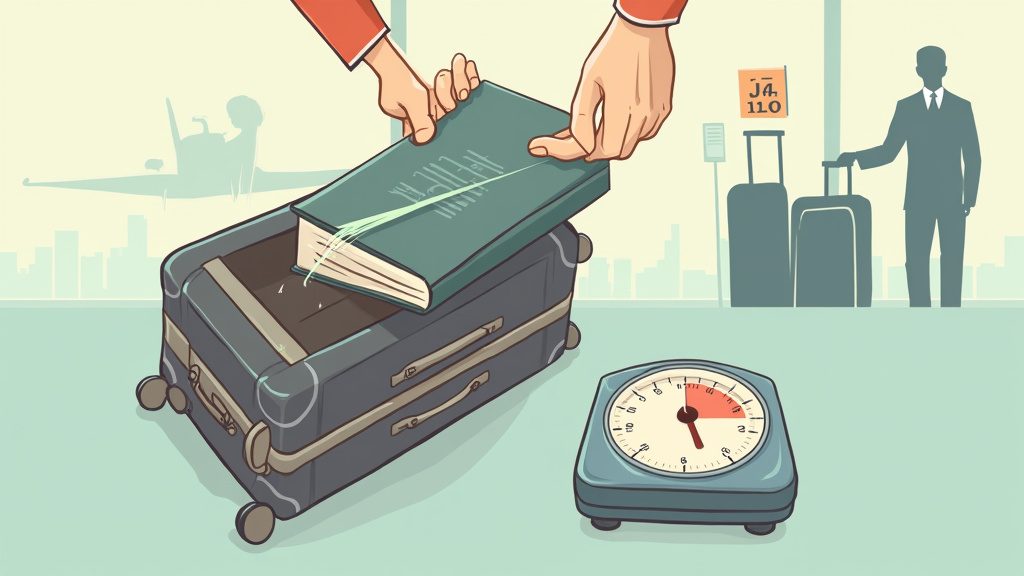
You have three seconds to decide. Here are your options, ranked from best to worst.
- Immediate Redistribution (The Quick Shift). If you’re only slightly over, open your bag and move the heaviest item to your personal item or wear it. This is your best chance for a free fix.
- Gate-Check (The Forced Hand). If you’re at the gate and the bag is over weight or the overhead bins are full, the agent will tag it and take it from you at the jet bridge. It will be returned plane-side at your destination. This is usually free but carries a small risk of delay.
- Pay the Fee (The Wallet Hit). If you’re at the ticket counter and over the limit, they will charge you an excess baggage fee. This can range from $50 to $200. It’s often more expensive than checking a bag would have been if paid for in advance.
- Abandon Items (The Last Resort). I’ve seen people leave hardcover books or heavy souvenirs in airport trash bins. Don’t let this be you.
The stress and cost of overweight baggage fees are completely avoidable with a $15 luggage scale and ten minutes of planning at home.
Frequently Asked Questions
Do any U.S. airlines have carry-on weight limits?
Yes, but they are the exception, not the rule. Hawaiian Airlines has a strict 25 lb limit. Budget carriers Frontier and Breeze Airways have 35 lb limits. The major legacy carriers (American, Delta, United, Southwest, Alaska, JetBlue) do not publish weight limits, relying on the size and lift test.
How strict are airlines about carry-on weight?
International and budget airlines are very strict and will weigh your bag at check-in and often again at the gate. Major U.S. domestic airlines are lenient on weight but strict on size. If your bag visibly struggles to fit in the sizer or you struggle to lift it, they will intervene.
What is the standard carry-on size for most airlines?
For U.S. domestic flights, the most common dimension limit is 22 inches long x 14 inches wide x 9 inches deep, including wheels and handles. International airlines often use a slightly smaller standard, closer to 21.5″ x 15.5″ x 9″. Always verify with your specific carrier, as some, like Southwest, are more generous.
Can a 24-inch suitcase be a carry-on?
Almost never. A typical 24-inch spinner exceeds the standard 22-inch length limit. Even if it squeezes into the sizer when empty, any packing will cause it to bulge and fail. A 24-inch bag is designed as checked luggage.
What happens if my carry-on is too heavy?
If you are at the gate, the airline will likely force you to “gate-check” the bag for free, handing it to them as you board. If you are at the ticket counter, they will charge you an excess baggage fee, which is often more expensive than pre-paying for a checked bag. In extreme cases on strict airlines, you may be refused boarding until the bag is checked.
Before You Go
Navigating carry-on weight limits is less about brute force and more about smart strategy. Weigh your bag at home. Know your airline’s actual number, not the rumor. Use your personal item as a ballast tank for heavy electronics. And remember, the size limits for carry-ons are just as important as the weight—measure that bag, wheels and all. A few minutes of prep saves you cash, stress, and the spectacle of repacking on the terminal floor. Your shoulders and your wallet will thank you.