What Size Luggage Carry On? Avoid This $100 2-Inch Mistake
This post contains affiliate links. As an Amazon Associate, we earn from qualifying purchases.
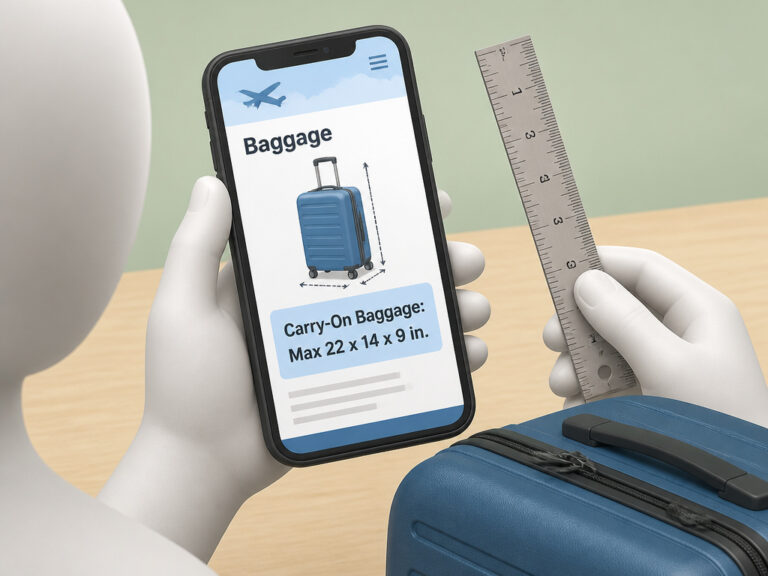
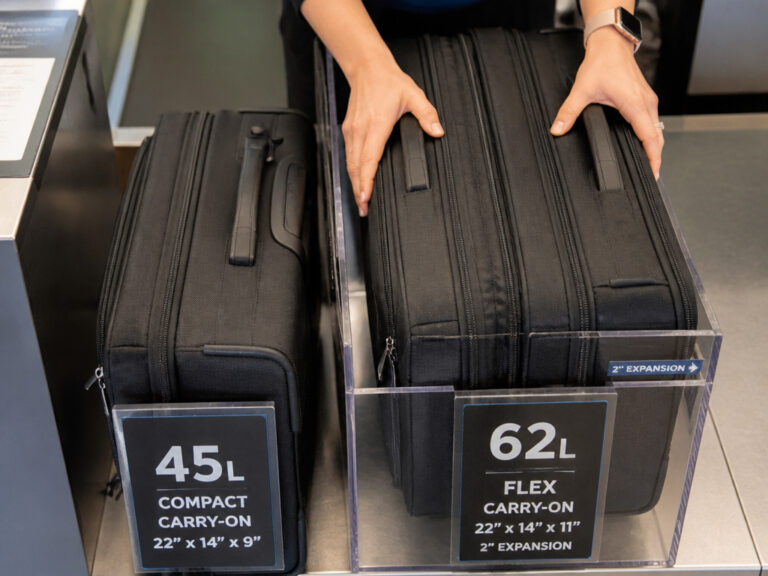
Most US airlines publish a maximum carry-on size of 22 x 14 x 9 inches, including wheels and handles. This “standard” is a loose guideline, not a guarantee, airlines like Qatar Airways cap at 20x15x10 inches, and budget carriers like Frontier and Spirit use metal sizer boxes that reject bags bulging even a quarter-inch over their posted limits. The real answer depends on your specific airline, its enforcement policy, and whether your bag is soft-sided.
That gap between the published number and the physical sizer is where the gate-check fee hits. A bag that looks compliant on your floor can jam in the airport’s metal frame, and the agent’s tape measure always wins.
What follows: the exact dimensions for major US and international carriers, the ISO standard that explains why some bags jam automated systems, and a step-by-step method for measuring your bag the way a gate agent will. By the end, you’ll know which number on the tag to trust and how to avoid the $100 surprise at the jet bridge.
Key Takeaways
- The common “22x14x9 inch” US carry-on size is a maximum, not a target; aim for a bag labeled 21.5″ or under to clear most sizer boxes.
- Budget airlines (Frontier, Spirit, Ryanair) and many international carriers (Emirates, Qatar Airways) enforce smaller, stricter dimensions with physical sizers, soft bags no longer get a “squish it” pass.
- Measure your bag packed, from the bottom of the wheels to the top of the extended handle; empty dimensions are irrelevant.
- A bag can meet size limits but still be rejected by automated systems if it lacks a flat surface, has dangling straps, or weighs under 5 lbs.
- Your ticket’s fare class (Basic Economy) can override the standard allowance, limiting you to a personal item only.
The 22x14x9 Inch Standard (and Why It’s a Trap)
Most domestic US airlines. Delta, American, United, JetBlue, Alaska, publish a maximum carry-on size of 22 x 14 x 9 inches. This is the number you’ll see stamped on millions of suitcases. It is also mostly a marketing convenience. Airlines know a bag sold as “22-inch carry-on” will, in reality, measure closer to 21.5 inches once you account for the retracted handle and unmolded corners. The published limit is a ceiling, not a floor.
The FAA’s official FAA carry-on baggage advisory circular (AC 121-29B) advises airlines to set dimensions that ensure bags fit securely in overhead bins and don’t require force to close the doors. It does not mandate a universal size.
The trap is assuming this number is safe everywhere. It is not. Two forces work against it: physical sizer boxes and airline-specific shrinkage.
Gate sizers are metal frames with fixed internal dimensions. If your bag doesn’t slide in easily, it fails. A soft-sided 22-inch bag, when fully packed, can bulge to 22.5 inches. That extra half-inch is the difference between the overhead bin and a $65 gate-check fee on Frontier. European and Asian carriers have used these sizers for years; US budget airlines adopted them widely in 2026 to speed up boarding and monetize non-compliance.
Airline-specific limits are often smaller. Look beyond the US majors. Qatar Airways allows just 20 x 15 x 10 inches (50 linear inches). Emirates, Ethiopian Airlines, and Royal Air Maroc use a strict 21.7 x 15 x 7.9 inch (55x38x20 cm) standard. If your trip includes a connection on one of these carriers, their smaller rule applies for your entire journey.
| Airline Type | Typical Published Size | Enforcement Style | Risk If You’re Over |
|---|---|---|---|
| US Major (Delta, American) | 22″ x 14″ x 9″ (56x36x23 cm) | Visual, occasional tape measure | Gate check, possible fee ($30-$50) |
| US Budget (Frontier, Spirit) | 24″ x 18″ x 10″ (but sizer is smaller) | Mandatory metal sizer box | Guaranteed gate-check fee ($60-$100) |
| International Full-Service (Emirates, Qatar) | 21.7″ x 15″ x 7.9″ (55x38x20 cm) | Sizer box at hub airports | Bag may be checked to hold, no option to carry on |
| European Low-Cost (Ryanair, easyJet) | 22″ x 17.7″ x 9.8″ (56x45x25 cm) | Strict sizer, paid carry-on permit | High fee at gate (€50-€70), denial of boarding |
Your first step is never the bag’s tag. It’s your airline’s website, under “Baggage” or “Travel Info.”
How to Measure Your Bag the Way a Gate Sizer Does
You need a tape measure and your bag packed for a typical trip. An empty suitcase is a useless reference, fabric expands, pockets bulge, the internal frame shifts.
Height: Bottom of the wheels to the top of the extended handle. This is the most common failure point. People measure the shell and forget the handle, which adds 1-2 inches. The sizer box height is fixed from its floor to its ceiling. Wheels and handle are included.
Width: The widest point side-to-side, including any external pockets. On a hardshell spinner, this is usually the center. On a soft-sided roll-aboard, the packed-out sides.
Depth: Front to back, fully packed. For a bag that goes overhead wheels-first, this is the dimension that fights the bin’s depth. Overstuff the expansion zipper, and you lose.
Where this goes sideways: Measuring with the handle retracted. The sizer box is a fixed tunnel; your retracted handle doesn’t matter if the bag won’t fit through the entrance. Always extend the handle fully when you check.
After you have your numbers, subtract at least half an inch from each for a safety margin. A bag that measures exactly 22 inches tall will be a forced fit. Aim for a true 21.5-inch height. This is why many frequent travelers buy bags marketed as “21-inch carry-on” or “international size”, they’re built to the stricter global average.
If you’re shopping, use our guide on how to measure carry-on luggage to decode product specs. A brand’s “case dimensions” often exclude wheels and handles; the “overall dimensions” include them. Trust only the overall number.
Carry-On Size Limits: 109 Airlines Compared
The variance is staggering. According to a 2026 comparison of 109 airlines, the most generous carry-on size belongs to Frontier Airlines (24 x 18.1 x 9.8 in / 61x46x25 cm). The strictest is a tie between Air Senegal, Emirates, and seven others at 21.7 x 15 x 7.9 in (55x38x20 cm).
This isn’t academic. It’s the difference between a week’s worth of clothes and a strategic packing puzzle.
| Region | Strictest Example | Most Generous Example | Key Takeaway |
|---|---|---|---|
| United States | Alaska Airlines (22×13.8×8.7 in) | Frontier Airlines (24×18.1×9.8 in) | Budget carriers offer more space but enforce it rigidly with sizers. |
| Europe | Ryanair (21.7×15.7×7.9 in) | easyJet (22×17.7×9.8 in) | Low-cost fares often exclude overhead bin access; you must pay for it. |
| Middle East / Africa | Emirates, Qatar, Ethiopian (21.7x15x7.9 in) | Saudia, Royal Jordanian (22×17.7×9.8 in) | Premium carriers are often stricter to ensure bin space for all passengers. |
| Asia / Australia | AirAsia, Jetstar (22×14.2×9.1 in) | Thai Airways, Sri Lankan (22×17.7×9.8 in) | Weight limits (often 7 kg / 15.4 lbs) are as critical as size. |
Why such a spread? Aircraft bin design varies by model (Airbus A320 vs. Boeing 787), and airline business models differ. A budget airline monetizes baggage space; a full-service airline includes it in the fare but must guarantee it fits. The global standard, outlined in the IATA Baggage Reference Manual, provides guidelines, but each carrier sets its own operational rules.
Your strategy: identify the strictest airline on your itinerary and pack to its limits. If you’re flying Delta to London but returning on British Airways, BA’s slightly more generous dimensions don’t help you on the outbound leg. Delta’s gate agent checks the bag that’s in front of them.
When Your Bag is “Non-Standard” Even at the Right Size
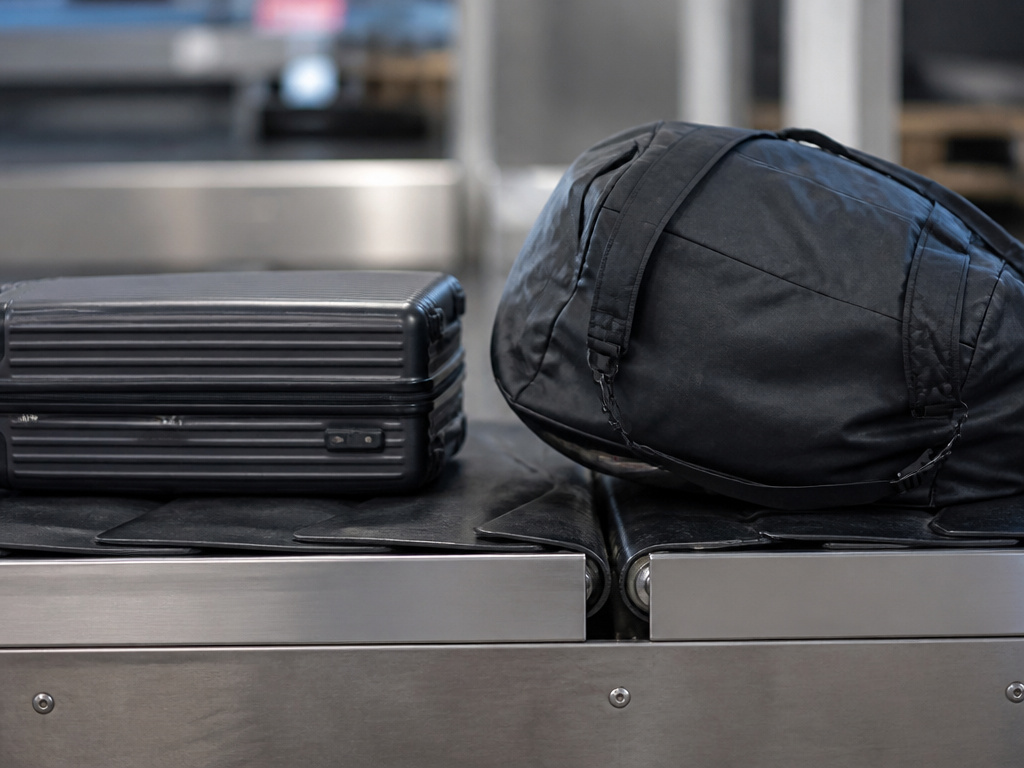
The ISO 12604-1:2017 standard for baggage handling reveals a hidden layer. A bag can meet every airline’s size restrictions and still be flagged as “non-conveyable” by airport automated systems. The machines that sort and route thousands of bags per hour have physical limits beyond simple dimensions.
The ISO standard notes that baggage is unsuitable for mechanized systems if it: * Lacks at least one stable, flat surface. * Has protruding straps, hooks, or loose components. * Is very small (under 2 kg / 5 lbs) or very light, which can jam sensors. * Has a irregular shape that tumbles or gets stuck on conveyor bends.
ISO 12604-1:2017, Section 4.1.3: “Even pieces meeting mass and dimension limits can be unsuitable… If they lack a stable shape, at least one flat surface, or have protruding straps, hooks, or similar appurtenances.”
This is why duffel bags, overstuffed backpacks, and grocery-tote style carry-ons get gate-checked more often, they’re floppy. They might fit the sizer with a push, but they’re a jam risk in the automated baggage system that sometimes handles carry-ons during gate-check. The handler sees a problem before it happens.
The fix is structure. A hard-shell suitcase like the Travelpro Optima or the Delsey Carrousel has a rigid shape. A soft bag with a rigid frame panel and secured straps presents a stable profile. This is a core part of what is considered carry-on luggage by the systems, not just the agents.
The Tools You Need: Sizer Bin-Tested Luggage
You can guess, or you can buy a bag designed to pass. Look for the phrase “sizer bin tested” on product specs. It means the manufacturer has physically tested the bag in the metal frames used at airports. This is your best guarantee.
For most US domestic travel, the Travelpro Maxlite 5 International Carry-On is the benchmark. Its overall dimensions (21.75 x 15.75 x 7.75 in) are built just under the strictest common limits. It’s lightweight (5.4 lbs) and expandable, but you must remember not to use the expansion if you’re near the limit.
For a near-indestructible option that fits the technical standard carry-on dimensions, the Peli 1535 Air Carry On Case is used by field engineers and photographers. Its interior is 20.39 x 11.20 x 7.21 inches, well within even Qatar’s rules, and its hard shell won’t bulge. It’s heavy, but it will survive being gate-checked if it comes to that.
The Delsey Paris Carrousel Carry-On offers a balance: a hard shell for shape retention, smooth spinner wheels, and an expandable design. Just know that using the expansion feature likely puts it over the acceptable carry-on size for most airlines.
TL;DR: For one bag that works everywhere, pick a hardshell spinner labeled 21-21.5 inches in height, with overall dimensions under 22x14x9. Weigh it packed. That covers 95% of scenarios without drama.
Frequently Asked Questions
Is 24-inch luggage a carry-on?
Almost never. A 24-inch suitcase refers to the internal body length, typically making its overall height 26-27 inches with wheels and a handle. This far exceeds the max carry-on size for any major airline. A 24-inch bag is a checked bag.
Do airlines actually measure every carry-on?
No, but they measure enough to keep everyone honest. US major airlines rely on visual inspection unless a bag is obviously oversized. Budget carriers (Frontier, Spirit, Ryanair) and many international airlines (Emirates, Air France) use sizer boxes at the gate consistently. Enforcement is always stricter on full flights.
What if my carry-on is slightly too big?
You have two outcomes. If there is space in the cabin, the airline may gate-check your bag for free, returning it to you on the jet bridge after landing. If the flight is full or the airline is strict, you will pay a gate-check fee (often $60-$100), and the bag travels in the aircraft hold. You collect it at baggage claim.
Can I use a duffel bag as a carry-on?
Yes, if it meets the size limits. However, duffel bags are soft and prone to overpacking, making them more likely to be flagged by visual inspection or to jam in a sizer box. For reliable passage, choose a duffel with a structured base and compressible sides, and never fill it to capacity.
How strict are the 7 kg weight limits?
Extremely strict on airlines that have them, primarily in Asia, the Middle East, and on some European carriers. They will weigh your bag at check-in and often again at the gate. A backpack or shoulder bag is frequently weighed along with your roller bag as part of your total cabin allowance. Exceeding it means a check-in fee or forced repacking.
Before You Go
The correct carry-on luggage size is the one your specific airline enforces on the day you fly. The number 22x14x9 is a starting point, not a passport. Your real tools are a tape measure, your airline’s baggage policy page, and a bag designed with a half-inch of margin.
Check your fare rules. Basic Economy often means personal item only. Measure your bag packed, handle extended. And if you’re connecting through a hub for a strict carrier like Emirates, their smaller rule is your new rule. That extra inch of space in your suitcase isn’t worth the $100 and the stress at the gate. Pack to the tightest limit on your ticket, and your bag will follow you on board.