Maximum Liquid Allowed in Carry-On Luggage: The 3-1-1 Rule
This post contains affiliate links. As an Amazon Associate, we earn from qualifying purchases.
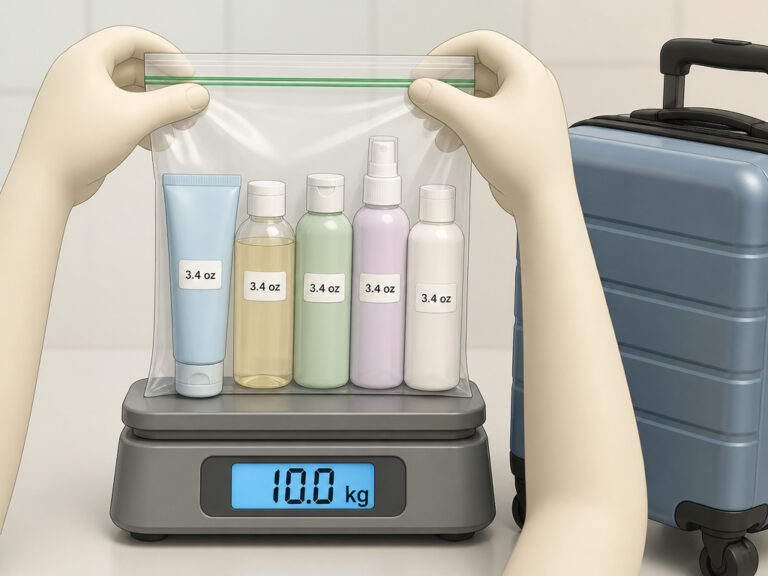
The maximum liquid allowed in carry-on luggage is 3.4 ounces (100 milliliters) per container. Every container must fit inside a single, clear, quart-sized plastic bag, and each passenger gets one bag. This is the TSA’s 3-1-1 rule.
That 100 ml cap isn’t a suggestion. It’s a hard limit on container size, not the amount of liquid inside. A half-full 200 ml shampoo bottle fails. The rule exists because standard security scanners can’t reliably identify liquids in larger, opaque containers. The quart bag is the control measure—it physically limits the total volume any one person can bring into the cabin.
What follows: the exact specs for that bag, what surprisingly counts as a “liquid,” the full list of exemptions for medicine and baby food, and how this rule shifts when you fly through Canada, Brazil, or buy duty-free.
Key Takeaways
- The 3-1-1 rule means 3.4 oz (100 ml) containers, 1 quart-sized bag, 1 bag per passenger.
- Container size matters, not content. A large, partially-filled bottle is prohibited.
- Medications, baby formula, and duty-free purchases are exempt from the 100 ml limit but have specific packing rules.
- Non-solid foods like yogurt, peanut butter, and jam are considered liquids and must follow the 3-1-1 rule.
- Bag dimensions matter. A bag measuring 20 cm by 17.5 cm (8 in. By 7 in.) is the maximum allowed by CATSA.
What Is the 3-1-1 Rule?
The 3-1-1 rule is the TSA’s shorthand for its carry-on liquid restrictions. It breaks down into three numbers that are easy to remember but strict in application.
Containers of liquids, aerosols, gels, creams and pastes in your carry-on must be 3.4 ounces (100 milliliters) or less. All containers must fit in one clear, resealable plastic bag no more than 1L in capacity. The bag must be transparent so screening officers can easily see the contents.
The first “3” stands for 3.4 ounces. This is the maximum volume of the container itself. The “1” in the middle is for one quart-sized, clear, plastic, resealable bag. The final “1” is one bag per passenger. This rule isn’t just for toiletries. It covers any substance that can conform to the shape of its container at room temperature.
Forget the rule, and you face a choice at security: surrender the item, exit the line to check your bag, or find a mailer. Neither saves time or money.
Why the 100 ml and Quart Bag Limits?
The limits are security engineering, not arbitrary inconvenience. X-ray machines struggle to differentiate between harmless liquids and potential threats in large, opaque containers. The 100 ml container size is small enough that the potential threat from any single container is limited. The quart bag acts as a total volume limiter.
If you could bring ten 100 ml bottles, that’s one liter total. The bag must close without stretching. This is the physical test. If you force it, the zipper strains or the seams bulge. A screening officer will see that and pull your bag for inspection. The goal is a smooth, predictable security flow.
What Counts as a Liquid?
The definition is broader than water or shampoo. The TSA and other agencies use a functional definition: if it spreads, pours, or squirts at room temperature, it’s a liquid for security purposes. This catches many common travel items.
Common liquids include:
- Cosmetics: Liquid foundation, mascara, lip gloss.
- Toiletries: Shampoo, conditioner, toothpaste, shaving cream.
- Foods: Yogurt, pudding, maple syrup, peanut butter, jam.
- Gels and Pastes: Hair gel, styling paste, sunscreen.
Where this goes sideways: Assuming “solid” food is always safe. A jar of peanut butter is a paste. A cup of yogurt is a gel. Both must be in 100 ml containers inside your quart bag. Freezing a gel to make it solid doesn’t work—screeners check its state at room temperature.
The line gets drawn at items that are truly solid. A stick of deodorant is fine. A bar of soap passes. A can of tuna with less than 100 ml of liquid brine is permitted, but it still needs to fit in your liquids bag. When in doubt, apply the spread test. If you can smear it, it’s likely a liquid.
The Quart-Sized Bag: Your One Liter Container
Your quart bag is the physical boundary for all your liquids. Not any bag will do. The official requirement is a clear, resealable plastic bag with a capacity of about one liter. In the U.S., this is called “quart-sized.” In Canada, CATSA specifies a “1L bag” with approximate dimensions of 15.24 cm by 22.86 cm (6 in. By 9 in.) or 20 cm by 17.5 cm (8 in. By 7 in.).
You cannot use a gallon-sized freezer bag. You cannot use a cosmetic case with a clear window. The bag must be fully transparent and sealable. Standard Ziploc-style quart bags are the default choice because they meet every requirement and are cheap to replace.
| Bag Characteristic | Requirement | What Happens If You Don’t Comply |
|---|---|---|
| Size | ~1 Liter (Quart) | A larger bag will be rejected; you must repack on the spot. |
| Clarity | Fully Transparent | An opaque or tinted bag prevents visual inspection; item removal is required. |
| Closure | Resealable (Zipper) | A bag that doesn’t seal can’t contain spills; it may be rejected as a leak risk. |
| Closure Status | Must Fully Close | An overstuffed bag that can’t zip signals you’ve exceeded the volume limit. |
You must present this bag separately at security. Pull it from your carry-on luggage and lay it flat in a bin. This allows for a quick visual scan. Burying it in your suitcase guarantees a hand search and delays everyone behind you.
Critical Exemptions to the Rule
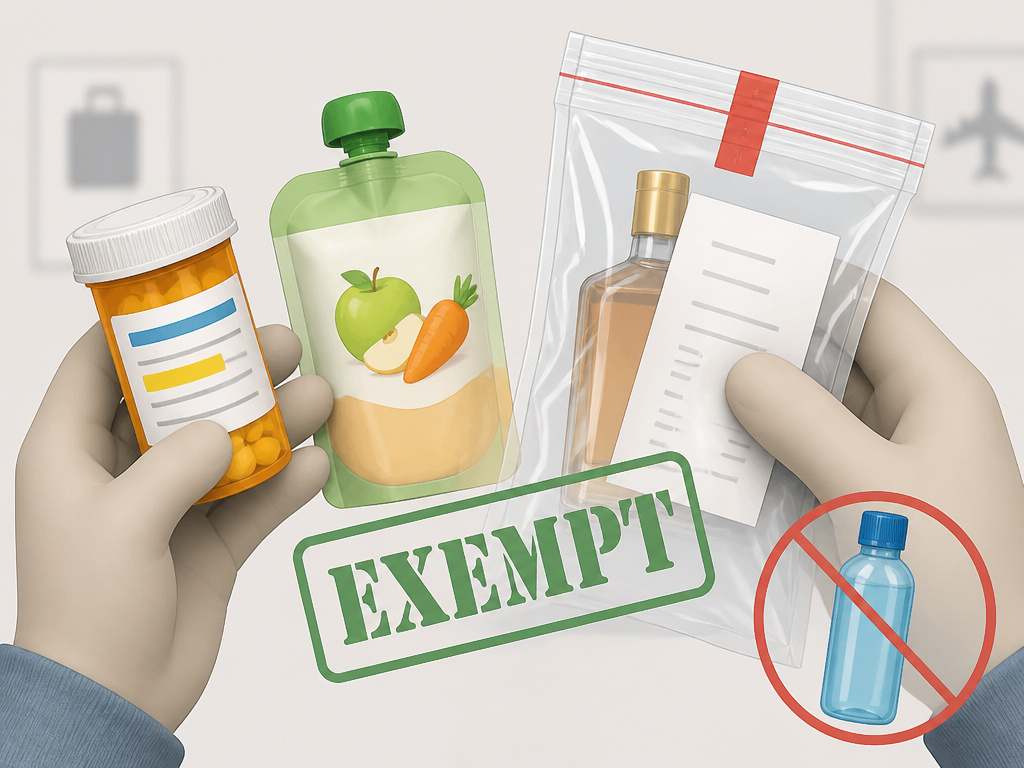
The 3-1-1 rule has life-critical exceptions. These items are allowed in quantities greater than 100 ml, but they come with specific procedures.
1. Medications (Prescription & Non-Prescription)
Liquid prescription medicines, insulin, cough syrup, and gel-based supplements are exempt. You must declare them to the security officer for separate screening. They do not need to be in your quart bag. Keep them in their original pharmacy packaging with a label matching your ID.
2. Infant and Child Nourishments
Formula, breast milk, juice, and baby food in pouches are allowed in volumes needed for the journey when traveling with a child under two. Inform the officer before screening begins. These are also screened separately.
3. Duty-Free Liquids
You can carry duty-free alcohol or perfume in containers over 100 ml if you are on an inbound international flight with a connection. The key is the tamper-evident bag. The retailer must seal it, and the receipt must be inside and dated within 48 hours. Do not break this seal until after your final security checkpoint.
4. Medical Liquids
Liquids for diabetes management, distilled water for CPAP machines, and frozen gel packs needed for medication are exempt. Declaration is mandatory.
Common mistake: Assuming baby food is automatically exempt for any traveler. If you’re not traveling with an infant, that 120 ml apple sauce pouch must follow the standard 3-1-1 liquid restrictions for carry-on.
How to Pack Your Liquids Bag Correctly
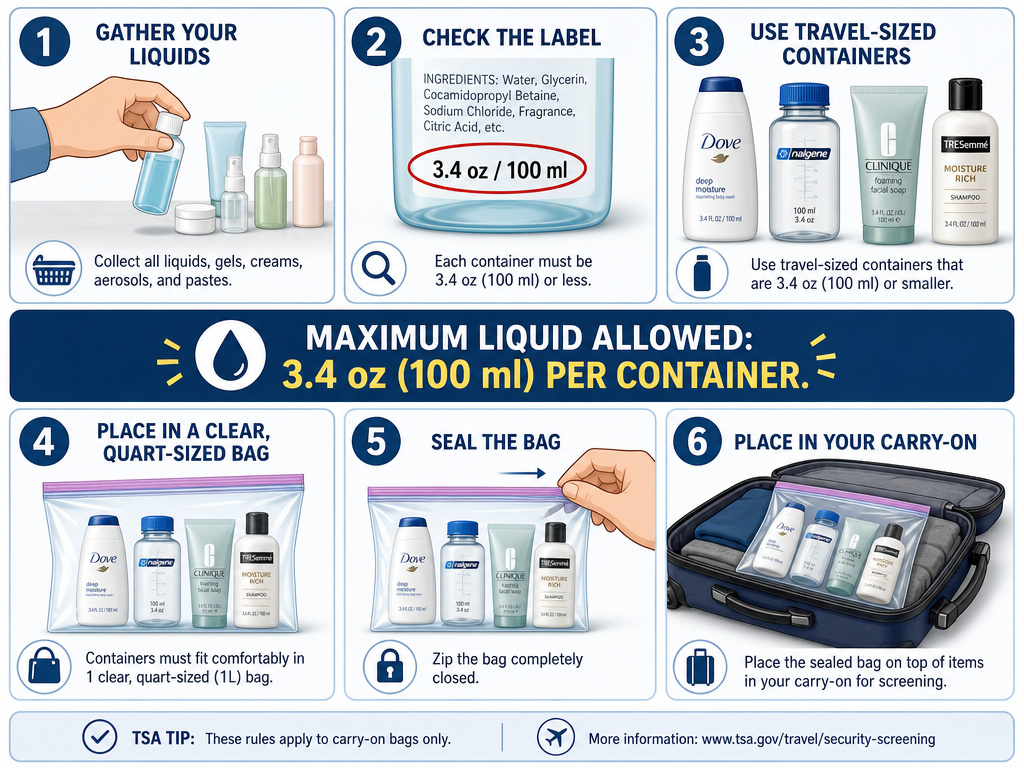
Packing isn’t just about fitting things in. It’s about creating a predictable, spill-resistant package that screeners can approve in three seconds.
- Gather all your liquids. Don’t forget the lip gloss in your purse or the hand sanitizer on your keychain.
- Check every container size. Look for the “ml” or “fl oz” marking on the bottle, not just how full it is.
- Use travel-sized containers. Brands like Dove, Pantene, and Colgate make 3.4 oz versions. For longer trips, use reusable silicone bottles from Nalgene or GoToob.
- Place bottles upright in the bag. Lay them flat like dominoes, not stacked. This minimizes pressure on the caps.
- Seal the bag completely. Run your fingers along the entire zipper track.
- Put the bag on top. Store it in an exterior pocket or the very top of your carry-on bag for immediate access.
Skipping step six means digging through your packed clothes while a line of people watches. It turns a 10-second process into a two-minute ordeal.
International Variations: TSA vs. CATSA vs. ANAC
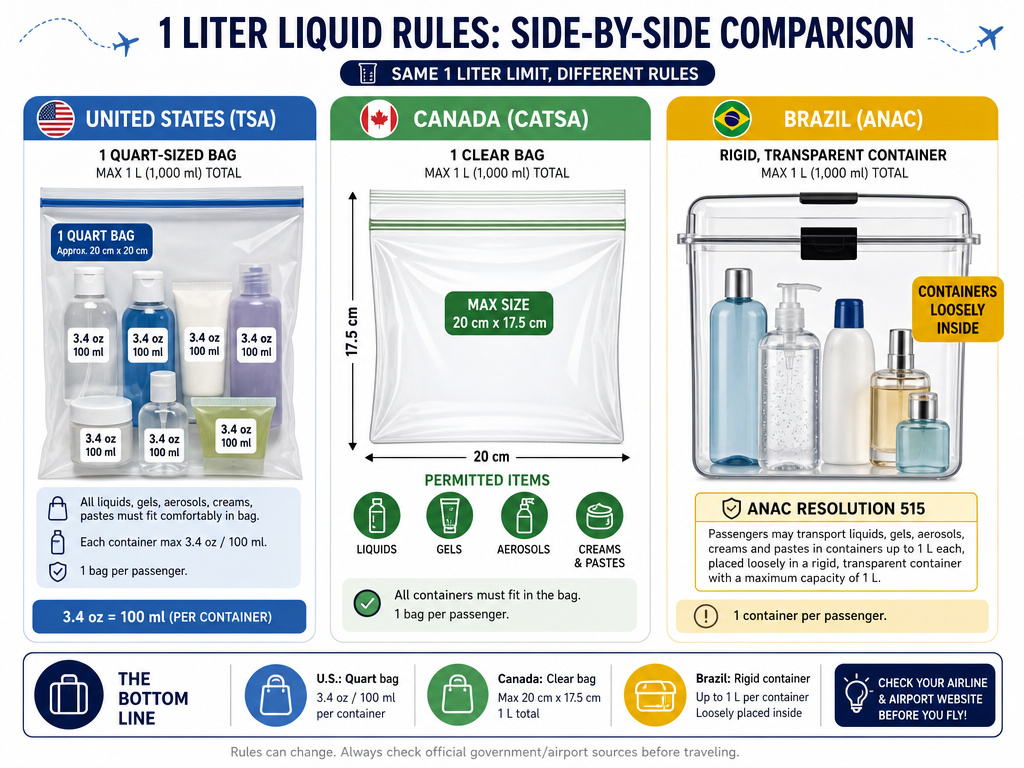
The core 100 ml / 1L bag rule is a global standard based on ICAO guidelines, but national agencies implement it with slight twists. If your trip involves multiple countries, plan for the strictest interpretation.
| Agency (Country) | Container Limit | Bag Limit | Key Difference |
|---|---|---|---|
| TSA (USA) | 3.4 oz (100 ml) | 1 quart-sized bag | The baseline 3-1-1 rule. Duty-free rules are specific to inbound international travel. |
| CATSA (Canada) | 100 ml/100 g | 1 clear 1L bag | Explicitly includes non-solid food. Provides exact bag dimensions (e.g., 20 cm x 17.5 cm). |
| ANAC (Brazil) | 100 ml | 1 transparent 1L container | Governed by ANAC’s Resolution No. 515, of May 8, 2019. Requires bottles be placed “loosely” inside the closed container. |
Brazil’s ANAC rule highlights how specific regulations can be. Their resolution mandates the container itself, not just a bag, and emphasizes that bottles must be loose for easy inspection. This is the kind of nuance that catches connecting passengers off guard.
For any international journey, checking the destination’s aviation authority website is non-negotiable. Relying solely on U.S. TSA restrictions is a gamble.
Frequently Asked Questions
Can I bring multiple 3.4 oz bottles?
Yes. You can bring as many 3.4 oz (100 ml) containers as you can fit inside your single, quart-sized bag while still sealing it closed. This typically averages between 6 to 9 bottles, depending on their shape.
Does toothpaste count as a liquid?
Yes. The TSA classifies toothpaste as a paste or gel, so it must adhere to the 3-1-1 rule. Travel-sized tubes are almost always under 100 ml.
What about solid deodorant or a bar of soap?
Solid deodorant sticks and bar soap are not considered liquids. You can pack them anywhere in your carry-on luggage without size restrictions or the need to put them in the liquids bag.
What happens if my liquids bag is over the limit?
Screening officer will pull your bag for inspection. You will be given a choice: voluntarily surrender the non-compliant items, place them in your checked baggage (if you have any), or exit security to mail them or repack. This causes significant delays.
Are contacts solution and eye drops allowed?
Yes, but they must comply with the 3-1-1 rule if the container is over 100 ml. Most travel-sized bottles of saline solution are under this limit. Larger, essential medical liquids should be declared as medications.
Before You Go
The maximum liquid allowed in carry-on luggage boils down to a simple physical test: if your 3.4 oz bottles fit comfortably inside a sealed quart bag, you’ll pass. The real work is in the details—classifying peanut butter as a liquid, knowing the exact bag dimensions for Canada, and understanding how to declare exempt items like medicine.
Print your official TSA travel guidance and tuck it in your bag. Use a clear TSA-approved liquids bag like the ones from Ziploc or Tru-Fit. Pack it last on top. That preparation turns a potential security headache into a non-event. Your gate is waiting.