Cheese in Hand Luggage: Can I Take It? Rules for Travel
This post contains affiliate links. As an Amazon Associate, we earn from qualifying purchases.
Yes, you can take solid cheese in your hand luggage on domestic flights. The TSA allows it in both carry-on and checked bags with no quantity limits. Creamy, spreadable, or liquid-based cheeses like Brie, cream cheese, or feta in brine are subject to the 3.4 oz (100 ml) liquid rule per container in your carry-on.
That “solid” definition is the whole game. It’s not about how a cheese feels at room temperature. It’s about whether it holds its shape and doesn’t pour. Get that line wrong at security and your carefully packed wedge gets tossed into the bin.
What follows: the exact TSA and international agency definitions, the 2kg weight limit for entering the EU, the packing move that keeps cheese from being flagged as a security threat, and what to do when an agent says no.
Key Takeaways
- Solid cheeses (cheddar, parmesan, hard gouda) have no carry-on limits. The TSA’s rule is based on form, not firmness.
- Creamy cheeses (brie, camembert, cream cheese) are liquids for security. Each container must be 3.4 oz (100 ml) or less to fly in your carry-on.
- Entering the EU? You’re limited to 2kg total of animal products. This includes all cheese in your personal luggage, per EU Regulation 2019/2122.
- USDA APHIS bars cheeses that “pour like a liquid” from international entry. Ricotta and cottage cheese are explicitly banned, regardless of packaging.
- Pack cheese at the top of your bag and be ready to show it. Dense blocks can look suspicious on X-rays, leading to manual inspections.
The TSA’s “Solid” vs. “Liquid” Cheese Divide
The TSA’s hand luggage cheese policy is blunt. Solid cheese gets a green light. The confusion starts with what “solid” means to a security officer staring at an X-ray screen.
TSA solid cheese rules define “solid” as any cheese that does not conform to the shape of its container and cannot be poured or spread like a liquid or gel. This is a functional test, not a culinary one.
A room-temperature Brie might not leak, but its creamy interior qualifies as a gel. The same goes for goat cheese logs, mascarpone, or any cheese spread. If you can smear it with a knife, it’s under the 3-1-1 liquid rule. Your best bet is to review the official list of prohibited carry-on items for gel-based foods.
| Cheese Type | TSA Carry-On Status | Key Reason |
|---|---|---|
| Hard (Parmesan, Aged Cheddar) | Allowed, no limit | Maintains defined shape, no liquid content. |
| Semi-Hard (Gouda, Swiss) | Allowed, no limit | Holds form, doesn’t spread at room temp. |
| Soft & Creamy (Brie, Camembert) | Allowed only if ≤ 3.4 oz/100 ml per container | Interior is a spreadable paste, classified as a gel. |
| Spreadable (Cream Cheese, Laughing Cow) | Allowed only if ≤ 3.4 oz/100 ml per container | Designed to be spread, falls under liquid rules. |
| In Liquid (Feta in brine, Mozzarella balls) | Allowed only if liquid portion ≤ 3.4 oz/100 ml | The liquid medium is the restricted component. |
Where this goes sideways: Assuming “solid” means “firm.” A ripe Taleggio or a runny Harbison cheese will be confiscated if it’s over 100 ml, even if it’s technically a whole cheese. When in doubt, put it in your checked bag.
The 3.4 oz / 100 ml Rule for Creamy & Spreadable Cheeses
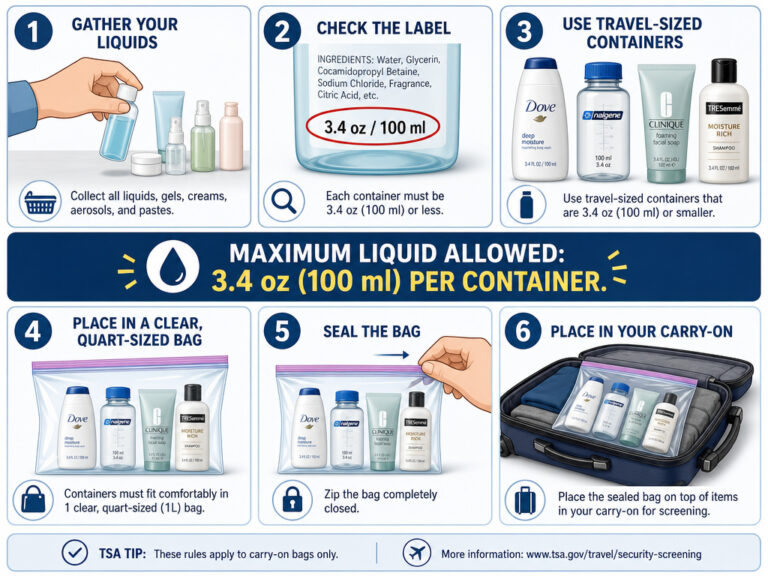
This is the standard liquid limit for carry-on luggage. All your liquids, gels, aerosols, creams, and pastes must fit inside a single one-quart clear bag. Each container can hold no more than 3.4 ounces (100 milliliters).
For cheese, this means any creamy or spreadable variety must be in a container that size or smaller. You can’t bring an 8 oz tub of Philadelphia. You could bring three 3.4 oz tubs, each in its own quart bag, but that’s pushing it.
Common mistake: Thinking you can cut a large Brie into 100-gram pieces. The rule applies to the container, not the cheese itself. A 200-gram wedge in one package is one container over the limit, even if you could technically cut it.
The rule exists because these substances have a similar density to liquid explosives on X-ray scanners. Security needs to limit the total volume a passenger could carry on board. This is the same logic that governs other permitted items like travel shampoos or sauces.
Your move: For carry-on, buy travel-sized portions. For checked luggage, there’s no limit, pack the whole wheel.
International Rules: USDA APHIS and EU Weight Limits
Domestic rules are simple. Crossing a border adds two major layers: agricultural protection and customs allowances.
Entering the United States: The USDA’s Animal and Plant Health Inspection Service (APHIS) controls this. Their APHIS dairy import regulations allow “solid hard or soft cheeses” from any country, with a critical caveat: the cheese must not contain meat and must not “pour like a liquid.”
“Pour like a liquid” explicitly includes ricotta and cottage cheese. These are prohibited from entry in your luggage, regardless of quantity or packaging. Commercially sealed, shelf-stable cheeses are generally fine.
Entering the European Union: EU Regulation 2019/2122 sets a personal exemption. You can bring products of animal origin (including all cheese) in your personal luggage if the combined weight does not exceed 2 kilograms. This is a total weight for all such products, not per item.
| Destination | Agency | Key Rule | Practical Limit |
|---|---|---|---|
| United States | USDA APHIS | No “liquid-pour” cheeses (ricotta, cottage). Solid cheese allowed. | No weight limit, but must be for personal use. |
| European Union | EU Customs | Personal luggage exemption for animal products. | 2 kg combined total weight. |
| Canada | CATSA | Follows 100 ml rule for spreadable cheeses in carry-on. | 100 ml per container in carry-on. |
These rules exist to prevent disease spread and protect local agriculture. Declare all food products on your customs form. The penalty for smuggling cheese isn’t just losing the cheese.
Why Cheese Triggers Additional Screening (The “Explosive” Look)
This is the part nobody mentions until it happens to them. Dense, uniform blocks of organic material, like a wedge of aged Manchego or a wheel of Gouda, have an X-ray density very close to certain plastic explosives.
Where this goes sideways: A traveler on a European domestic flight had a semi-hard cheese confiscated because security classified its creamy interior as a liquid. Another reported being pulled aside because their dense cheese block looked “suspiciously uniform” on the scanner.
The TSA’s own page encourages travelers to “organize their carry-on bags and keep them uncluttered” to avoid obstructing X-ray images. A cheese block buried under cables and chargers looks like you’re hiding something.
How to avoid the hassle:
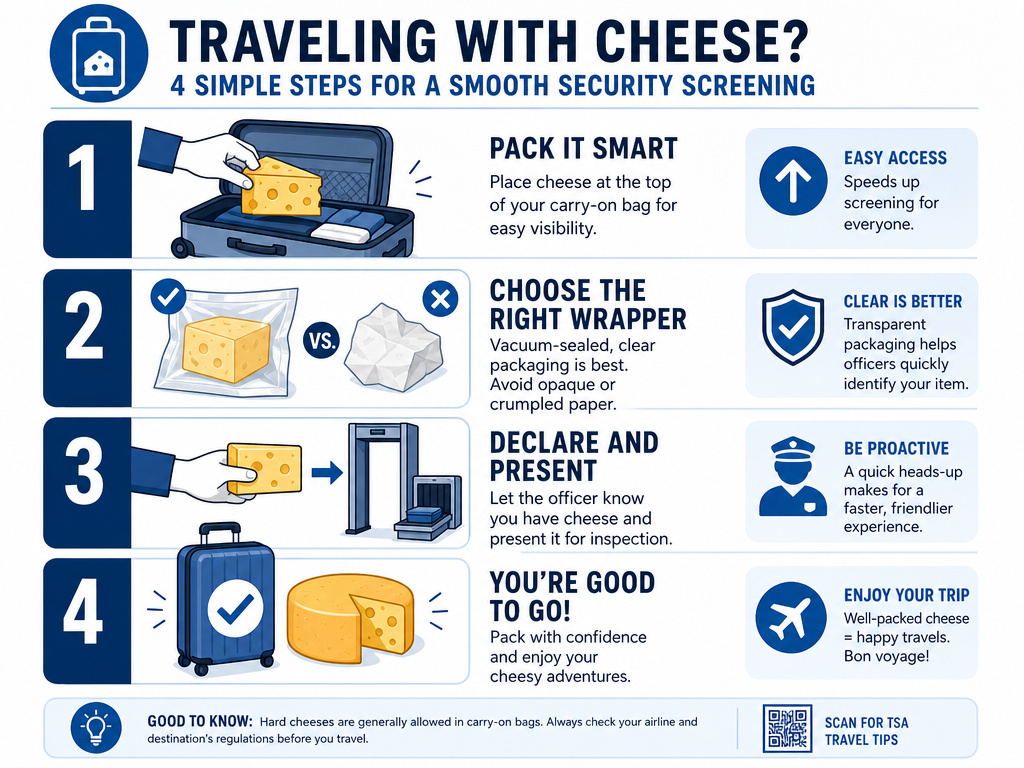 1. Pack cheese at the top of your carry-on. Don’t bury it.
2. Use clear packaging if possible. A vacuum-sealed bag is better than opaque paper.
3. Be ready to take it out. If the bag gets flagged, politely tell the officer, “That’s a block of cheese I can remove for inspection.”
4. Consider checking it. In checked baggage, there are no liquid rules and far less scrutiny.
1. Pack cheese at the top of your carry-on. Don’t bury it.
2. Use clear packaging if possible. A vacuum-sealed bag is better than opaque paper.
3. Be ready to take it out. If the bag gets flagged, politely tell the officer, “That’s a block of cheese I can remove for inspection.”
4. Consider checking it. In checked baggage, there are no liquid rules and far less scrutiny.
This isn’t paranoia. It’s a predictable outcome of airport security physics. Treat your cheese like the electronics or sharp objects you pack, something that might need a second look.
Packing Cheese for Checked Luggage
Checked bags are the free zone for cheese lovers. You can pack hard, soft, spreadable, and liquid-packed cheeses in any quantity. The goal shifts from compliance to preservation.
Your toolkit for a 24+ hour journey:
- Vacuum sealer: The single best investment. It prevents odor transfer and locks out moisture.
- Hard-sided cooler bag or insulated lunch box: Provides thermal mass.
- Frozen gel packs: Use the rules for aerosols in checked luggage as a guide, gel packs are fine as long as they’re frozen solid at screening.
- Ziploc bags (double-bagged): A cheap backup for containing any potential seepage.
The packing sequence:
- Seal each cheese individually. Hard cheeses can be pre-cut.
- Wrap the sealed cheeses in a kitchen towel or newspaper for insulation.
- Place them in the cooler bag with the frozen gel packs.
- Put the cooler bag in the center of your suitcase, surrounded by clothing.
This method keeps cheese cool for a full day of travel. It also contains any smell, which is a courtesy to baggage handlers and your own clothes. For more general strategies, see our tips for packing carry-on luggage, which emphasize organization.
Special Cases: Knives, Gift Packs, and Large Quantities
Traveling with cheese often involves accessories or large amounts. Here’s how to handle the edge cases.
Cheese knives and tools: These are prohibited items in carry-on luggage. Any blade must go in your checked bag. Secure it in a sheath or wrap the blade in cardboard and tape to protect handlers.
Gift packs and baskets: These are tricky. If the basket contains a spreadable cheese or honey over 3.4 oz, the entire item may be confiscated at security. Your best bet is to ship it ahead or check it. For delicate luxury food items like caviar or truffles, similar careful packing and checking apply.
Large quantities for personal use: There is no official weight limit for solid cheese in domestic checked bags. However, if you’re checking a suitcase full of 20 pounds of cheese, be prepared to explain it’s for personal consumption if asked. For international travel, strictly adhere to the 2kg EU limit or USDA rules.
Bottom line: When your cheese travel plan involves more than a snack, default to the checked bag. It simplifies every rule.
Frequently Asked Questions
Can I take cheese on a plane in my hand luggage?
Yes, solid cheese is allowed in hand luggage without quantity restrictions. Creamy or spreadable cheese must follow the 3.4 oz (100 ml) liquid rule per container.
Is Babybel cheese allowed in hand luggage?
Yes, Babybel cheeses are solid and individually sealed. They are perfectly fine in any quantity in your carry-on or checked bag.
Can you take Philadelphia cream cheese in hand luggage?
You can only take Philadelphia cream cheese in your carry-on if it’s in a container of 3.4 ounces (100 ml) or less. A standard 8 oz tub must go in your checked luggage.
How much cheese can I bring into the EU?
You can bring up to 2 kilograms (about 4.4 lbs) of cheese combined with all other products of animal origin in your personal luggage for personal consumption, according to EU Regulation 2019/2122.
Can I bring cheese back to the USA from Europe?
Yes, you can bring back solid cheese from Europe to the USA. Cheeses that “pour like a liquid,” such as ricotta or cottage cheese, are prohibited by USDA APHIS regulations.
Does cheese need to be in original packaging?
No, the TSA does not require original packaging for solid cheese. However, for international travel and customs declaration, original commercial packaging can help prove it’s a store-bought, regulated product.
Before You Go
Pack solid cheese freely in your carry-on. Treat creamy cheese like a liquid, under 3.4 oz or in your checked bag. Remember the 2kg limit for Europe and the USDA’s ban on pourable cheeses. The real trick isn’t knowing the rules; it’s packing so clearly that security never has to guess what’s in your bag. Put the cheese on top, be ready to show it, and you’ll walk through while others are explaining their gourmet spread.