What to Write on a Luggage Tag: Key Data Fields Explained
This post contains affiliate links. As an Amazon Associate, we earn from qualifying purchases.
Write your full name, a mobile phone number with country code, and an email address on your luggage tag. These three fields give a baggage agent two immediate contact paths. Omit your home address. On the back or inside a privacy flap, add a secondary contact person’s number and your destination city or hotel. This setup matches the data airlines use in their own systems while keeping your private life off public display.
That name-phone-email triad is the personal subset of the structured data model the International Air Transport Association defines for the industry. Your tag is a backup to the airline’s primary tracking, which relies on a 10-digit license plate barcode.When that system fails, a tag tears off, a scanner misses, the human-readable info on your personal tag becomes the fallback protocol. The goal is to feed the recovery system exactly what it needs, nothing more.
What follows breaks down the IATA’s baggage tag data fields, why the attachment point fails before the tag does, and how to layer a smart tracker with a dumb tag. You’ll see where most traveler advice gets the risk backwards and which tag materials survive a baggage carousel in December.
Key Takeaways
- The airline’s barcode is the primary tracking tool; your personal tag is a human-readable backup for when automated systems fail.
- Attachment hardware is the most common point of failure, a metal buckle or welded loop beats a plastic strap every time.
- A QR-code tag (like the Forge TSID) provides a secure, battery-free way for a finder to report your bag without seeing your personal details.
- Never put a temporary destination address (Airbnb, hotel) on the external tag; it tells anyone your house is empty and becomes obsolete in days.
- Place a second information sheet inside your bag, on top of your clothes; it’s the last-resort identifier if the external tag is destroyed.
The Core Data Fields (And Why They Matter)
Your luggage tag is a specific data input for a baggage agent holding your wayward suitcase. The industry’s framework for this is defined in documents like the IATA Baggage Reference Manual, which outlines everything from messaging standards to the 10-digit license plate system.Your personal tag should mirror the relevant personal fields from that system.
A standard IATA-compliant baggage tag contains a structured data set: a tag issuer code, a serial number, and routing information. The personal identifier fields, name and contact, are the human-readable fallback when the barcode is unreadable or missing.
The front of your tag needs three lines, maximum.
Full Name: Use the name on your government ID and ticket. “Mike” when your manifest says “Michael” adds a 15-minute verification delay for an agent handling 200 bags an hour. If you have a common name, include a middle initial.
Mobile Phone with Country Code: This is the primary recovery channel. Write it in international format: +1 (555) 123-4567. Assume the agent is in a different country. A local number without a country code is useless if your bag lands in Frankfurt and you’re back in Chicago.
Email Address: This is the reliable backup, especially for international travel when phone access can be spotty or roaming is off. Use an address you check daily.
That’s it for the external face. This approach is about efficiency. An agent glancing at your tag gets two immediate contact paths without wading through irrelevant data.The rest of your essential tag details belong in a secondary, concealed location.
| Field | Put on Front? | Reason | If You Skip It |
|---|---|---|---|
| Full Name | Yes | Matches airline manifest for quick verification. | Bag sits in “unknown owner” storage for days until manifest is manually cross-referenced. |
| Mobile (with country code) | Yes | Enables immediate phone contact by any agent worldwide. | Recovery depends solely on email, adding 12-24 hour delay to first contact. |
| Email Address | Yes | Provides a reliable, low-cost backup contact path. | If your phone is dead or out of service, the bag is effectively unreachable. |
| Home Address | No | High privacy risk with zero recovery benefit. | No impact on recovery. Airlines do not mail bags to addresses. |
| Destination Address | No (conceal it) | Becomes outdated instantly and signals your house is empty. | Bag cannot be forwarded to your hotel; it will be routed to a central baggage office for pickup. |
What Never Goes on a Luggage Tag
Some information doesn’t just fail to help, it actively works against you. Privacy risks are real, but they’re often misunderstood. The biggest threat is broadcasting a specific, actionable signal to someone with criminal intent.
Common mistake: Adding your hotel and dates to the external tag. This tells anyone who handles your bag exactly when your home is unoccupied. By the time your bag is lost, that information is already obsolete for recovery purposes.
Your home address is the classic example. It offers no utility to an airline, they won’t courier a 50-pound suitcase to your doorstep. It only provides a roadmap to your empty house. Identity documents are even worse.
Never include these:
- Home address
- Social Security Number
- Passport Number
- Driver’s License Number
- Full itinerary with dates
- Social media handles
The “why” is mechanical, not just fearful. Airlines have your booking details in their system. A baggage agent uses a internal reference number to pull up your entire itinerary, flight changes, and contact info. Writing “Hotel California, Jan 1-7” on a tag is redundant at best. At worst, it’s a billboard. A better practice is to understand general TSA carry-on rules and prohibited carry-on items so your packing doesn’t create separate problems.
The Concealed Information Layer

The front of the tag is for speed. The concealed layer is for depth. This is where you add the context that helps an agent solve a more complex problem, like forwarding your bag to a new location.
Flip the tag over or use one with a privacy flap. On this hidden side, list two more things.
Secondary Contact: This is a family member, close friend, or even your workplace front desk. Label it clearly: “Alternate Contact: Jane Doe +1 (555) 987-6543.” This person should know your travel plans and have permission to coordinate on your behalf. When you’re on a 14-hour flight with your phone off, this is the circuit breaker.
Destination City and Hotel: Not the full address. Just the city name and hotel name. “Los Angeles, The Ambassador Hotel.” This gives an agent the geographical context to route your bag to the correct airport baggage service office. It provides guidance without the privacy risk of your room number.
For maximum resilience, print this information on a slip of paper and tuck it inside the tag’s plastic window or tape it to the inside of the tag holder. Then, place a duplicate copy on top of your packed clothes inside the suitcase. If the external tag is ripped off completely, this internal sheet is the final backup. This redundancy is as critical as knowing how to properly attach a luggage tag in the first place.
The Tag Itself Matters as Much as the Ink

You can have perfect information written in perfect script. If the tag snaps off its loop during the first baggage transfer, it’s worthless. Manufacturers note that attachment failure is the most common point of breakdown, not the tag body wearing out.
Your tag is a piece of travel hardware. Evaluate it like one.
Attachment: A metal buckle or a welded metal loop is the standard. Plastic clips and thin leather ties fail after a few encounters with conveyor belt gears. The loop should be small enough that it can’t easily catch on a handling cart rail.
Material: Leather, thick PVC, or stamped metal. Flimsy paper tags, even the airline-issued ones, are single-use items. A quality tag lasts for years. The best luggage tags for your trip will use these materials.
Legibility: A clear, thick plastic window that seals completely. Moisture from rain or wet tarmac will blur ink and smear thermal printer paper in under an hour. The window must be sealed on all four sides.
Visibility: A bright color or distinct pattern helps you spot your bag from 30 feet away on a crowded carousel. This isn’t just for convenience. If you can identify your bag immediately, you can intercept it before someone else mistakenly walks off with it.
Smart Tags vs. Dumb Tags: The Layer Strategy
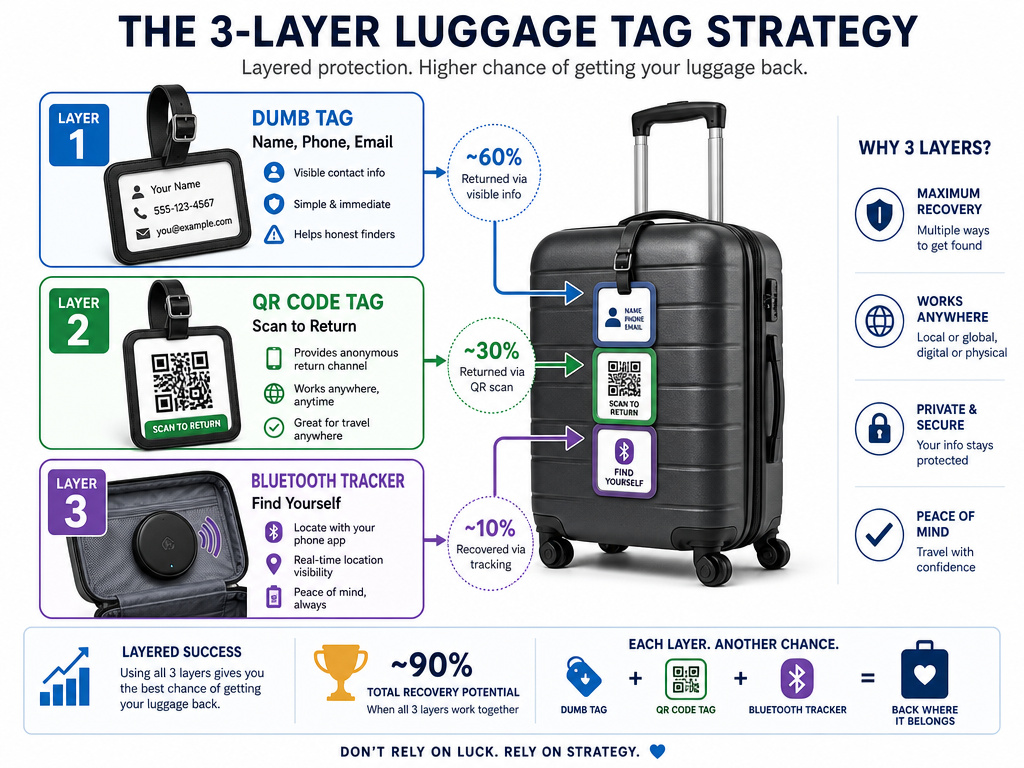
A traditional tag is “dumb”, it just sits there with your information. A “smart” tag adds a digital layer. The two aren’t mutually exclusive; they work best in tandem. Your choice depends on what failure mode you’re guarding against.
Bluetooth Trackers (Apple AirTag, Tile): These are find-yourself devices. You get a location on your phone. They’re brilliant for knowing your bag is still at the airport while you’re in a taxi, or that it’s on the wrong carousel. They do nothing to help a baggage agent or a honest finder return the bag to you. The agent has no way to scan it.
QR Code Tags (Forge TSID, Dynotag): These are return-to-me devices. The tag has a unique QR code. When scanned with any smartphone camera, it leads to a secure webpage where the finder can report the bag found. That report triggers an immediate email and text alert to you, without the finder ever seeing your personal details. No app, no battery, no signal broadcast.
The most resilient setup uses all three layers: 1. A durable, external “dumb” tag with your core name/phone/email. 2. A QR-code tag as a secondary external or internal tag. 3. A Bluetooth tracker placed inside the bag’s lining.
This covers the major failure scenarios: a torn-off tag (QR code), a lost bag in a dead zone (Bluetooth last location), and an agent needing instant info (readable text). It’s the same principle as using both a belt and suspenders, but for your suitcase’s identity.
How to Actually Write It (The Tools)
Handwriting is the weak link. Smudges, poor pen choice, and shrinking script over time make tags hard to read. Upgrade your process.
For Permanent Info: Use a fine-point permanent marker (like a Sharpie) on the paper insert before you slide it into the plastic window. Let it dry for 60 seconds. For a truly permanent solution, order a metal tag with the information laser-etched.
For Trip-Specific Info: Use a label maker. Print the destination city/hotel and dates on a small white label and stick it on the concealed side of your tag insert. After the trip, you peel it off. No outdated information, no crossed-out lines.
The Professional Method: Create a digital template. Use a simple word processor to set up a table with your name, phone, email, and secondary contact. Use a large, sans-serif font like Arial or Helvetica at 14-point size. Print it on heavy cardstock, cut it to size, and laminate it with packing tape before sliding it into the tag. This is the clearest, most durable option for your luggage tag information.
Where this goes sideways: Writing with a ballpoint pen on the insert while it’s already inside the plastic sleeve. The tip indents the plastic, creating a blurry, shiny patch that’s impossible to read under airport lighting. Always write on the paper first, then insert.
Special Scenarios and Edge Cases
Standard rules bend under specific pressure. Your tag strategy should adapt to the trip.
International Travel: The country code on your phone number is non-negotiable. Consider adding a second email address. Be aware that some countries have specific airline rules for duffles or checked baggage that might affect how your bag is handled.
Cruises: Your “destination” is the ship, which moves. Use the cruise line’s name and your departure port city on the concealed layer. The cruise line has a manifest and will hold bags for arriving passengers.
Long-Term Travel (Months): Your tag information must be stable for the entire duration. A secondary contact back home who can relay messages becomes critical. A QR-code tag shines here, as the webpage it links to can be updated with your current location as you move.
Group/Family Travel: Put a single point-of-contact phone number on all tags (e.g., one parent’s mobile). On the concealed layer, list all family members’ names. This simplifies the agent’s job, one call coordinates the return of multiple bags.
The bottom line for any edge case: your tag must close the loop between a stranded bag and a human who can act. The more complex the trip, the more you need that secondary contact and the clearer your primary number needs to be.
Frequently Asked Questions
Should I put my address on my luggage tag?
No. An airline will not mail your lost bag to your home. They will hold it at an airport baggage service office for you to pick up or forward it to your destination airport. Your address provides no recovery benefit and significant privacy risk. Use your phone and email instead.
Is it safe to put my email on a luggage tag?
Yes. An email address is a low-risk, high-reward field. It doesn’t reveal your location or identity beyond your name. It provides a reliable, free way for an airline to contact you if your phone is unreachable. Use a dedicated travel email if you’re concerned about spam.
What is the best type of luggage tag to buy?
Look for a tag with a metal attachment loop, a thick plastic or leather body, and a fully sealed plastic window. Brands like Travelpro Essentials make durable leather tags with privacy flaps. For a tech layer, a QR-code tag like the Forge TSID provides a secure, battery-free return system.
Can I just use an AirTag and skip the physical tag?
No. An AirTag helps you find your bag, but it does not help an airline or a good Samaritan return it to you. Baggage handlers have no way to scan or interact with an AirTag. A physical tag with your contact information is a mandatory backup.
How often should I update my luggage tag information?
Check it before every trip. Ensure the phone number is current and the secondary contact is still valid. Remove any old destination labels from previous trips. The core information (name, permanent phone, email) only needs updating if those details change.
Before You Go
Your luggage tag is a simple tool with a single job: get your bag back to you when the primary system fails. That job is done with three lines of text, name, phone, email, written clearly on a tag that won’t fall off. Conceal your destination details. Add a QR-code tag for a silent, smart backup. And always, always put a second information sheet inside the bag itself.
The goal is to communicate precisely with the person who needs the information, and no one else. A bright, sturdy tag with the right data is a functional piece of plastic.It’s the fastest path off the lost-and-found cart and back to your hands.