Luggage Tags: What to Put on Them and Crucial Privacy Tips
This post contains affiliate links. As an Amazon Associate, we earn from qualifying purchases.
Put your full name, a reachable phone number with country code, and an email address on your luggage tag. Do not include your home address, passport number, or social media handles. Use a tag with a privacy flap, place a second contact card inside your bag, and remove all old airline barcode tags before checking in.
That tag you clip to your suitcase isn’t the primary way your bag finds its flight. The airline’s own 10-digit barcode tag does that job, scanned by Automated Tag Readers along miles of conveyor belts. Your personal tag is the backup system for when that automated routing fails, when the barcode is damaged, an old tag confuses the scanner, or the bag falls off a cart airside and sits for hours.
What you write on that backup tag decides whether a lost bag comes back to you in a day or becomes a permanent mystery. It also decides who else can read your details while your bag circles a carousel.
Key Takeaways
- The airline’s barcode tag routes your bag; your personal tag is for recovery when that system fails. An old barcode tag from a past trip can misroute your bag.
- Essential info is name, phone (with country code), and email. A home address provides no routing benefit and is a security risk.
- Use a tag with a privacy flap or concealed info panel. Always place a second contact card or label inside the main compartment.
- Remove all old airline stickers and tags before each flight. If the new barcode tag looks smudged or torn at check-in, ask for a reprint.
- Smart trackers like an Apple AirTag work alongside a physical tag, not instead of one. They tell you where your bag is, but airline staff still need a way to contact you.
The Two Tags on Your Bag (And Why One Matters More)
Your checked suitcase carries two forms of ID. The first is the airline barcode tag, a 10-digit license plate the agent attaches at check-in. The second is whatever personal tag you’ve added.
The airline barcode tag is the primary actor. Its barcode contains your flight information, final destination, and connection airports. Automated Tag Readers (ATRs) mounted on conveyor systems scan this code to sort and route your bag. This process is defined in industry standards like the IATA Baggage Reference Manual.
Your personal luggage tag is the understudy. It sits idle unless the main system fails. That failure has specific, documented causes: a damaged barcode, a bag falling off a transport cart, or, critically, an old barcode tag from a previous trip confusing the scanner.
Common mistake: Leaving old airline tags on your bag. The ATR might scan the stale barcode and route your bag to a destination from a trip you took six months ago. This is one of the most preventable causes of misrouted luggage.
Delta Airlines has embedded RFID chips in their barcode tags since 2016 for more reliable reading, but the optical barcode is still the universal fallback. You can’t control the print quality of this tag, but you can protect it. Don’t stack heavy items against the tag side of your bag in the suitcase. If the tag looks smudged, torn, or illegible after the agent attaches it, ask for a new one on the spot.
The 3 Essential Lines (and 2 Lines to Skip)
Your tag needs just enough information for a person, an airline recovery agent, a hotel concierge, a finder, to contact you directly. It does not need information for the automated system. That distinction rewrites the old rules.
Here is what belongs on the front of your tag, in this order.
Line 1: Your Full Name
Use the name on your ticket and passport. “M. Smith” isn’t helpful if the manifest says “Margaret Smith.” Airlines match found bags to passenger manifests by name. If you have a common name, consider adding a middle initial.
Line 2: Mobile Phone Number with Country Code
Use a number you can answer while traveling. Include the plus sign and your country code (+1 for US/Canada, +44 for UK, etc.). This is the fastest way for anyone who finds your bag to make contact.
Line 3: Email Address
This is your secondary contact channel. Some travelers create a dedicated email for travel to keep primary inboxes separate and minimize phishing risk. It’s a valid, persistent way to receive a message if your phone is off or out of service.
Now, here is what you should never write on an external tag.
Skip: Your Home Address
It provides zero benefit for bag recovery. Airlines route via the barcode, not your address. It also advertises that your house is empty to anyone who handles your bag. If you feel you must include an address, use your destination hotel or a business address, but know it’s not necessary.
Skip: Passport Number, Driver’s License, or Social Security Number
These are identity-theft gold and serve no purpose for bag return. No airline employee will ask for your passport number to reunite you with a suitcase.
Where this goes sideways: A tag cluttered with unnecessary details. A recovery agent processing a hundred bags an hour needs to see your contact info instantly. A tiny, handwritten home address underneath three other lines gets missed. Keep it clean.
| Put This On | Why It’s Needed | Skip This | Why It’s a Risk |
|---|---|---|---|
| Full Name | Matches airline passenger manifest for verification | Home Address | Security risk; provides no routing benefit |
| Mobile Phone (with country code) | Direct, immediate contact method | Passport / ID Numbers | Identity theft; unnecessary for recovery |
| Email Address | Secondary contact if phone is off/unreachable | Detailed Travel Itinerary | Privacy risk; itinerary can change |
| (Optional) Destination City | Helps ground staff understand the bag’s intended location | Social Media Handles | Links your physical belongings to your digital life |
A final, non-negotiable step: place a second contact card or label inside your bag, on top of your belongings. External tags tear off. If both the barcode and your external tag are gone, this internal slip is the only way to link the bag to you.
Choosing and Using the Right Physical Tag
The tag itself matters as much as the info on it. A flimsy paper tag in a downpour is useless. Your goal is durability and controlled privacy.
Look for tags with a privacy flap or a design where the information is concealed inside a sleeve or under a cover. This prevents casual observation of your details on the carousel. Brands like Travelpro offer leather tags with protective flaps, while many silicone or plastic tags have a snap-shut window.
The attachment method is critical. A loose loop on a handle can snag and tear. A secure belt-style tag or one that uses a durable, locking plastic strap is better. When attaching a tag, make sure it’s fastened to a structural part of the bag, like a reinforced handle loop, not a decorative strap that could rip.
For best luggage tags, materials rank like this: metal (aluminum, stainless steel) > thick leather > rigid plastic > flimsy plastic > paper. Metal tags are nearly indestructible but can be noisy. Leather molds to your bag and ages well. The right choice balances durability, privacy, and how easily you can update the info inside.
Smart tags with QR codes are a growing category. They don’t broadcast a location like an AirTag. Instead, when scanned, they direct the finder to a secure online form that notifies you via email or SMS. This keeps your personal details off the physical tag entirely. They work as a high-tech version of the internal contact card.
Smart Trackers vs. Physical Tags: The Partnership
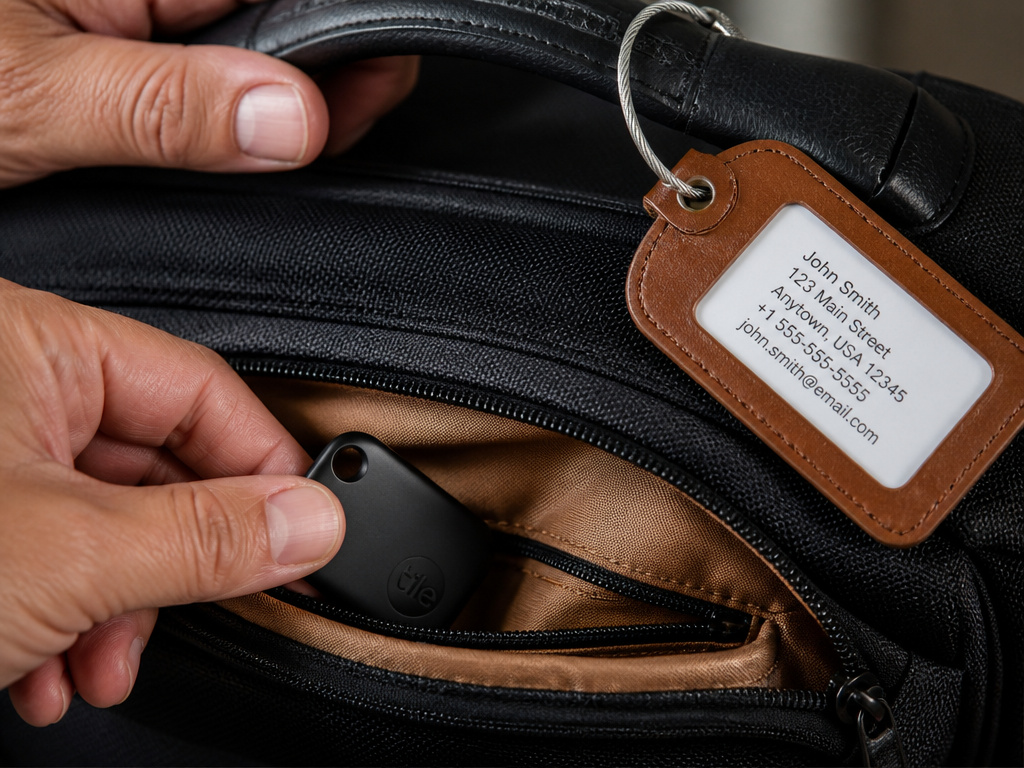
An Apple AirTag, Tile, or Chipolo is not a luggage tag. It’s a location beacon. These devices tell you where your bag is, but they don’t tell airline staff how to call you.
The partnership is powerful. A tracker can show you your bag never left the departure airport, saving hours at the arrivals carousel. It can show it’s sitting in a baggage office across the terminal. But if your bag is found in a lost-and-found room with a dead tracker battery and no physical tag, the staff has no way to start the return process.
The part nobody mentions: Trackers are most valuable for the “where is it?” panic in the first 24 hours. Physical tags are forever valuable for the “who does this belong to?” question that comes after.
Use both. Slip the tracker inside a zippered pocket or interior compartment. Keep your physical tag with clear contact info on the outside. This two-layer system covers the two main failure scenarios: the bag being lost in the system, and the bag being found but orphaned.
Special Cases and Edge-Country Rules
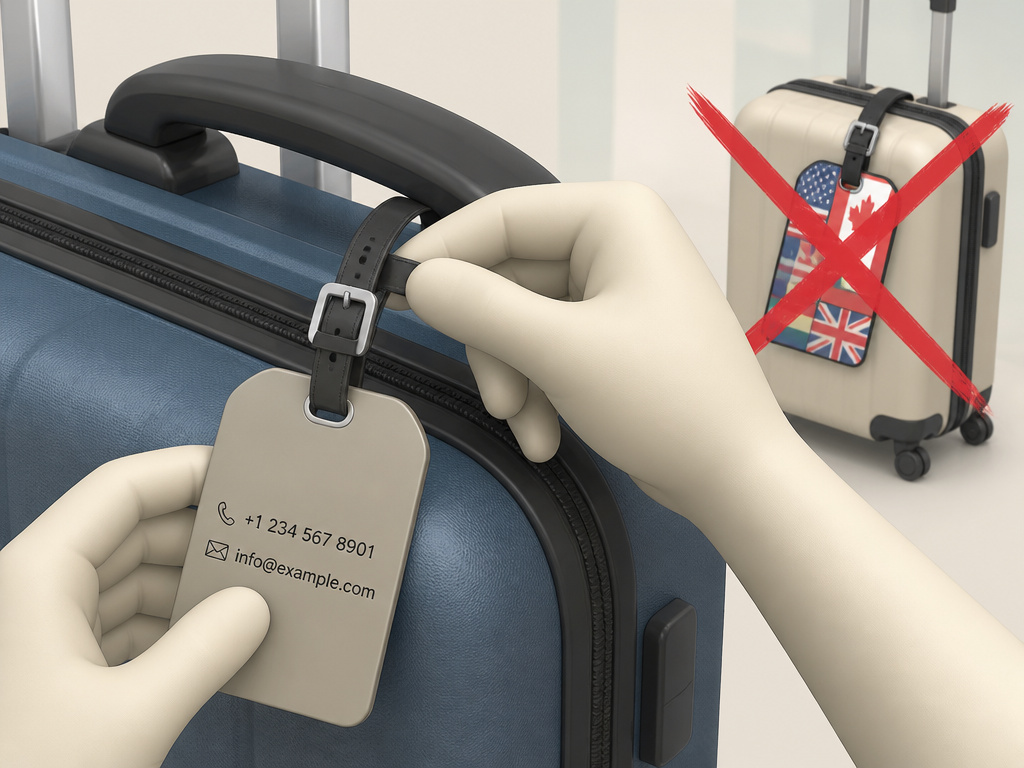
Some travel scenarios tweak the standard advice.
Traveling with Children
Avoid putting your child’s full name on an external tag. Use your own name and contact details. This maintains their privacy and ensures any communication about the bag goes to you, the responsible adult.
International Travel to Sensitive Regions
Be mindful of tags that broadcast your nationality, such as flag motifs or “USA” insignia. In areas with political tensions, this can make your bag a target for additional, unwanted scrutiny or theft. Neutral, generic tags are safer.
Carry-On Bags That Get Gate-Checked
You should tag your carry-on luggage exactly like checked baggage. If the flight is full and your cabin bag is taken at the gate, it enters the checked baggage system with the same risks. A tag speeds its return if separated.
The “Itinerary Inside” Debate
Some sources suggest placing a copy of your itinerary inside your bag. The theory is that if all tags are lost, staff will know your destination. The risk is that itineraries change, and an old one creates confusion. A simple card with your name, phone, email, and destination city (e.g., “Bound for: Paris”) is safer and sufficient.
Frequently Asked Questions
Should I put my work phone or personal phone on my luggage tag?
Put the number you are most likely to answer while traveling, regardless of time zones. If that’s your personal cell, use that. If you’ll have your work phone on and checked, that’s fine. The key is reachability.
Is it safe to use a QR code luggage tag?
Yes, provided the QR service is from a reputable company. A QR tag that links to a secure, password-protected profile where you control the visible information (e.g., only your name and an email) can be more private than a traditional tag. It removes your phone number from public view entirely.
What’s the best pen to use for writing on a luggage tag?
Use a fine-point permanent marker (like a Sharpie) on paper inserts. Ballpoint pen ink can smudge. For tags where you write directly on plastic or metal, an oil-based paint pen is more durable. The goal is legibility that survives humidity, rain, and friction.
Do I need a tag if my suitcase has a built-in tracker?
Yes. The tracker is for you. The tag is for everyone else in the baggage handling chain who might need to identify the owner without special apps or devices. Always have a physical tag as the universal fallback.
How many luggage tags should I put on one bag?
One well-secured, high-quality external tag is enough. The priority is a single, clear, durable point of contact. Clipping on three different tags creates clutter, increases snag points, and looks desperate. Invest in one good one and back it up with the internal card.
Before You Go
Your luggage tag is a simple tool with a complex job. It bridges the gap between a fully automated system and human error. Write the three lines that matter: your name, your reachable phone number, your email. Hide that info behind a flap. Strip off last trip’s airline stickers. Slide a second contact card inside your bag.
That’s the system that works. It doesn’t rely on the airline’s technology being perfect. It doesn’t assume your bag will never be alone in a corridor. It just makes sure that if your suitcase ends up anywhere but at your feet, the person who finds it knows exactly how to get it back to you.