The Biggest Carry On Luggage Size: Airline Rules Explained
This post contains affiliate links. As an Amazon Associate, we earn from qualifying purchases.
The biggest carry-on luggage size is not a single number. It depends on the airline, aircraft, and fare class. The most widely accepted limit for US domestic flights is 22 x 14 x 9 inches (56 x 36 x 23 cm), while the strictest global airlines cap at 55 x 38 x 20 cm. The International Air Transport Association (IATA) recommends a voluntary maximum of 56 x 45 x169 cm (22 x 17.7 x 9.8 in), but airlines set their own enforceable rules.
That 22 x 14 x 9 inch figure is a baseline, not a guarantee. It works for Delta, American, United, JetBlue, and Alaska. Step outside those carriers, or onto a smaller regional jet, and your bag might need to shrink.
What follows: the ISO standard that explains why bags have minimum weights, a data-driven breakdown of the strictest and most generous airlines, and the one measurement mistake that triggers a gate-check fee every time.
Key Takeaways
- No single “biggest” size exists. Your airline’s published policy is the only rule that matters.
- Enforcement tightened in 2026. Gate agents now use physical sizer boxes routinely, especially on budget and European carriers.
- The ISO standard sets a 2kg (5lb) minimum. Bags lighter than this can jam automated baggage systems.
- Frontier and Southwest allow the largest US carry-ons. Emirates and Air Senegal enforce the smallest global dimensions.
- Measure packed, including wheels and handles. An empty bag’s dimensions are irrelevant.
The Global Standard Isn’t Just One Number
You will read that the standard is 22 x 14 x 9 inches. That’s true for a specific set of major US airlines. It is false for the planet.
The real answer lives in layers. There’s the IATA’s voluntary guideline, the FAA’s safety-driven stowage rules, and the ISO’s engineering specification for baggage conveyor belts. Your carry-on has to satisfy all three to move through an airport without manual intervention.
The International Air Transport Association (IATA) recommends a maximum carry-on size of 56 cm × 45 cm × 25 cm (22.0 in × 17.7 in × 9.8 in) including wheels and handles. This is a voluntary guideline for airlines, not a regulation. Individual carriers set their own enforceable limits, which are often smaller.
IATA’s “Cabin OK” initiative tried to push a smaller, universal 55 x 35 x 20 cm standard a few years back. It failed. Airlines didn’t adopt it uniformly, and travelers rebelled. So we’re left with a patchwork.
The FAA carry-on baggage advisory circular, AC 121-29B, doesn’t give a number. It tells airlines how to design a program that ensures bags don’t block aisles, overhead bins close without force, and nothing falls out when bins open. The FAA’s concern is weight, balance, and evacuation paths, not your bag’s brand.
The engineering layer is ISO 12604-1:2017. This standard specifies dimensions and mass for baggage so it works with automated handling systems worldwide.
Why Your Bag Has a Minimum Weight
Most guides talk about maximums. The ISO standard talks about a minimum: 2 kg (about 5 lbs).
Where this goes sideways: A carry-on bag lighter than 2 kg (5 lb). According to ISO 12604-1:2017, very low-mass baggage can hamper the functioning of automated baggage handling equipment. The system’s rollers and sensors are calibrated for a certain weight; an ultralight bag might not trip the sensors and can get stuck or misrouted.
This is why a near-empty backpack or a small duffel can be a problem in checked baggage systems. It’s less relevant for pure carry-ons, but it reveals the airport’s mechanical reality. Your bag isn’t just personal property; it’s a physical object moving through an industrial machine.
The same ISO document notes that pieces exceeding the standard dimensions may require an “outsize baggage circuit” in the terminal. This is the manual-handling lane for skis, golf bags, and yes, oversized suitcases. It’s slower and increases the risk of damage.
Airline Carry-On Size Limits: The 2026 Dataset
Forget averages. You need the edges: the strictest and most generous airlines. The Packzup dataset from June 2026 covers 109 airlines. It shows the spread is wider than most travelers assume.
| Airline | Region | Carry-on Dimensions (cm) | Carry-on Dimensions (in) |
|---|---|---|---|
| Air Senegal | Senegal | 55 × 38 × 20 | 21.7 × 15 × 7.9 |
| Emirates | UAE | 55 × 38 × 20 | 21.7 × 15 × 7.9 |
| Frontier Airlines | USA | 61 × 46 × 25 | 24 × 18.1 × 9.8 |
| Southwest Airlines | USA | 61 × 41 × 27 | 24 × 16.1 × 10.6 |
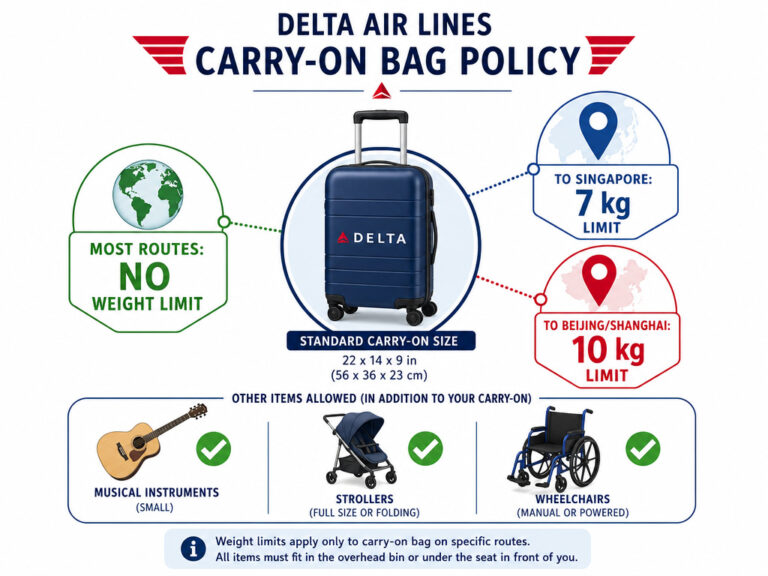
| Delta Air Lines | USA | 56 × 35 × 23 | 22 × 13.8 × 9.1 |
The table makes the point visually. Flying from Dubai to Dakar? Your biggest carry-on luggage size allowed shrinks dramatically. Hopping from Denver to Dallas on Frontier? You get an extra two inches in height and width.
The 10 strictest airlines all share the 55 x 38 x 20 cm limit. This club includes Emirates, Ethiopian Airlines, flydubai, Royal Air Maroc, and others primarily in the Middle East and Africa.
The 10 most generous are led by Frontier (24 x 18.1 x 9.8 in) and Southwest (24 x 16.1 x 10.6 in). After them, a group including Spirit, Allegiant, Thai Airways, and easyJet allows 22 x 17.7 x 9.8 inches.
Common mistake: Assuming “US airline” means “big bag friendly.” Alaska and Hawaiian Airlines are US carriers with stricter limits (22 x 14 x 9 in). Hawaiian also enforces a 25 lb weight limit for carry-ons.
How Airlines Actually Measure Your Bag
They use a metal sizer box at the gate. The bag must fit inside without force. The Wikipedia guide to hand luggage notes that enforcement intensity varies, but the tool is universal.
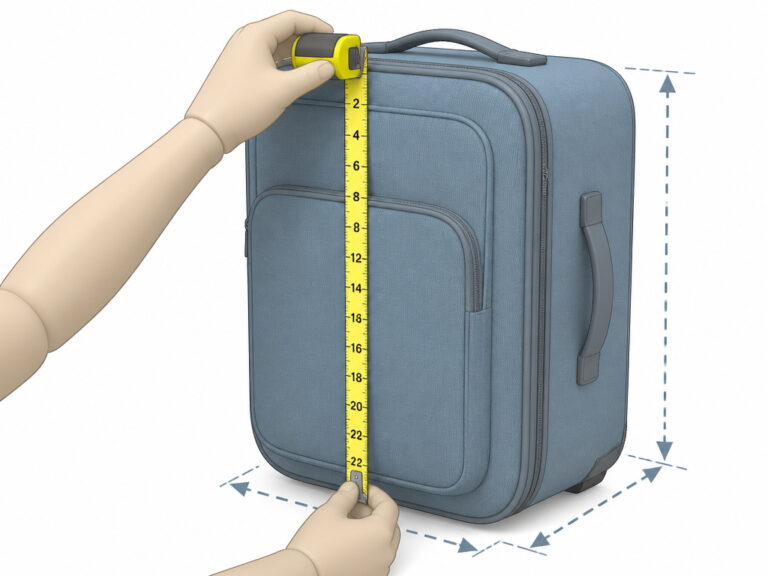
Height is measured from the bottom of the wheels to the top of the extended handle. Width includes any side pockets or compression straps that bulge out. Depth is front to back, fully packed.
This is the step people get wrong. They measure their bag empty, at home, without the wheels. At the gate, a packed bag is wider, the handle adds an inch, and the wheels add another two. That’s the difference between a pass and a $65 gate-check fee.
Measure your bag packed. Then add an inch to each dimension for real-world squish. If you’re at 23 x 15 x 10, you’re over for every major US airline except Frontier and Southwest.
The 45L vs 62L Reality: What “Biggest” Actually Carries

Luggage brands advertise volume in liters. A 45L carry-on holds about a week’s worth of careful packing. A 62L “expandable” bag might hold two weeks’ worth, if you can get it into the cabin.
The Travelpro Maxlite 5 International Expandable Rollaboard is a 45L bag. Its dimensions are 21.75 x 15.75 x 7.75 inches. Travelpro explicitly states it’s “sizer bin tested” for most US airlines, but warns the expanded version may not meet restrictions.
The DELSEY Cadence Carry-On Plus Expandable Spinner doesn’t publish its volume, but its dimensions are in the same 22-inch range. It includes an expansion zipper.
The part nobody mentions: Expansion zippers add about 2 inches of depth. That’s enough to push a compliant bag over the carry-on luggage size limit. Use the expansion only if you’re certain you won’t face a sizer, or if you’re willing to check the bag.
The maximum size for carry-on isn’t about finding the bag with the highest liter count. It’s about finding the bag whose external dimensions match your most frequent airline’s sizer box, and whose internal layout maximizes every cubic inch.
Clamshell designs waste space on the hinge side. Soft-sided bags can bulge. Hard-sided polycarbonate doesn’t give. Your goal is a bag that fits the sizer with the lid closed easily, every time.
How to Choose Your Actual Biggest Bag
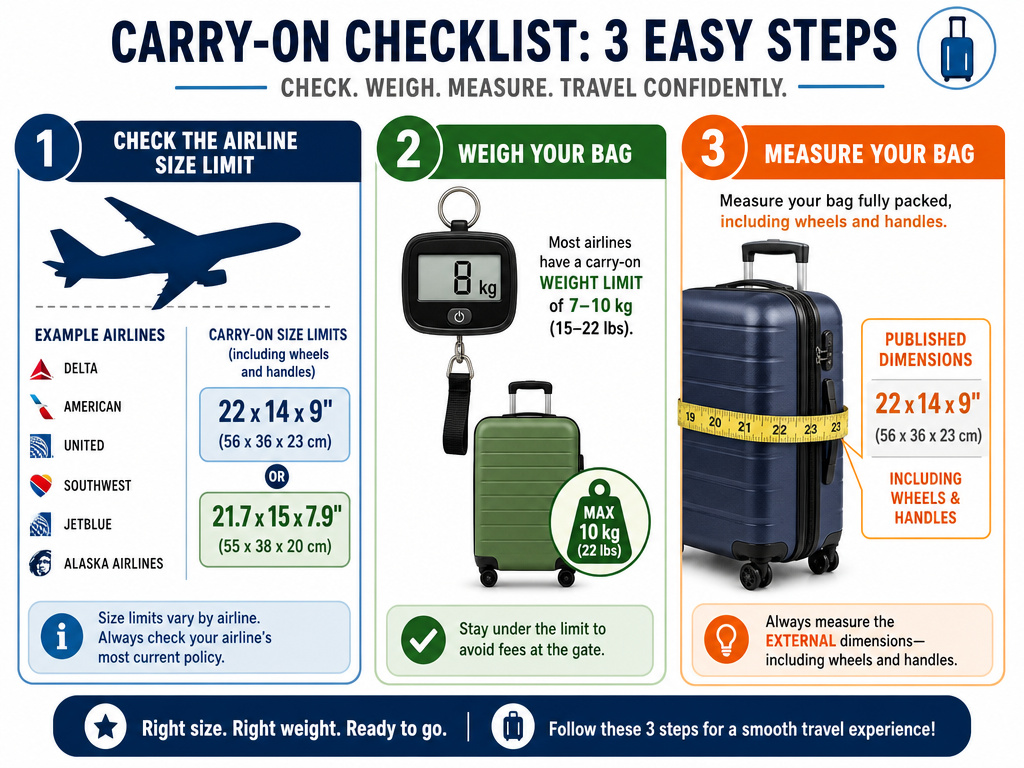
First, list the airlines you fly most. If your travel is mostly domestic US on majors, target 22 x 14 x 9 inches. If you fly internationally, especially to the Middle East or Africa, assume 21.7 x 15 x 7.9 inches is your largest carry-on dimensions.
Second, decide on weight. Many Asian and European airlines have carry-on size limits paired with a 7-10 kg (15-22 lb) weight cap. A heavy bag that meets dimension limits can still be rejected.
Third, pick a specific model. Don’t shop for “a carry-on.” Shop for the Travelpro Maxlite 5 or the DELSEY Cadence. Know its published dimensions including wheels and handles. Check current reviews on Amazon for real-world fit reports.
Here are the three tools you need: 1. A fabric tape measure. Check your bag packed. 2. A luggage scale. Verify you’re under weight limits. 3. Your airline’s official baggage policy page. Do this two days before departure, rules change.
Skip the “expandable” feature if you fly a mix of airlines. The extra space is a trap. It tempts you to overpack, and an overpacked bag never fits the sizer.
The One Measurement That Matters Most
It’s not height or width. It’s linear inches, the sum of height, width, and depth.
Airlines like Delta, American, and Southwest use this metric. Delta’s limit is 45 linear inches. A bag measuring 22 x 14 x 9 inches adds up to exactly 45 linear inches. This is the mathematical proof of the US standard.
Calculate your bag’s linear inches. If the number is 45 or less, you’re likely safe on most US full-service carriers. If it’s 46 or more, you’re in the zone where a strict gate agent might pull you aside.
Frequently Asked Questions
Is a 24-inch suitcase a carry-on?
Usually not. A 24-inch suitcase typically exceeds the 22-inch height limit once wheels and a handle are added. It will be forced into the sizer at the gate and likely rejected. Treat a 24-inch bag as checked luggage.
Do airlines ever allow slightly bigger carry-ons?
Sometimes, on a half-empty flight with spacious overhead bins. This is discretionary, not policy. Do not board expecting grace. Assume the sizer box is the final judge.
What is the biggest carry-on luggage size for European airlines?
It varies wildly. EasyJet allows 56 x 45 x 25 cm. Ryanair’s standard free allowance is much smaller at 55 x 40 x 20 cm. You must check the specific airline; “European” isn’t a category.
Can a duffel bag be a carry-on?
Yes, if it meets the dimension rules. Soft duffels can often be squished into a sizer, but if they’re overstuffed, they become rigid and won’t fit. A duffel’s flexibility is an advantage until it isn’t.
What happens if my carry-on is too big at the gate?
The airline will gate-check it for a fee, usually $60-$100. Your bag goes into the cargo hold, and you pick it up at baggage claim. This defeats the main purpose of carrying on.
Before You Go
The biggest carry-on luggage size is a moving target anchored by your airline’s metal sizer box. The data shows Frontier and Southwest offer the most room; Emirates and its peers offer the least.
Your job is simple: measure your bag packed, know your airline’s numbers, and leave the expansion zipper alone. The maximum carry-on dimensions are a ceiling, not a goal. Hitting that ceiling without a safety margin is how you end up paying a fee.
If you fly one airline repeatedly, buy the bag that fits their sizer with room to spare. If you fly many, buy the bag that fits the strictest airline on your list. That’s the real biggest bag, the one that always flies with you.