What Size Is a Large Suitcase | The 3 Numbers That Decide
This post contains affiliate links. As an Amazon Associate, we earn from qualifying purchases.
A large suitcase is typically 29 to 31 inches (74-79 cm) in height, 19 to 21 inches (48-53 cm) in width, and 12 to 14 inches (30-36 cm) in depth, offering a capacity between 95 and 120+ liters. These dimensions are a retailer category, not an airline standard, and always include wheels and handles. The exact fit for your trip depends on matching these exterior measurements to your airline’s linear-inch limit and the 50-pound weight cap.
That last clause is where trips get expensive. A suitcase can be the perfect size and still cost you a hundred dollars in overweight fees before you leave the curb.
What follows: the three numbers that define “large,” how to measure any bag correctly, and the material choice that decides whether you pack 15 outfits or hit the scale at 49 pounds.
Key Takeaways
- “Large” is a retailer label, not an airline rule. Always verify your bag’s linear dimensions (length + width + height) against your specific carrier’s checked-baggage limit.
- Measure from the wheels to the top of the retracted handle. Airlines count every protruding part, and an extra half-inch can push you into oversize territory.
- Capacity tells half the story. A 120L expandable bag filled with denim and shoes will hit 50 pounds long before it’s full. Packing light materials is the only way to use the space.
- Polycarbonate wins on weight. An aluminum case like the Monos Check-In Large weighs 16.8 pounds empty—a Samsonite Proxis in the same size class weighs 6.8 pounds. That’s 10 more pounds of clothes you can pack.
- Expandable zippers are for souvenirs, not for outbound packing. Using the full expansion on the way out almost guarantees an overweight bag.
The 3 Core Dimensions Every Brand Measures
You need three numbers: height, width, and depth. Manufacturers all measure the same way because airlines demand it.
Place the empty, closed suitcase upright on a flat surface. Measure from the floor (bottom of the wheels) to the top of the highest fixed handle or the top of the shell if the handle retracts. That’s the height. For width, lay the case on its side and measure from the floor to the highest point. For depth, lay it on its back and measure from the floor up.
This method includes every permanent protrusion. A telescoping handle must be fully pushed down. A soft front pocket that bulges when packed doesn’t count—until you get to the airport and it does. Assume the worst.
| Brand & Model | Exterior Dimensions (H x W x D) | Capacity (Liters) | Empty Weight |
|---|---|---|---|
| Away The Large | 29″ x 20.5″ x 12.5″ | 104 L | 12.1 lbs |
| Samsonite Proxis 75cm | 29.5″ x 20.1″ x 12.2″ | 98 L | 6.8 lbs |
| DELSEY Cadence Large | 31.25″ x 13″ x 19.75″ | 109 L | 11.9 lbs |
| TUMI 19 DEGREE Large | 29.9″ x 20.1″ x 11″ | 99 L | 12.1 lbs |
These are the exterior dimensions you’ll find on every product page. They are your starting point, not your finish line.
The next step is the airline’s math. Most U.S. Carriers use a “linear inch” limit for standard checked bags, usually 62 total inches. You add the height, width, and depth. The Away The Large comes to 62 linear inches exactly. The DELSEY Cadence, at 64 linear inches, is already over that common limit before you pack a sock.
Common mistake: Buying a bag based on its “large” label without checking the linear-inch sum. A bag that’s 31 inches tall often pushes the other dimensions over, resulting in a 64- or 65-inch total that triggers a $100+ oversize fee.
Always do the addition yourself. The retailer’s category is about marketing and comparison within their own lineup. The airline’s rule is about physics and fees.
Capacity in Liters vs. Outfits: The Packing Reality
A liter is a unit of volume. An outfit is a unit of hope. Manufacturers convert one to the other optimistically.
Away says its 104L Large holds 15-18 outfits. Samsonite says its 98L Proxis holds 10-15 outfits for 2-3 weeks. The difference isn’t just six liters—it’s the definition of “outfit.” A manufacturer’s outfit is a light summer dress and a cardigan. Your outfit might be jeans, boots, and a sweater.
The real constraint is weight, not volume. Fill a 120L expandable suitcase with the 15-18 outfits Away promises, and you’ll be at the 50-pound checked-baggage limit for most airlines. Probably over it.
Where this goes sideways: Using an expandable suitcase’s extra capacity on the outbound journey. The Away Large Flex adds 1.75 inches of depth when unzipped, boosting capacity to 115L. That space is for bringing things home. Pack into it on the way out, and you will exceed the weight limit. Every time.
Here is the practical translation. For a two-week trip: * 98-104L (Standard Large): Tight if you pack bulky items or shoes. Possible with careful capsule planning and wearing your heaviest items on the plane. * 110L+ (Expanded or Generous Large): Comfortable for two weeks with normal variety. You must still monitor weight. * 120L+ (Extra Large Category): For cold-weather travel with heavy coats or specialized gear. You will be playing weight tetris.
Capacity numbers help you compare suitcases against each other. They do not grant permission to fill every liter.
Polycarbonate vs. Aluminum: The Weight Trade-Off
The shell material decides your packing budget before you choose a single shirt.
Polycarbonate is a hard, flexible plastic. It absorbs impacts by flexing and popping back, and it’s light. The Samsonite Proxis 75cm large suitcase is built from a proprietary polypropylene called Roxkin™ and weighs 6.8 pounds empty. The Away The Large, in standard polycarbonate, weighs 12.1 pounds.
Aluminum is prestige and protection. It’s the material of premium cases like the Monos Aluminum Check-In Large. It won’t flex—it dents. And it’s heavy. The Monos large weighs 16.8 pounds empty.
That’s a ten-pound difference on the scale before you pack. Ten pounds is two pairs of jeans, three sweaters, and a pair of shoes. Or a hundred-dollar overweight fee.
| Material | Best For | Weight Penalty | Durability Reality |
|---|---|---|---|
| Polycarbonate | Most travelers, weight-conscious packers | Low (6-12 lbs) | Flexes on impact; may scratch but rarely cracks. |
| Aluminum | Frequent checkers who value prestige & max protection | High (14-18 lbs) | Develops a patina (dents and scratches); shows every journey. |
| Hybrid (Polycarb frame, aluminum corners) | Those seeking a middle ground | Moderate (10-14 lbs) | Protects vulnerable corners; still heavy. |
The choice is brutal. The aluminum case feels indestructible at the baggage carousel. It also forces you to pack 30% less to stay under 50 pounds. The polycarbonate case feels lighter when you lift it into your car and lets you pack more. It might arrive with a new scuff.
There is no best answer. There’s your priority.
Airline Limits: Linear Inches and the 50-Pound Wall

Your suitcase doesn’t travel in a retailer’s category. It travels under an airline’s policy.
First, the size gate. As outlined, most major U.S. Airlines (Delta, American, United) set a 62 linear-inch limit for a standard checked bag. International and budget carriers vary widely. Always check your airline’s “checked baggage” page the week you pack.
Second, the weight wall. The standard weight limit is 50 pounds. Cross it, and fees jump from $30-40 to $100-200. This is the number that makes capacity and material matter.
A fully packed Away Large Flex (115L capacity, 12.1 lbs empty) will hit 50 pounds with mostly casual clothes. The same volume in the aluminum Monos would hit 50 pounds when only two-thirds full.
Your packing strategy must start with the suitcase’s empty weight. Weigh your empty bag. Subtract that from 50. That’s your actual packing budget in pounds. It’s a much clearer number than liters.
Expandable Suitcases: A Feature, Not a Default

The expandable zipper is the most misunderstood feature in luggage.
It is not for packing more on the way to your destination. It is for packing the same amount more loosely, or for bringing back souvenirs, gifts, or dirty laundry that takes up more space.
When you expand a suitcase, you increase its depth. This often pushes the linear-inch total over your airline’s limit. You also create more space to fill, which directly leads to overweight fees.
The mechanics are simple. An expansion panel adds 1 to 2 inches of depth, which translates to 15-25 extra liters of capacity. That’s enough space for three to five extra sweaters or a few hardcover books. It’s also 5-8 extra pounds if you fill it with clothes.
Use the expansion zipper on the return trip, when you’re less concerned about precise packing and may have purchased items. On the outbound journey, keep it zipped. Treat the expanded capacity as emergency space, not planned volume.
How to Choose: The 5-Minute Suitcase Audit
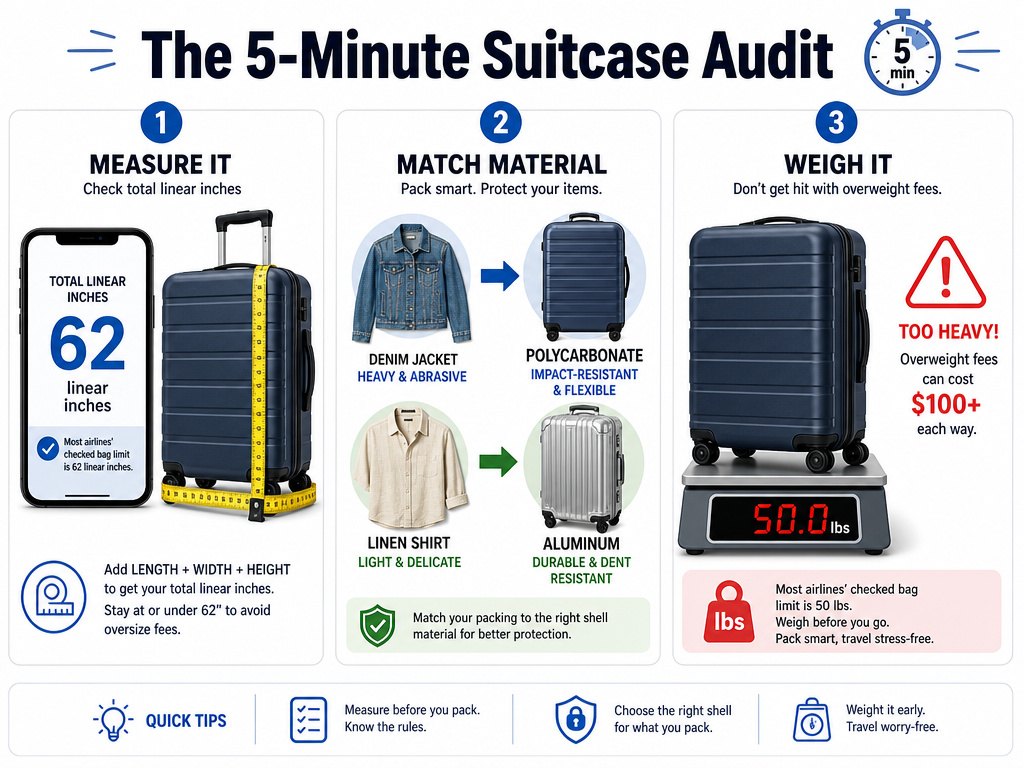
Stop looking at colors and reviews. Answer these three questions in order.
- What is my airline’s linear-inch limit? Find it. Write it down. This is your maximum exterior size.
- What is my packing style? Do you pack heavy fabrics (denim, wool) or light ones (linen, technical fabrics)? Heavy packers need a lighter empty suitcase (polycarbonate). Light packers can afford the aluminum premium.
- Is this for checked use only? If you’ll ever need to carry this bag fully packed, weight matters more than prestige. A 50-pound aluminum case is a hernia risk at a train station with no cart.
For most people making one or two checked-bag trips a year, a polycarbonate large suitcase is the default. The Samsonite Proxis 75cm or the Away The Large cover the need without drama. The Samsonite wins if every pound counts. The Away wins if you value its compression system and warranty.
For frequent travelers who check bags monthly, the calculus shifts. Durability under constant airline handling becomes paramount. The TUMI 19 DEGREE Large Expandable or a premium polycarbonate line like DELSEY’s Cadence offer better wheel systems and longer warranties for that beating. The aluminum Monos is for those who accept the weight penalty as the cost of ultimate shell protection.
Bottom line: Buy the lightest, most durable polycarbonate case that fits your airline’s size limit. You’ll never regret the extra packing weight it grants.
Frequently Asked Questions
Is a 28-inch suitcase a large?
Yes, a 28-inch suitcase is universally considered a large checked bag. Its dimensions will typically be around 28″ x 20″ x 12″, putting it at the smaller end of the large category with a capacity near 95-100L. It’s a good choice if you want a large suitcase but are concerned about hitting strict airline checked luggage size limits.
How many liters is a large suitcase?
Large suitcase holds between 95 and 120+ liters. Common models like the Away The Large have 104L, while expandable models like the TUMI 19 DEGREE go from 99L to 117L. This typical medium suitcase capacity is significantly less, usually around 70-90L.
What is the average large suitcase size?
The average large suitcase size is approximately 30 inches tall, 20 inches wide, and 13 inches deep. This results in a linear-inch total around 63 inches and a capacity near 105 liters. Remember, “average” doesn’t mean “approved”—always check your standard suitcase sizes against your specific airline.
Can a large suitcase be a carry-on?
No. A large suitcase is designed for checked baggage. Its dimensions far exceed any carry-on size limits, which are typically around 22″ x 14″ x 9″. A 24-inch suitcase is often the maximum size that might be considered a carry-on by some airlines, but even that is not guaranteed and is usually too big.
Is 62 linear inches a large suitcase?
Yes, 62 linear inches (the sum of height, width, and depth) is the maximum standard size for a checked bag on many airlines and squarely defines a large suitcase. Most large suitcase dimensions are designed to meet or come very close to this 62-inch limit.
Before You Go
A large suitcase is a container defined by three exterior measurements and a weight limit. The “large” label gets you in the ballpark. Your airline’s linear-inch rule and 50-pound scale decide the game.
Choose polycarbonate for weight, aluminum for prestige and dent resistance. Ignore the outfit estimates. Pack with your bathroom scale first. Use the expander for the trip home.
The right case fits the plane and leaves room for what you actually want to bring.