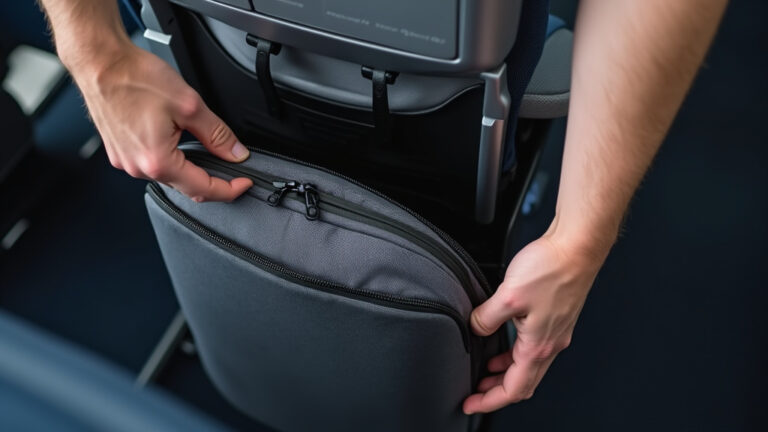
How Big Is a Carry-On Suitcase? The Size Chart
This post contains affiliate links. As an Amazon Associate, we earn from qualifying purchases.
A carry-on suitcase is typically 22 inches tall, 14 inches wide, and 9 inches deep (22x14x9 inches), which equals 45 linear inches. This size meets the base requirements for most major U.S. airlines like American, Delta, and United. The real answer, however, is your specific airline’s published limit, which can be smaller, especially on budget carriers and international flights.
Most people think buying a bag labeled “carry-on” guarantees it will fit. It doesn’t. Airlines change their rules, and gate agents have absolute discretion with a metal sizer box. You can follow every online guide and still get flagged if you miss the two measurements that aren’t on the tag.
This guide breaks down airline-specific size charts, explains how to measure correctly (wheels and handle included), and shows you how to navigate basic economy, international carriers, and the gate-check scramble. You’ll learn which type of luggage gets a forgiveness inch and the single most important page to check before every trip.
Key Takeaways
- The standard 22″x14″x9″ (45 linear inch) bag works for major U.S. carriers, but budget airlines like Spirit and Frontier enforce smaller limits, often 22″x18″x10″.
- Always include wheels and the extended handle in your measurements. A bag that’s 21″ without the handle becomes 23.5″ with it extended — and that’s the number that counts.
- Basic Economy tickets on American, United, and Delta often restrict you to one personal item only. You must pay a fee to bring a standard carry-on into the cabin.
- International carriers like Ryanair and EasyJet have strict linear inch limits (around 40-42″) and low weight limits (15-22 lbs). They also charge high fees for non-compliant bags.
- A soft-sided suitcase can often be squeezed into a sizer box, while a hard-sided case at the exact same dimensions might not fit if it’s rigid.
The Two Numbers That Actually Matter
You will see two measurement systems. Airlines use one or both.
The first is the H x W x D spec: height, width, depth in inches. American Airlines uses 22″ x 14″ x 9″. The height is almost always the most critical dimension because of the overhead bin’s shape. The second system is linear inches, the sum of those three numbers. Many international airlines use this, like British Airways’ 22″ x 18″ x 10″ bag being 50 linear inches.
Carry-on luggage dimensions are defined by each airline, not by a universal standard. The most common baseline in the United States derives from the maximum size that fits in a typical overhead bin, which the Federal Aviation Administration cites as 45 linear inches (22 x 14 x 9 inches). Individual carriers then impose stricter limits based on aircraft type and commercial strategy.
Forget the dimensions printed on your luggage tag. Those are marketing claims, not guarantees. Your only source of truth is the airline’s website. A bag sold as “carry-on compliant” might be 22.5″ tall, which immediately fails for any airline with a strict 22″ limit.
TL;DR: Your bag must meet your airline’s specific H x W D or linear inch limit. The 22″x14″x9″ (45″) standard is just a starting point.
How to Measure Your Suitcase (The Right Way)
Most people measure the main shell. That’s wrong. You measure every external protrusion.
Stand the suitcase upright and fully extend the telescoping handle. Measure from the bottom of the wheels to the top of the handle. That’s your height. For width, measure at the widest point, which is often the curved side panels. For depth, measure from the front face to the back, including any exterior pockets or compression straps that bulge when full.
I learned this the expensive way with a Travelpro Platinum Elite I trusted for years. At a Frontier gate, the agent pointed to the sizer. My bag was half an inch over because I had packed the expansion zipper open. The fee was $99 at the gate. I now measure every bag before I pack it, and I never use the expansion feature unless I’m checking it.
Here is the correct measurement sequence:
- Empty the bag. A full bag can bulge, adding inches.
- Extend the handle to its highest locked position.
- Use a rigid ruler or tape measure on a flat floor.
- Record all three numbers, then add them for the linear inch total.
Skipping any of these steps means your numbers are fiction. A bag that’s 21.5″ tall on the shell gains another 2.5″ with the handle up. That 24″ total will not fit in the sizer, no matter how you angle it.
Airline-by-Airline Size and Weight Limits
This is where generic advice fails. Budget airlines survive on bag fees, and their sizers are unforgiving. Major carriers are more lenient on size but may have hidden weight limits for international routes.
| Airline | Carry-On Size (H x W x D) | Linear Inches | Weight Limit | Personal Item Size |
|---|---|---|---|---|
| American | 22″ x 14″ x 9″ | 45″ | None (domestic) | 18″ x 14″ x 8″ |
| Delta | 22″ x 14″ x 9″ | 45″ | None (domestic) | Fits under seat |
| United | 22″ x 14″ x 9″ | 45″ | None (domestic) | 17″ x 10″ x 9″ |
| Southwest | 24″ x 16″ x 10″ | 50″ | None | 18.5″ x 13.5″ x 8.5″ |
| Spirit | 22″ x 18″ x 10″ | 50″ | 40 lbs | 18″ x 14″ x 8″ |
| Frontier | 24″ x 16″ x 10″ | 50″ | 35 lbs | 18″ x 14″ x 8″ |
| Ryanair | 21.7″ x 15.7″ x 7.9″ | 42″ | 22 lbs | 15.7″ x 9.8″ x 7.9″ |
| EasyJet | 22″ x 18″ x 10″ | 50″ | 15 lbs | 17.7″ x 14.9″ x 7.9″ |
Southwest is the notable outlier with a generous 50 linear inch limit. They don’t charge for checked bags either, so their policy is built for convenience. Conversely, Ryanair’s sizer is a precise metal cage. If your bag doesn’t slide in effortlessly, you’re paying.
Common mistake: Assuming “no weight limit” applies to your international flight — most U.S. carriers impose a 15-22 lb limit on transatlantic and transpacific routes, even in economy. Check the specific route rules.
The maximum carry-on size for one airline can be a violation for another. This is why checking the official airline carry-on rules page for your carrier is non-negotiable. The FAA traveler preparation page reinforces that these carry-on luggage limits are set by the airlines, not the government.
TL;DR: Southwest is most generous; Spirit/Frontier are strict on size; Ryanair/EasyJet are strict on size AND weight. Always verify for your specific route.
The Personal Item Loophole (And Its Limits)
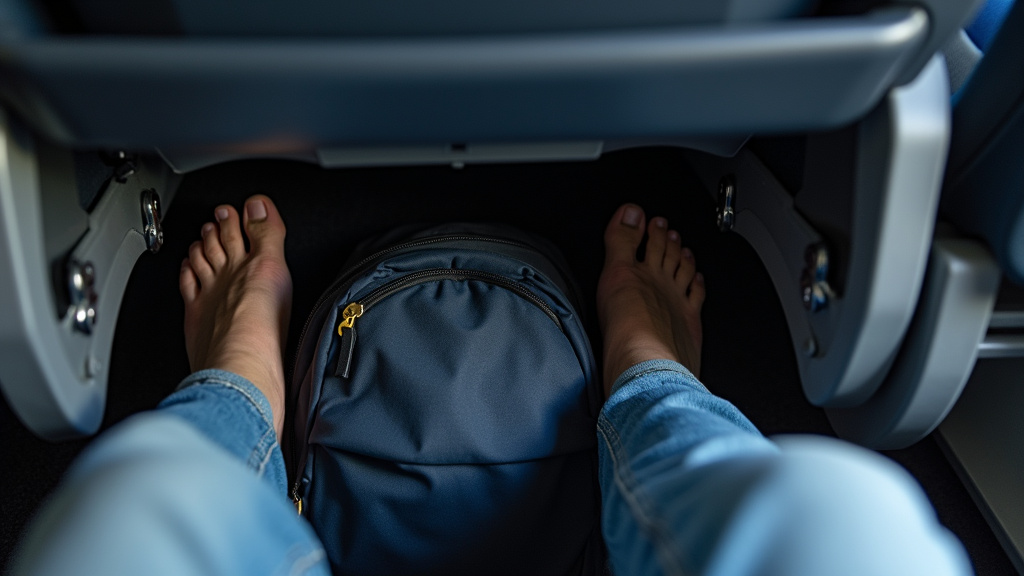
Your personal item is your backup plan. It must fit under the seat in front of you.
Airlines define this as a purse, laptop bag, or small backpack. The typical dimension ceiling is around 18″ x 14″ x 8″. This isn’t a suggestion. On packed flights, gate agents will make you prove it fits in a smaller sizer. A overstuffed backpack that can’t slide under the seat will force you to gate-check your main carry-on.
I use a 26L backpack as my personal item. It’s technically within the 18″x14″x8″ spec, but when fully packed, the depth pushes past 9 inches. On a Delta flight last year, the flight attendant asked me to stow it sideways because it was obstructing the footwell. It worked, but it was tight. Now I pack it three-quarters full.
Your personal item should hold your absolute essentials: medications, laptop, travel documents, a change of clothes. If the overhead bins fill up and your main suitcase gets gate-checked, you’ll be glad those items are with you. This is a core part of any savvy carry-on luggage size strategy.
When Basic Economy Changes Everything
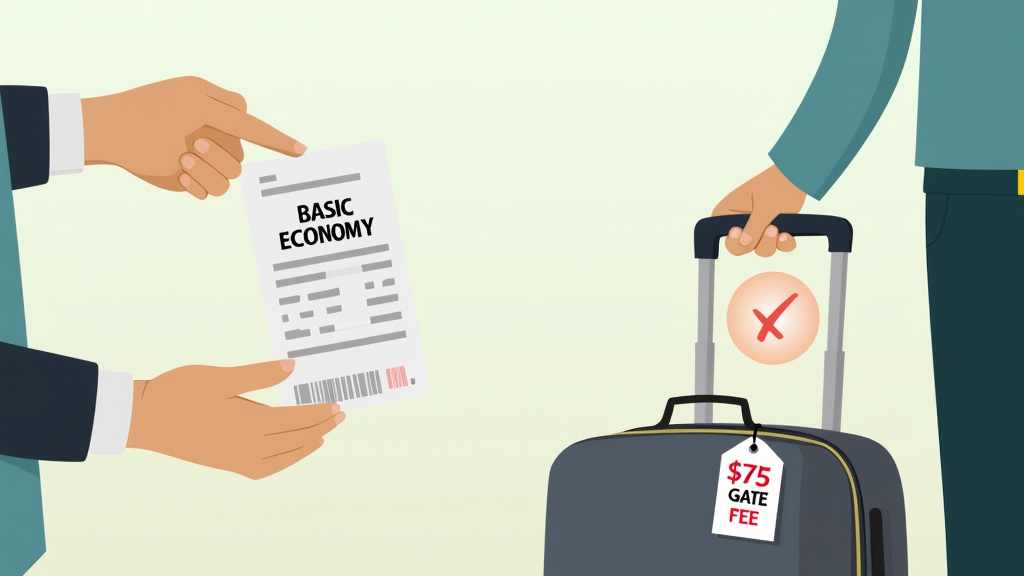
Basic Economy is a different product. On American, United, and Delta, it typically includes only a personal item.
You cannot bring a standard carry-on suitcase into the cabin unless you pay an additional fee at booking or at the gate (where it’s more expensive). This is the most common shock at the gate: passengers with a Basic Economy ticket and a rolling suitcase being told they owe $75. The agent isn’t being rude. You bought a ticket that explicitly excludes overhead bin access.
The way around this is to purchase a “carry-on bag” add-on during booking, which is usually $30-$60 round-trip. Or, upgrade to standard economy. Trying to sneak a full-size bag onto the plane is a guaranteed way to get flagged and charged the highest possible fee. Their systems highlight Basic Economy passengers on the manifest.
The Soft-Sided Secret
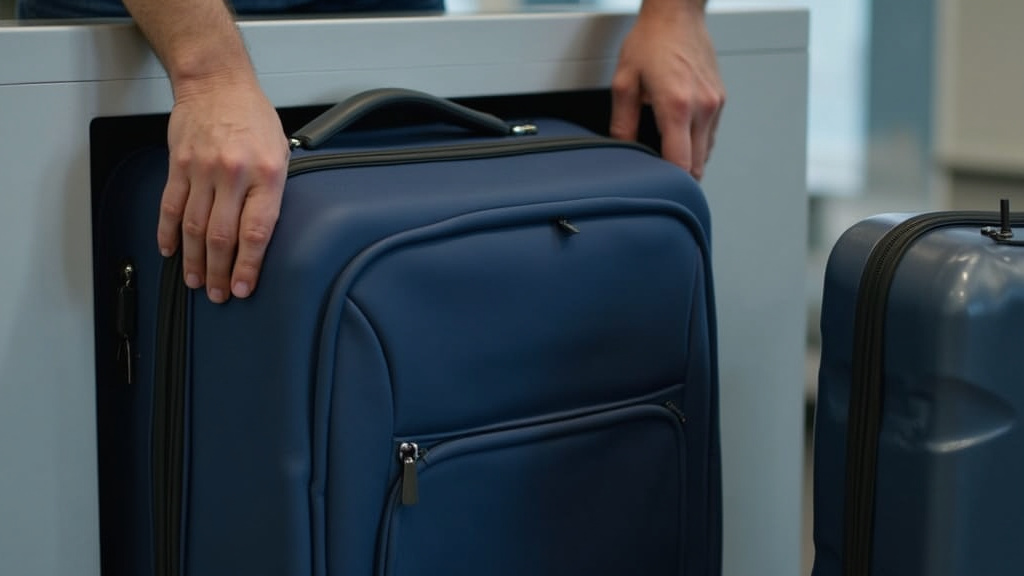
A soft-sided suitcase, like those from Travelpro or Briggs & Riley, has give.
A hard-sided polycarbonate case, like an Away or Monos, does not. If both are manufactured to the exact same 22″x14″x9″ dimensions, the soft-sided bag might compress by half an inch when pushed into a metal sizer. The hard-sided case will not. That half-inch is the difference between a nod from the gate agent and a credit card transaction.
This isn’t cheating. It’s using material physics to your advantage. The carry-on size parameters assume a rigid object. A fabric shell with a flexible frame can conform to the sizer’s shape, much like how a standard carry-on dimensions chart can’t account for real-world compression. This is a key detail often missed in generic carry-on bag dimensions guides.
I prefer a soft-sided carry-on for tight-rule airlines like Frontier. The slight compression has saved me from fees twice on flights out of Denver. The hard-sided case stays home for trips on Southwest or when I’m checking a bag.
International Carriers: A Different Game
European and Asian airlines are stricter. They enforce both size and weight, often at lower limits.
Ryanair’s priority boarding fee (which includes a carry-on) gets you a 22 lb bag that must fit their sizer. Non-priority passengers are limited to a tiny under-seat bag. They weigh and size at the gate aggressively. I’ve seen people repacking their bags on the jet bridge, transferring heavy items to their coat pockets.
The weight limit is the killer. A typical packed 22″ rolling suitcase easily hits 25-30 lbs. You must pack lighter or be prepared to pay. These airlines treat bag fees as a core revenue stream, not a nuisance charge. Their carry-on size allowances are a contract. Violate it, and you will pay.
What Happens If Your Bag Doesn’t Fit?
You will be gate-checked. This isn’t the end of the world, but you need to know the process.
The gate agent will tag your bag and take it from you at the jet bridge. It will travel in the aircraft’s cargo hold and be returned to you on the jet bridge at your destination (not at the baggage carousel). You must remove any items you need during the flight before handing it over, including medications, electronics, and valuables. Gate-checking is free on most major airlines, but budget carriers may charge a fee even at this stage.
The risk is that a gate-checked bag is handled more roughly than a normally checked bag. It’s also the last bag loaded, which sometimes means it’s the first one unloaded. But not always. I had a gate-checked bag take 45 minutes to appear at a small regional airport because the ground crew had to unload the entire hold.
TL;DR: If you’re gate-checked, keep essentials in your personal item. The bag will (usually) meet you at the plane door at your destination.
Frequently Asked Questions
Can I bring a carry-on and a backpack?
Yes, on most full-service airlines. Your carry-on goes in the overhead bin, and your backpack (or purse, or laptop bag) must fit under the seat in front of you. Budget airlines like Spirit and Frontier often charge extra for the overhead bag, limiting you to just the under-seat item on their lowest fare.
Do wheels count in carry-on size?
Yes. Absolutely. You measure from the bottom of the wheels to the top of the extended handle. Airlines’ dimensional limits include all external parts. A bag that is 21″ tall without wheels might be 23″ with them, pushing it over a 22″ limit.
What is the 3-1-1 liquids rule for carry-ons?
This is a TSA security rule, not an airline size rule. You can bring liquids, gels, and aerosols in containers of 3.4 ounces (100ml) or less, all placed inside a single one-quart clear plastic bag. This bag must be screened separately. It does not affect your suitcase’s physical dimensions, but you must follow it to pass security. The TSA carry-on size restrictions page covers this in detail.
Is there a weight limit for carry-on luggage?
On most major U.S. domestic flights, no. You just need to be able to lift it into the overhead bin yourself. However, many airlines have weight limits for international flights (commonly 15-22 lbs) and for budget carriers (Frontier: 35 lbs, Hawaiian: 25 lbs). Always check your airline’s rules.
What if my carry-on is slightly too big?
You have three options: 1) Hope the gate agent doesn’t notice (a gamble that usually fails on full flights), 2) Be prepared to gate-check it (often free but inconvenient), or 3) Pay a hefty fee at the gate to bring it on board. The safest bet is to ensure your bag complies with the published carry-on size restrictions.
Are there items that don’t count as a carry-on?
Yes. These are typically “special items” like a jacket, umbrella, food/drink purchased after security, duty-free items in a sealed bag, a child safety seat, a stroller, or assistive devices like a wheelchair or crutches. They are exempt from your bag count but must still be stowed safely.
The Bottom Line
The correct carry-on size is the one your airline posts on its website. Memorize the 22″x14″x9″ baseline, but then immediately check your carrier’s current policy. Your two most powerful tools are a tape measure and the airline’s “baggage” FAQ page.
Pack with the understanding that overhead space is a contested resource. Your personal item is your lifeline. Choose a soft-sided bag if you frequently fly budget airlines, and never assume your Basic Economy ticket includes the overhead bin. This isn’t just about avoiding fees. It’s about moving through the airport faster and with less stress. Measure your bag. Check your airline. Then go.
{
“@context”: “https://schema.org”,
“@type”: “HowTo”,
“name”: “How to Measure and Choose a Carry-On Suitcase That Fits”,
“totalTime”: “PT10M”,
“tool”: [
{
“@type”: “HowToTool”,
“name”: “Flexible measuring tape”
},
{
“@type”: “HowToTool”,
“name”: “Your airline’s current size and weight policy page”
}
],
“step”: [
{
“@type”: “HowToStep”,
“name”: “Measure height, width, and depth with wheels and handle extended”,
“text”: “Place your empty suitcase upright. Measure from the floor to the top of the extended handle for height. Measure the widest point for width and the deepest point for depth.”
},
{
“@type”: “HowToStep”,
“name”: “Add the three numbers for the linear inch total”,
“text”: “Add the height, width, and depth measurements together. This sum is your bag’s linear inch count, a key metric for many international carriers.”
},
{
“@type”: “HowToStep”,
“name”: “Compare your numbers to your specific airline’s limits”,
“text”: “Check your airline’s website for its exact H x W x D or linear inch limit. Do not rely on the luggage tag’s ‘carry-on approved’ claim.”
},
{
“@type”: “HowToStep”,
“name”: “Test the fit with a personal item”,
“text”: “Ensure your personal item (backpack, purse) fits under the seat in front of you and complies with the airline’s smaller dimension rules.”
}
]
}
{
“@context”: “https://schema.org”,
“@type”: “FAQPage”,
“mainEntity”: [
{
“@type”: “Question”,
“name”: “Can I bring a carry-on and a backpack?”,
“acceptedAnswer”: {
“@type”: “Answer”,
“text”: “Yes, on most full-service airlines. Your carry-on goes in the overhead bin, and your backpack (or purse, or laptop bag) must fit under the seat in front of you. Budget airlines like Spirit and Frontier often charge extra for the overhead bag, limiting you to just the under-seat item on their lowest fare.”
}
},
{
“@type”: “Question”,
“name”: “Do wheels count in carry-on size?”,
“acceptedAnswer”: {
“@type”: “Answer”,
“text”: “Yes. Absolutely. You measure from the bottom of the wheels to the top of the extended handle. Airlines’ dimensional limits include all external parts. A bag that is 21\” tall without wheels might be 23\” with them, pushing it over a 22\” limit.”
}
},
{
“@type”: “Question”,
“name”: “What is the 3-1-1 liquids rule for carry-ons?”,
“acceptedAnswer”: {
“@type”: “Answer”,
“text”: “This is a TSA security rule, not an airline size rule. You can bring liquids, gels, and aerosols in containers of 3.4 ounces (100ml) or less, all placed inside a single one-quart clear plastic bag. This bag must be screened separately. It does not affect your suitcase’s physical dimensions, but you must follow it to pass security. The TSA carry-on size restrictions page covers this in detail.”
}
},
{
“@type”: “Question”,
“name”: “Is there a weight limit for carry-on luggage?”,
“acceptedAnswer”: {
“@type”: “Answer”,
“text”: “On most major U.S. domestic flights, no. You just need to be able to lift it into the overhead bin yourself. However, many airlines have weight limits for international flights (commonly 15-22 lbs) and for budget carriers (Frontier: 35 lbs, Hawaiian: 25 lbs). Always check your airline’s rules.”
}
},
{
“@type”: “Question”,
“name”: “What if my carry-on is slightly too big?”,
“acceptedAnswer”: {
“@type”: “Answer”,
“text”: “You have three options: 1) Hope the gate agent doesn’t notice (a gamble that usually fails on full flights), 2) Be prepared to gate-check it (often free but inconvenient), or 3) Pay a hefty fee at the gate to bring it on board. The safest bet is to ensure your bag complies with the published carry-on size restrictions.”
}
},
{
“@type”: “Question”,
“name”: “Are there items that don’t count as a carry-on?”,
“acceptedAnswer”: {
“@type”: “Answer”,
“text”: “Yes. These are typically \”special items\” like a jacket, umbrella, food/drink purchased after security, duty-free items in a sealed bag, a child safety seat, a stroller, or assistive devices like a wheelchair or crutches. They are exempt from your bag count but must still be stowed safely.”
}
}
]
}