Carry-On Luggage Size Limit: The Exact Dimensions That Fit
This post contains affiliate links. As an Amazon Associate, we earn from qualifying purchases.
The carry-on luggage size limit is not one universal number, but a common standard exists: 22 inches tall, 14 inches wide, and 9 inches deep (56 x 35 x 23 cm), including all handles, wheels, and pockets. Your specific airline sets the final rule, and you must check its website before every trip to confirm dimensions, weight limits, and personal item allowances.
Most people think they just need to know the 22x14x9 number. They buy a bag with those specs printed on the tag and assume they’re covered. The problem is that tag doesn’t account for the airline employee holding a metal sizer at the gate, your bag being overstuffed, or you flying on a smaller regional jet. That assumption is how you end up paying a $75 gate-check fee while everyone else boards.
This guide breaks down the standard, shows you how to measure your bag so it actually fits, explains the critical difference between TSA and airline rules, and gives you a plan for navigating the most common airline policies without a last-minute surprise.
Key Takeaways
- The 22″ x 14″ x 9″ carry-on size is a common U.S. standard, but it’s not a law. Always verify with your specific airline.
- The TSA regulates what goes inside your bag (liquids, batteries). Your airline regulates the bag’s external size and weight. Confusing the two is a top mistake.
- Always measure your bag including wheels and handles. A “22-inch” bag is often 24-25 inches tall with the handle extended, which will fail a sizer test.
- Soft-sided bags have more forgiveness at the sizer than hard-shell cases. A packed soft bag can compress a half-inch; a polycarbonate shell cannot.
- On a completely full flight, gate agents are more likely to enforce size limits strictly. Pack assuming you might have to gate-check.
The 22x14x9 Standard (And Why It’s Not Universal)
Head to any luggage store and you’ll see rows of “carry-on compliant” bags stamped with 22″ x 14″ x 9″. This dimension became a de facto standard because it fits the overhead bins of most Boeing 737 and Airbus A320 series aircraft, the workhorses of domestic U.S. travel. The math is simple. It leaves a little wiggle room in a standard bin.
But here’s the catch. No government agency mandates this size. The Transportation Security Administration’s carry-on luggage guidelines are exclusively about content security, what you can and cannot pack. The authority for physical bag size rests entirely with each individual airline. They set the rules to optimize their plane’s storage and their revenue from baggage fees.
For most major U.S. network carriers, the maximum carry-on dimensions are 22 inches in height, 14 inches in width, and 9 inches in depth. This includes all handles, wheels, and external pockets. Some airlines express this as a 45 linear inch limit, calculated by adding the height, width, and depth together.
TL;DR: 22x14x9 is a useful target, but your airline’s published policy is the only rule that matters on travel day.
How Airlines Deviate From the “Standard”
The moment you step off a major carrier and onto a budget airline, a regional jet, or an international flight, the rules shift. The variation isn’t random; it’s driven by cabin size and business model.
Budget airlines like Frontier and Spirit often use slightly larger sizers (24″ x 16″ x 10″) but pair them with strict weight limits and fees for any bag that isn’t a personal item. Their profit depends on ancillary fees, so they incentivize you to pay for a carry-on upfront. Regional jets, like the CRJ-200 or Embraer 175, have laughably small overhead bins. Your standard 22-inch roller won’t fit sideways. On these flights, they often gate-check all roller bags for free, storing them in the cargo hold and returning them at the jet bridge.
International carriers frequently have lower weight limits (15-26 lbs) alongside strict size rules. They assume you’ll check a bag for a long-haul trip. The table below shows how much the “standard” can change.
| Airline Type | Typical Size Limit | Common Weight Limit | Biggest Risk |
|---|---|---|---|
| Major U.S. (Delta, American) | 22″ x 14″ x 9″ (45 linear in) | Often none for domestic | Gate-check on full regional flights |
| Budget U.S. (Frontier, Spirit) | 24″ x 16″ x 10″ | 35-40 lbs | High fee if not pre-paid, strict sizer enforcement |
| European Budget (Ryanair) | 21.6″ x 15.7″ x 7.8″ | 22 lbs | Rigid sizer, high fee for failure |
| Major International (Lufthansa, ANA) | 21.5″ x 15.7″ x 9″ | 17-26 lbs | Weight check at check-in counter |
I learned this the hard way on a connecting flight from Dallas to Wichita on an American Eagle CRJ. My trusty Travelpro Rollaboard, a model sold as carry-on, was flagged before boarding. The flight attendant took one look and said it was going underneath. No argument, no fee, just a pink tag. Now I check the aircraft type when I book. If it’s a regional jet with small bins, I use a duffel.
How to Measure Your Carry-On Bag (The Right Way)
You own a tape measure. Use it. The method most people use, holding the tape against the bag while it’s leaning in a corner, is wrong. You’ll miss the wheels and the handle, which adds two to three inches of failure.
Place your empty bag upright on a hard, flat floor. Extend the handle fully. Measure from the floor (the bottom of the wheels) to the very top of the extended handle. That’s your true height. For width, measure across the bag at its widest point, usually the center. For depth, measure from the front to the back, including any external pockets that bulge out or compression straps.
Common mistake: Measuring a bag without the handle extended, the sizer at the gate is a solid metal box. If your handle sticks up an inch above the lip, your bag fails. Every time.
That “linear inch” system airlines like Delta use is just the sum of these three numbers. If your bag is 22″ H + 14″ W + 9″ D, that’s 45 linear inches. If it’s 23+14+9, you’re at 46 linear inches and technically non-compliant. Will they catch it? Maybe not. But the sizer will.
Why the sizer always wins: The sizer is the final judge. It’s usually made to the airline’s exact maximum dimensions. Your bag must slide in freely without you pushing, shoving, or angling it. A soft-sided bag has a slight advantage here; you can often squeeze the sides to get it to drop. A hard-shell spinner has zero give. That’s why many frequent fliers prefer soft-sided roll-tops or duffels, they’re more forgiving at the moment of truth.
Personal Item vs. Carry-On: The Two-Bag Rule
Most airlines in the U.S. operate on a “one plus one” system. You get one overhead carry-on and one personal item that fits under the seat in front of you. This is not a suggestion; it’s a space allocation model. The personal item is your lifeline if the overhead bins fill up.
A proper personal item is a backpack, laptop bag, large purse, or small duffel. The common size limit is around 18″ x 14″ x 8″. It must slide under the seat without blocking your feet or protruding into the aisle. This is where you stash your laptop, medications, a change of clothes, and any valuables. If the flight is full and they start gate-checking carry-ons, your personal item stays with you.
Here’s the strategic part. Your personal item doesn’t get measured as often. Gate agents are focused on the rolling suitcases heading for the bin. A stuffed backpack that looks reasonable rarely gets a second look. This makes your personal item the perfect place for heavier items (books, electronics) and overflow from your main bag. I pack my tools and heavier camera gear in my backpack for this reason. It stays at my feet, and it never gets weighed.
What doesn’t count as a personal item? A rolling suitcase, a full-size garment bag, or a second oversized tote. I’ve seen people try to bring a roller and a massive shopping bag. The gate agent will make them consolidate or check the roller.
Weight Limits and the 3-1-1 Rule

Size is only half the battle. You also have to worry about weight and what’s inside the bag.
Weight Limits: Many U.S. airlines don’t list a weight limit for domestic carry-ons. The unofficial rule is “if you can lift it into the bin yourself, it’s fine.” This changes dramatically overseas. Airlines like Japan’s ANA have an 8 kg (17.6 lb) limit. European carriers often enforce 10 kg (22 lb). They will weigh your bag at check-in. Exceed it, and you’re checking the bag and paying a fee. The lesson? For international travel, use a luggage scale.
The TSA 3-1-1 Liquids Rule: This is a security regulation, not an airline policy. All liquids, gels, aerosols, creams, and pastes must be in containers of 3.4 ounces (100 milliliters) or less. All containers must fit inside a single, clear, quart-sized, zip-top plastic bag. One bag per passenger. This includes common items people forget: toothpaste, lip gloss, sunscreen, and peanut butter. I keep my liquids bag at the very top of my personal item for easy removal at security. Forget this, and the TSA agent will pull your bag for a hand search, slowing you and everyone behind you.
I once had a nearly-full tube of toothpaste confiscated. It was 4.2 ounces. The agent didn’t care that it was almost empty. The rule is about container size, not remaining volume. I bought a travel-sized tube at the airport pharmacy for triple the price.
Airline-Specific Policies You Must Check
You cannot memorize every airline’s policy. You must develop the habit of checking every time you fly. Here is a snapshot of major players to illustrate the variation, but their websites are the final authority.
| Airline | Carry-On Dimensions | Linear Inches | Weight Limit | Key Note |
|---|---|---|---|---|
| Delta Air Lines | 22″ x 14″ x 9″ | 45″ total | None (domestic) | Uses linear inch guidance; basic economy fares have stricter rules. |
| American Airlines | 22″ x 14″ x 9″ | 45″ total | None (domestic) | Regional jets may require gate-check; no fee for this. |
| Southwest Airlines | 24″ x 16″ x 10″ | N/A | None | One of the most generous U.S. policies; two checked bags fly free. |
| United Airlines | 22″ x 14″ x 9″ | 45″ total | None (domestic) | Basic Economy allows only a personal item; carry-on incurs fee. |
| JetBlue | 22″ x 14″ x 9″ | N/A | None (Blue fare) | “Blue Basic” fare restricts carry-on; personal item only. |
| Frontier Airlines | 24″ x 16″ x 10″ | N/A | 35 lbs | Bag must be pre-paid online; airport fee is exorbitant. |
| Ryanair | 21.6″ x 15.7″ x 7.8″ | N/A | 22 lbs | Has a strict, small sizer at the gate; fees are high. |
The trend is clear: basic economy fares on major carriers now often restrict you to a personal item only. If you show up with a roller bag, you’re paying a gate-check fee that’s higher than if you’d paid for the bag upfront. This is a revenue strategy. Read your fare rules.
For the most current details, always review the FAA carry-on baggage tips as a starting point, then drill into your carrier’s site. Your diligence here is the only thing standing between you and an unexpected charge.
What Happens If Your Bag Is Too Big?
They won’t arrest you. The process is straightforward, annoying, and potentially expensive. Here’s the sequence.
At the check-in counter, the agent might notice an oversized bag and ask you to test it in the sizer. If it fails, they’ll tag it for checked baggage. You’ll pay the standard checked bag fee (often $35-$40), and it will go on the conveyor belt.
At the security checkpoint, the TSA does not care about your bag’s size. They only care about contents. An oversized bag passes through the X-ray machine without comment.
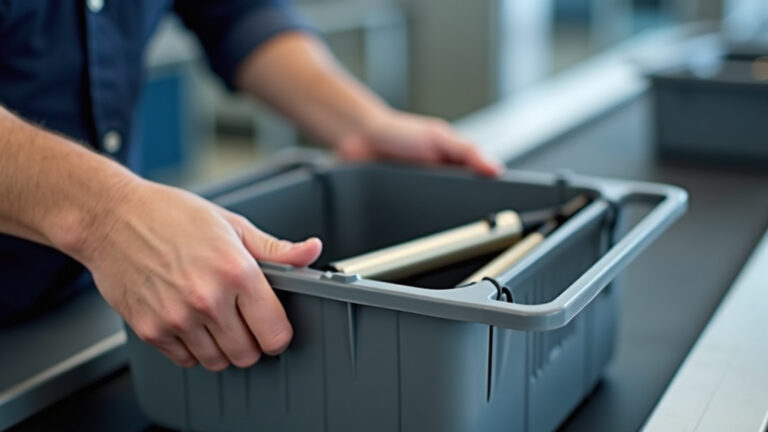
At the gate, this is where most size enforcement happens. If the flight is full, agents will proactively look for oversized bags. They’ll ask you to place it in the sizer. If it doesn’t fit, they’ll tag it for gate-check. On major airlines, this is often free for a true carry-on that’s just a bit too big for the small plane’s bins. On budget airlines, this is where they hit you with a fee that can be $75 or more.
Your move: Stay calm. Remove your laptop, medications, keys, and any lithium-ion power banks. These cannot go in the cargo hold. They’ll hand you a claim tag, and you’ll leave the bag just outside the aircraft door. You pick it up on the jet bridge after landing. The bag is handled less than regular checked luggage, but it’s still out of your control.
Frequently Asked Questions
Do carry-on size limits include wheels and handles?
Yes, absolutely. Always. The sizer at the gate is a box of fixed dimensions. Your bag must fit inside it, wheels and extended handle included. This is the number one reason bags fail.
Is there a standard carry-on luggage size guide for all airlines?
No. There is a common target size of 22″ x 14″ x 9″, but it is not a universal standard. Each airline sets its own maximum carry-on dimensions, weight limits, and personal item rules. You must check your airline’s policy before you pack.
What is the largest carry-on size allowed by any major airline?
Among major U.S. carriers, Southwest and Frontier are some of the most generous, allowing up to 24″ x 16″ x 10″. However, Frontier pairs this with a strictly enforced 35-pound weight limit and fees if the bag isn’t pre-paid. The “largest” allowance is meaningless without the accompanying rules and fees.
Can I use a duffel bag as a carry-on?
Yes, a duffel bag is an excellent carry-on option if it fits your airline’s size limits. Soft-sided duffels are often more forgiving in a sizer than hard-shell suitcases. Just be mindful that without a frame, it can be harder to pack efficiently and may exceed size limits if overstuffed.
What if my bag fits in the overhead bin but not the sizer?
If it doesn’t fit the sizer, the gate agent will not let you try the overhead bin. The sizer is the legal standard for compliance. Arguing that “it fit last time” will not help. The sizer decision is final.
Do international flights have different carry-on size limits?
Yes, frequently. International carriers, especially in Europe and Asia, often have slightly smaller dimension limits (closer to 21.5″ tall) and almost always have strictly enforced weight limits, typically between 15 and 26 pounds (7-12 kg). Always verify with the operating airline.
Before You Go
The carry-on size limit isn’t a puzzle. It’s a published specification from your airline. Your job is to find it, measure your bag against it correctly, and pack with the understanding that a gate agent has the final say. Target the 22x14x9 standard, but never assume it’s enough.
Use a soft-sided bag for flexibility. Pack your essentials and valuables in your personal item. Check your airline’s website 24 hours before departure for any last-minute policy changes. And for peace of mind, know what you’ll do if you’re asked to gate-check, have those laptops and medications ready to pull out in ten seconds.
That preparation turns a potential travel headache into a non-event. You board, you stow your bag, and you don’t think about it again until you land. That’s the goal.