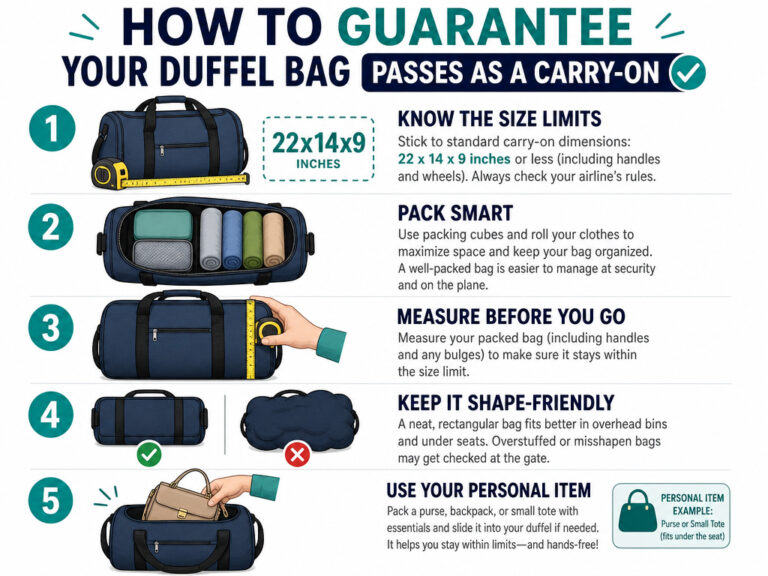
What Is a Duffel Bag? | The Specs That Define It
This post contains affiliate links. As an Amazon Associate, we earn from qualifying purchases.
A duffel bag is a large, soft-sided, flexible bag, typically cylindrical or tubular, designed for carrying bulky items. Its defining features are a single large compartment, a top closure (historically a drawstring, now often a zipper), and at least one carrying strap. The design prioritizes easy packing and simple storage over rigid internal organization.
That definition comes straight from the documents that standardize them. The Ethiopian Standard ES 6852:2021 calls it “a large cylindrical bag… Used to transport a large amount of items.” The U.S. Department of Defense’s spec A-A-59701 details a “Bag, Duffel” made of nylon duck. These aren’t marketing terms. They are the engineering and procurement blueprints that separate a duffel from every other bag category.
What follows is a breakdown of those specs, the one market statistic that explains its shape, and the three-choice matrix that decides whether a duffel is your best tool or a shoulder-bruising mistake.
Key Takeaways
- The official definition hinges on a soft, cylindrical shape and a large main compartment, per standards like ES 6852:2021.
- Duffel bags hold a 71.2% share of the gym bag market because their open design perfectly fits bulky, irregular gear like shoes and towels.
- Capacity in liters does not guarantee airline compliance. You must check a bag’s linear dimensions (length x width x height) against your specific airline’s sizer.
- A duffel fails against a backpack on walks over 10 minutes and against a suitcase on trips over 5 days. Its sweet spot is short-haul, car-to-destination carrying.
- For a first bag, a 40L model in 1000D nylon (like the Patagonia Black Hole) bridges gym, weekend travel, and carry-on use without tearing.
The Technical Definition (According to the Standards)
Forget vague descriptions. A duffel bag has a formal specification.
According to the Ethiopian Standard ES 6852:2021, a duffel bag is “a large cylindrical bag that is used to transport a large amount of items from one place to another.” The standard further specifies leather thickness (1.0 mm to 1.8 mm for luggage-grade goods), shoulder strap drop (25 inches), and strict limits on hazardous chemicals like lead, cadmium, and formaldehyde.
This Wikipedia duffel bag entry aggregates the common understanding: a large bag made of fabric like canvas or nylon, historically closed with a drawstring. The U.S. Military’s Commercial Item Description A-A-59701 mandates “nylon duck, Camouflage Green 483” for its duffel, with dimensions of 12.5 inches in diameter by 37 inches deep. These documents don’t describe a style. They define a tool.
The core anatomy is consistent: * Main Compartment: One large, open cavity. This is non-negotiable. * Closure: Top-down, via drawstring, zipper, or flap. * Carrying System: At minimum one shoulder strap or hand grip. * Construction: Soft-sided and flexible, with no internal frame.
When you understand the history of the duffel bag, its utilitarian design makes immediate sense. It was never meant for delicate organization. It was meant for capacity and durability.
What a Duffel Bag Is Actually Used For (The 71.2% Stat)
The duffel’s shape solves a specific problem: moving bulky, awkward items a short distance. Grand View Research data, cited by manufacturers, pins a 71.2% market share for duffels in the gym bag category. That number isn’t an accident.
| Primary Use Case | Why a Duffel Works | Ideal Capacity |
|---|---|---|
| Gym & Sports | Fits shoes, water bottles, towels, gear. Easy to dump in a locker. | 30L – 40L |
| Short-Trip Travel (2-4 days) | Wide opening allows for fast, visual packing. Folds flat when empty. | 40L – 45L (check dimensions!) |
| Moving Helper | Superior to floppy boxes for soft items like bedding and clothes. | 60L+ or a rolling duffel |
| Beach / Pool Outing | Sand shakes out easily. Can hold towels, sunscreen, a cooler. | 20L – 35L |
| General Storage | Collapses nearly flat. Perfect for seasonal clothing or camping gear. | Varies |
This covers the vast majority of common duffel bag uses. The duffel wins where you need to see and grab everything at once, or where the items themselves are shapeless.
Where this goes sideways: Choosing a duffel for a multi-city backpacking trip. By day three, the single-strap carry will bruise your shoulder, and the lack of internal organization means you’re dumping the entire bag to find your charger.
For structured packing a duffel bag, you add your own system—packing cubes. The bag provides the space; you provide the order.
Duffel vs. Backpack vs. Suitcase: The Carry Matrix
Your choice isn’t just about the bag. It’s about the journey from point A to point B. Match the tool to the transit.
Duffel Bag
- Wins on: Car trips, short walks (under 10 minutes), gym visits, weekend getaways.
- Fails on: Long walks, crowded transit, trips requiring wrinkle-free clothing.
- Mechanism: The single-strap or hand-carry design concentrates load on one shoulder. This is fine for a parking lot to a check-in desk. It becomes painful on a half-mile walk through an airport terminal.
Backpack
- Wins on: Commuting, hiking, air travel with long terminal walks, student life.
- Fails on: Quick access to all items simultaneously.
- Mechanism: Two straps distribute weight across your back and free your hands. The trade-off is a typically narrower opening and more segmented interior.
Suitcase (Rolling)
- Wins on: Business travel, trips over 5 days, keeping clothes neat and organized.
- Fails on: Stairs, cobblestones, overhead bin space on small aircraft.
- Mechanism: The hard shell and wheeled frame protect contents and transfer load to the ground. Mobility is limited by terrain and the need to pull it behind you.
The duffel’s niche is the middle ground where maximum packable volume and minimum empty-weight matter more than perfect weight distribution. If your journey involves more walking than driving, you’re in backpack territory.
How to Choose: Capacity, Material, and the Airline Trap
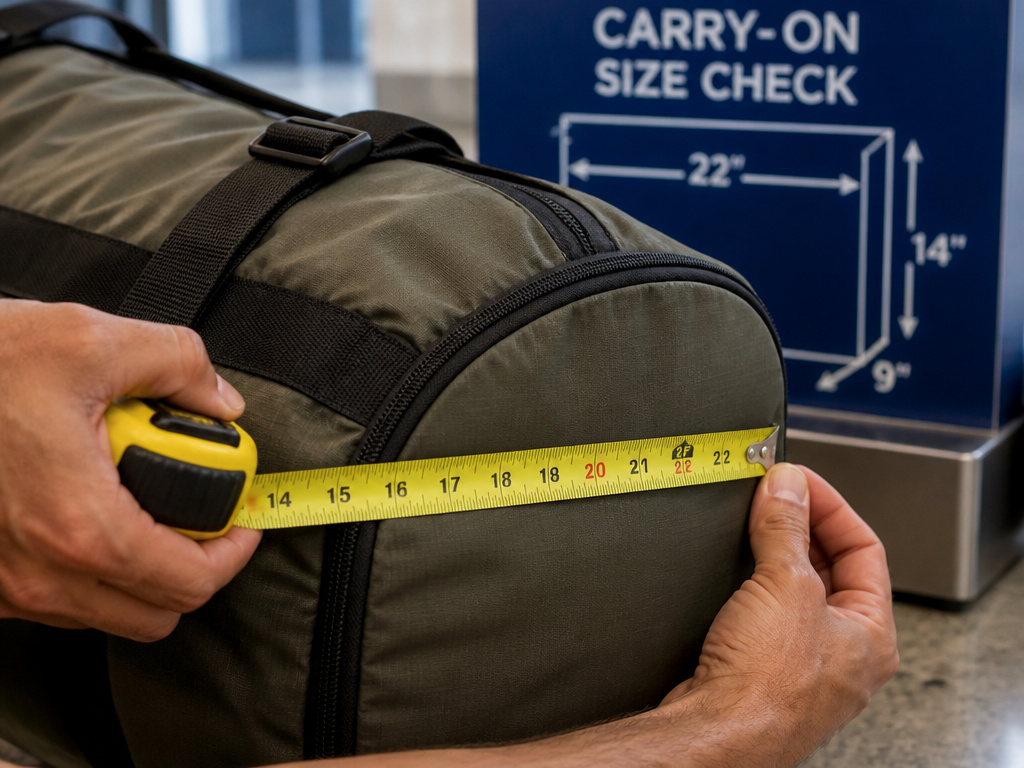
Choosing a duffel means locking three variables: how much it holds, what it’s made of, and whether it fits where you need it to go.
Capacity in Liters vs. Linear Dimensions
This is the most common mistake. A 45-liter bag is a measure of volume. An airline sizer measures length x width x height. A long, cylindrical 45L duffel might fit a bin. A short, boxy 45L duffel might exceed the height limit.
Common mistake: Assuming “carry-on duffel bags” are universally compliant. A bag marketed as 45L carry-on might fit Delta’s bin but be too tall for Spirit’s stricter sizer. You get gate-checked and pay a fee.
Always verify the exact dimensions of the bag against your airline’s exact policy. When in doubt, a 40L bag is almost always safe for a carry-on duffel. The duffel bag dimensions are more important than the liter claim.
Material Denier and Fabric Type
The denier (D) number indicates fiber thickness. Higher denier generally means greater durability and abrasion resistance.
| Material | Denier Range | Best For | Feels Like |
|---|---|---|---|
| Polyester / Nylon | 300D – 600D | Gym bags, light use. Affordable. | Lightweight, slightly slick. |
| Ballistic Nylon / 1000D+ Nylon | 1000D+ | Travel, checked duffel bag use, rough handling. | Heavy-duty, textured, burly. |
| Coated Canvas | N/A | Heritage style, moderate durability. | Stiff at first, softens with wear. |
| Leather (per ES 6852) | N/A (1.0-1.8mm thick) | Formal luggage, long-term durability. | Stiff, develops a patina. |
For a bag that will see airport tarmacs and car trunks, 1000D nylon is the baseline. It resists tears from conveyor belts and scuffs from asphalt. A 600D polyester gym bag will show wear in the same conditions within a season.
The Non-Negotiable Features
Look for these three features on any duffel you plan to use seriously: 1. Padded Shoulder Strap: A bare nylon strap cuts into you. The Ethiopian standard mandates a 25-inch drop and padding for a reason. 2. Trolley Sleeve: A pass-through on the back that slips over a rolling suitcase handle. This transforms a duffel from a burden to a companion piece. 3. Wet Pocket: A separate, lined compartment for damp swimsuits or gym clothes. It contains the mess.
Without these, you have a basic sack. With them, you have a system.
The Bottom Line
A duffel bag is a high-capacity, soft-sided transport tool defined by official standards. Its 71.2% dominance in the gym bag market proves its shape is perfectly adapted for bulky, irregular items. Your choice boils down to three questions.
Are you carrying mostly from a car to a final destination? Duffel. Is your trip longer than four days or require neat clothes? Suitcase. Are you walking more than ten minutes loaded? Backpack.
For one bag that does most things, get a 40L duffel in 1000D nylon—like the Patagonia Black Hole or The North Face Base Camp. Check its linear dimensions against your usual airline’s rules. Add a packing cube. Use the trolley sleeve. That setup covers the gym, a weekend trip, and surviving a baggage claim.
Frequently Asked Questions
What’s the difference between a duffel bag and a holdall?
Nothing functional. “Holdall” is the common British term for the same soft-sided, large-capacity bag. “Duffel” is more common in the U.S. The words are interchangeable in practice, though “duffel” is the term used in formal standards and military procurement.
Can a duffel bag be a personal item on a flight?
It depends on its size. A personal item must fit under the seat in front of you. Most full-size duffels are too large. A small duffel under roughly 18″ x 14″ x 8″ could qualify, but you are competing with your feet for space. A backpack is a more reliable personal item. For the main overhead bin, review the carry-on duffel bag rules.
Are duffel bags good for hiking?
No. A duffel bag is terrible for hiking. It lacks a proper hip belt and framed suspension to transfer weight to your hips, causing shoulder and back strain. It also swings awkwardly, throwing off your balance on trails. Use a dedicated hiking backpack.
How do you clean a duffel bag?
Check the manufacturer’s tag first. For most nylon or polyester bags, wipe the interior and exterior with a damp cloth and mild soap. Air dry completely—never machine dry, as heat can melt coatings or adhesives. For deeper cleaning a duffel bag, some are machine washable on gentle cycle, but this risks damaging zippers and internal liners.
What does the “D” stand for in material like 600D?
The “D” stands for denier, a unit of measurement for the linear mass density of fibers. It indicates the thickness of the threads used in the fabric. A higher denier number means thicker, heavier, and typically more durable yarns. 600D is common for mid-range bags; 1000D-1680D is used for heavy-duty travel and military gear.
Is a duffel bag or a backpack better for school?
For most students, a backpack is better. It distributes the weight of textbooks and a laptop evenly, freeing your hands. A duffel forces you to carry all the weight on one shoulder and offers no protection or organization for electronics. A duffel is only suitable for school if you’re solely carrying gym clothes or sports gear.