How Much for a Louis Vuitton Tote? Actual Prices Explained
This post contains affiliate links. As an Amazon Associate, we earn from qualifying purchases.
A new Louis Vuitton tote costs between $1,300 and over $15,000. The final price is decided by three non-negotiable factors: the specific model and size, the material (classic canvas, premium leather, or exotic skin), and the collection’s release year. The iconic Neverfull MM in Monogram Canvas starts around $1,900, while a large OnTheGo GM in Empreinte leather reaches $3,700. Limited editions and exotic skins push prices into five figures.
That starting range of $1,300 to $15,000 isn’t a guess. It’s the documented spread between the brand’s entry-level canvas pieces and its most exclusive offerings. The gap exists because Louis Vuitton operates on a tiered system where material and craftsmanship costs scale dramatically, not incrementally.
What follows is a breakdown of the real price anchors for current models, the mechanics of the pre-owned market, and the four hidden variables that can change your final cost by thousands. By the end, you’ll be able to read any product listing and know exactly which cost bracket it belongs in.
Key Takeaways
- Canvas is the entry point. The classic Monogram or Damier Canvas totes like the Neverfull and Speedy anchor the low end, starting around $1,300–$2,100.
- Leather commands a 50–100% premium. Moving to Empreinte or Epi leather for the same model, like the OnTheGo, typically adds $1,500–$2,000 to the price.
- The pre-owned market isn’t always cheaper. Vintage, discontinued, or pristine-condition pieces often sell above their original retail price on the resale market.
- Size changes cost predictably. Moving from a PM (Petite Model) to an MM (Medium Model) to a GM (Grand Model) within a line adds several hundred dollars per step up.
- Authentication is non-optional. Any price that seems too good to be true, especially online, is almost certainly a counterfeit. Factor the cost of a professional authentication service into any secondhand purchase.
The Core Price Ranges: Canvas, Leather, Exotic
Forget a single number. Louis Vuitton’s pricing is a ladder. Your first step is identifying which rung your desired bag sits on. The material is the primary determinant.
Monogram Canvas totes represent the accessible luxury tier. They use a coated canvas and treated leather trim, which balances durability with a lower production cost than full-leather construction. This is why they form the foundation of the LV price architecture.
The Canvas Foundation: $1,300 – $2,300
This tier is for the iconic prints: Monogram, Damier Ebene, and Damier Azur. The bags here are workhorses. The canvas is durable, the leather trim is sturdy, and the designs are timeless.
- Neverfull MM: The quintessential tote. In Monogram Canvas, it’s the price benchmark for the entire category.
- Speedy Bandoulière 30: A crossbody/tote hybrid. Slightly less capacity than a true tote, but a classic silhouette.
- Alma BB: A structured tote-alternative. It demonstrates that even within canvas, smaller, more structured bags hold value.
The trade-off is uniformity. These are the most produced and widely recognized bags. You pay for the brand and the pattern, not for unique materials.
The Leather Tier: $2,800 – $4,500
Here, the canvas disappears. The entire bag is crafted from premium leathers like Empreinte (embossed) or Epi (textured). The cost jumps because you’re paying for significantly more raw material and the skilled labor to work it.
The Louis Vuitton OnTheGo GM in Bicolor Monogram Empreinte leather is the archetype. It’s a statement piece. The leather is thicker, the construction is more complex, and the bag feels substantial. You move from “accessible luxury” to “unmistakable investment.”
| Material Tier | Price Anchor | Example Model | Feel & Use Case |
|---|---|---|---|
| Canvas | $1,300 – $2,300 | Neverfull MM | Lightweight, casual, high-visibility logo. Everyday workhorse. |
| Premium Leather | $2,800 – $4,500 | OnTheGo GM in Empreinte | Substantial, structured, luxury feel. Professional or statement piece. |
| Exotic Skin | $10,000 – $15,000+ | Limited Edition Crocodile | Ultra-luxurious, delicate, collector status. Red-carpet or portfolio asset. |
Leather bags also show wear differently. Scratches can be buffed, and a patina develops. This tier is for buyers who see the bag as a decades-long companion, not just a seasonal accessory.
The Exotic Peak: $10,000+
This is crocodile, python, ostrich. These are not just bags; they are limited-edition assets. The price reflects rare materials, specialized artisanship, and extreme scarcity.
You will rarely see these on a retail floor. They are often made-to-order or released in tiny quantities. The price is less about function and more about collector value and ultimate status. If you’re comparing best luxury totes, exotic LV models sit at the absolute apex.
Model, Size, and The Hidden Math
Within each material tier, the specific model and its size execute the final price. Louis Vuitton’s sizing codes—BB, PM, MM, GM—are precise indicators of both dimensions and cost.
The OnTheGo collection is the perfect case study. It’s offered in GM, MM, and PM. Each step down in size means less material used, which translates to a lower price point.
- OnTheGo GM (Grand Model): The largest. Uses the most leather. The price point is the family’s ceiling.
- OnTheGo MM (Medium Model): The popular middle ground. A noticeable price drop from the GM.
- OnTheGo PM (Petite Model): The smallest. The most affordable entry into the leather Empreinte line.
This scaling applies universally. A Speedy 25 costs less than a Speedy 30. The difference isn’t just capacity; it’s the square inches of canvas and leather trim factored into the Louis Vuitton price range.
Where this goes sideways: Assuming a “larger bag is always better value.” A GM tote may cost $500 more than an MM, but if it’s too bulky for your daily life, that’s $500 for wasted capacity and a bag that stays in the closet. Fit the size to your actual carry, not the fantasy.
New collections and collaborations also have a hidden tax. A newly released model often carries a 10-20% premium over a similar bag from the core, perennial collection. This “newness” price decays if the model is added to the permanent line.
The Pre-Owned Market: Deals, Landmines, and Vintage Gold
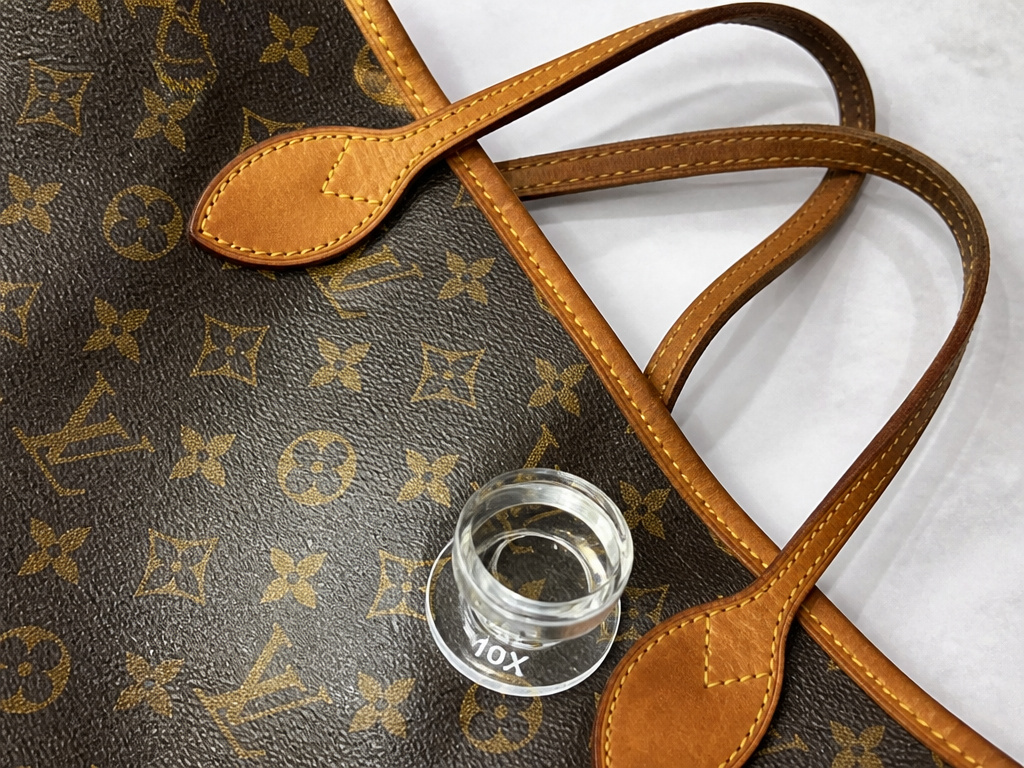
The secondary market is a parallel economy with its own rules. It’s not simply “used equals cheap.” Condition, rarity, and provenance rewrite the cost of a tote bag entirely.
The “Deal” Zone: This is for current models in good, but not perfect, condition. A three-year-old Neverfull MM with slight patina on the handles might sell for 25-30% below its current retail price. This is the sweet spot for a practical buyer who wants the look and function without the brand-new premium.
The Vintage Premium Zone: Discontinued models in excellent condition often appreciate. A pristine condition Vintage Alma from the 1990s can sell for more than a new one. Scarcity and collector demand override original price of a Louis Vuitton.
The Landmine Zone: Prices that are suspiciously low. This is the domain of counterfeits. A “$500 Louis Vuitton tote” is a fake, full stop. This is where you must apply the lessons from our guide on how to spot a fake LV tote. The cost of a professional authentication service is a mandatory line item in any secondhand purchase.
Reputable resellers like Fashionphile or The RealReal grade condition transparently—”excellent” versus “very good” versus “fair.” Each grade drops the price by a predictable margin. This transparency is what you pay for when buying from a pro instead of a private seller.
Four Hidden Factors That Change Your Final Cost
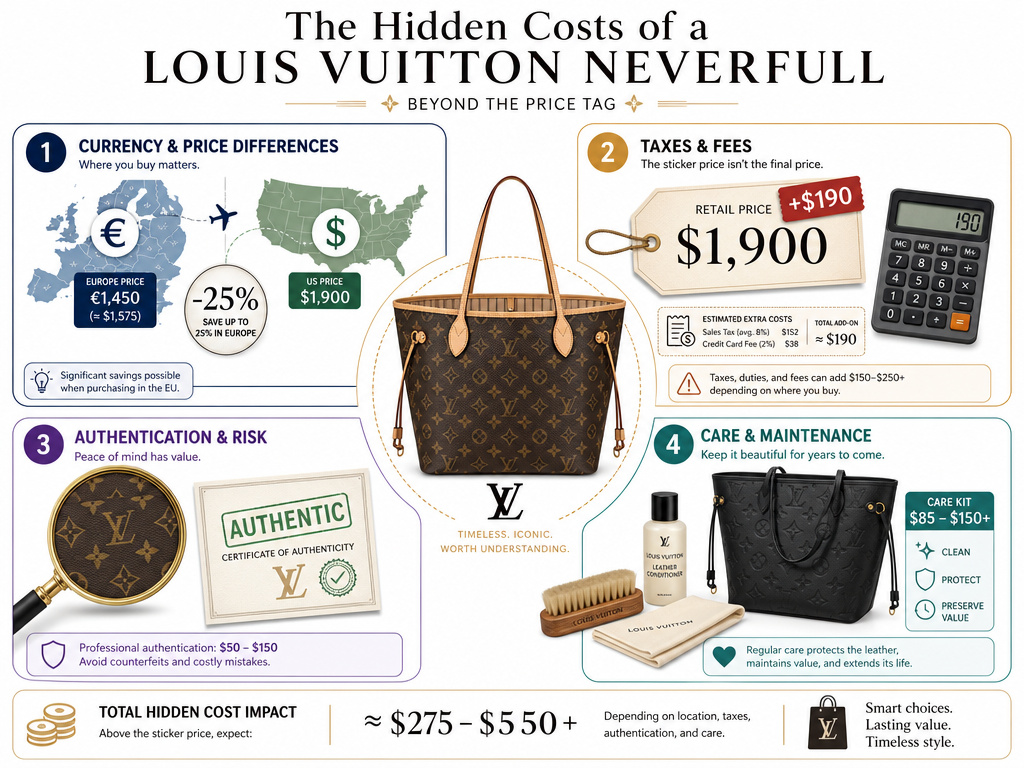
The retail tag is just the start. Four other variables can swing your final outlay by hundreds, sometimes thousands.
- Regional Pricing & Currency. Louis Vuitton adjusts prices by country. Buying in Europe (in Euros) before VAT refund can be 15-25% cheaper than buying the same bag in the United States. Conversely, prices in markets like Japan or Australia are often higher due to import duties and local taxes.
- Taxes. In the U.S., sales tax adds 6-10% at checkout, depending on your state. That’s an extra $190 on a $1,900 Neverfull. Online retailers may or may not collect it, but the legal liability remains.
- The Authentication Imperative. For any pre-owned purchase, a $30-$50 certificate from a service like Authenticate First or Real Authentication is non-negotiable insurance. It’s the cost of knowing your real Louis Vuitton bag is genuine.
- Care & Maintenance. Leather conditioners, canvas protectors, and professional cleaning aren’t free. For a leather Empreinte bag, budgeting $100-$200 every few years for professional spa treatment keeps it looking its best and protects resale value.
Ignoring these is how a “$3,700 bag” becomes a $4,200 reality. The savvy buyer budgets for the full lifecycle cost, not the sticker shock.
How Louis Vuitton Compares to Other Luxury Totes
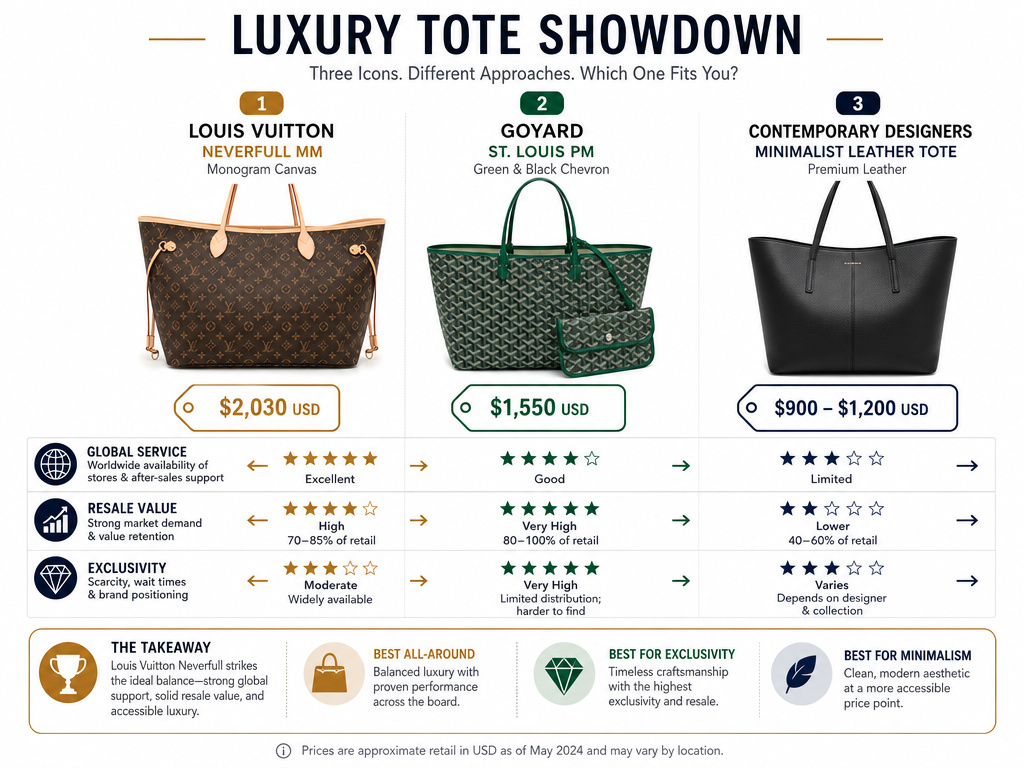
Is Louis Vuitton’s price justified? The answer lies in comparison. Put an LV tote next to a peer from Goyard tote prices or another luxury tote brand, and the value proposition sharpens.
Louis Vuitton vs. Goyard: Goyard’s signature St. Louis tote is often compared to the Neverfull. Goyard is typically more expensive for a similar canvas tote, has fewer retail locations, and is perceived as more exclusive. However, LV offers a far wider range of leather and exotic options. LV wins on versatility and global service network.
Louis Vuitton vs. Contemporary Designer (e.g., Tory Burch, Coach, etc.
The Resale Advantage: Louis Vuitton’s immense global recognition gives it the most stable and active resale market. A pre-owned LV bag will typically sell faster and for a higher percentage of its retail price than a comparable bag from a less ubiquitous brand. This liquidity is a financial cushion that cheaper brands don’t offer.
When evaluating the best Louis Vuitton totes, you’re not just buying a bag. You’re buying into an ecosystem with established resale value, global service, and a consistent design language. That ecosystem has a cost.
Frequently Asked Questions
What is the cheapest Louis Vuitton tote I can buy?
The most affordable new totes are in the classic canvas lines. The Neverfull MM in Monogram Canvas is the perennial entry point, currently around $1,900. Smaller canvas styles like the Speedy 25 or Alma BB can also be found in this $1,300-$2,100 range. For a lower upfront cost, the pre-owned market for these models is very active.
Why is the Neverfull cheaper than the OnTheGo?
It comes down to materials. The Neverfull is primarily coated canvas with leather trim. The OnTheGo is made entirely of thick, embossed Empreinte leather. The amount of high-cost raw material in the OnTheGo is multiples higher, which is reflected directly in the LV bag cost.
Do Louis Vuitton tote bags go on sale?
No. Louis Vuitton does not hold seasonal sales or discount its permanent collection in its own boutiques or official website. The only way to pay less than retail is to buy pre-owned from a reputable reseller, shop in a country with favorable exchange rates and VAT refunds, or purchase during a rare department store “private sale” event where the store itself offers a discount.
How much does size affect the price?
Significantly. Moving one size up within a model family (e.g., from Neverfull MM to GM) typically adds $200-$400. The increase covers the additional material and slightly scaled hardware. It’s a predictable cost, so always check the specific size code when comparing popular Louis Vuitton totes.
Is a pre-owned Louis Vuitton tote a good investment?
It can be, but “investment” implies guaranteed appreciation, which isn’t assured. A pre-owned tote is a better value for personal use. You avoid the steep initial depreciation. For true investment potential, you need rare, discontinued, or exotic pieces in pristine, collectible condition. For a daily bag, buying pre-owned in good condition is the smartest financial move.
The Bottom Line
A Louis Vuitton tote’s price is a precise function of material, model, and market. Start with the material ladder: canvas for entry, premium leather for a step up, exotic for the peak. Anchor your search with real model names like Neverfull MM or OnTheGo GM.
Then, factor in the hidden variables: size, regional pricing, taxes, and the non-negotiable cost of authentication for secondhand buys. The pre-owned market is where real value lives, but it requires diligence—use the methods in our guide to authenticate a Louis Vuitton before any money changes hands.
Ultimately, you’re not paying for just a bag. You’re paying for a specific tier of craftsmanship, a globally recognized brand ecosystem, and, in many cases, a piece with predictable resale liquidity. Know which of those you value, and let that guide your budget.