Guide to Replacing Luggage Wheels & Avoiding Motor Damage
This post contains affiliate links. As an Amazon Associate, we earn from qualifying purchases.
To replace luggage wheels, you need three things: the correct replacement part for your specific bag model, the right tools (typically a Phillips or hex screwdriver, an Allen wrench, and sometimes a flat wrench), and the knowledge of whether your axles are reverse-threaded. Installing a reverse-threaded axle in the wrong side strips the threads and ruins the housing, which is a repair you can’t undo.
That last point is the one most online tutorials skip. They assume every wheel tightens the same way. Burton luggage, for example, marks its right-side axle with an “R” and uses a reverse thread, tighten it counter-clockwise. Get that wrong and the wheel seizes or the axle spins loose within a dozen pulls. The rest is just matching parts and turning screws.
What follows: the two critical checks before you order anything, the universal step-by-step process that works for most soft-sided rollers, and the brand-specific quirks for Travelpro, Burton, Patagonia, Cotopaxi, and Briggs & Riley that decide whether your repair lasts six months or six years.
Key Takeaways
- Always order manufacturer-specific replacement wheels. Generic “universal” wheels rarely fit the axle diameter or housing depth correctly, and a mismatched part wobbles loose within weeks.
- Identify if your bag uses reverse-threaded axles before you start. Look for “R” and “L” markings on the axle heads. Installing a reverse-threaded axle on the wrong side strips the plastic threads inside the frame.
- A perfectly tightened wheel should spin freely for 1–2 seconds when flicked by hand. Overtightening crushes the bearing and creates drag; undertightening lets the wheel wobble and wear the axle hole oval.
- Most repairs require a Phillips or hex screwdriver, an Allen wrench (often 3/16″ or 4mm), and a flat wrench to hold an internal nut. Travelpro Rollaboard kits include these; Cotopaxi will ship you a free toolkit if you don’t have one.
- If a wheel is salvageable but the axle is bent, you can cut the axle with bolt cutters (wear safety glasses) to save the wheel. If both are missing, you skip straight to preparing the internal housing.
The Two Things to Check Before You Order Wheels
Do not buy a wheel until you answer these questions. The first decides compatibility; the second decides whether you can do the job at all.
What is your bag’s exact make, model, and production year?
Manufacturers change wheel designs. The Briggs & Riley Quick-Change Wheel Repair Kit, for example, fits Baseline Carry-Ons made from 2009 to March 2022, @work series from 2008 onward, and BRX series from 2010 onward. If your Baseline Carry-On was bought in April 2022, that kit will not work. The part number stamped on the old wheel is your best guide. If it’s worn off, check the manufacturer’s website with your model number, most, like Travelpro, list compatible replacement parts by series.
Common mistake: Ordering wheels based on diameter alone. A 2.75-inch wheel from Brand A has a different axle diameter and hub width than a 2.75-inch wheel from Brand B. The wrong hub binds against the housing; the wrong axle diameter either won’t fit or will rattle.
Are the wheels attached with standard screws, or are they molded into a proprietary plastic plate?
This is the divide between a bag you can repair and one that’s effectively disposable. Open the interior lining and look at the wheel housing. You want to see a metal screw or a nut-and-bolt assembly. If you see a single, large plastic plate with the wheel molded into it, glued or riveted to the shell, walk away. Replacing that requires cutting, epoxy, and a degree of luck. Bags designed for repair, like a Travelpro Rollaboard or a Cotopaxi Coraza, use discrete, replaceable parts.
Tools You Actually Need (It’s Not Just a Screwdriver)
A basic repair kit covers 80% of wheel replacements. You’ll use each tool for a specific mechanical purpose, and skipping one usually means you can’t finish the job.
| Tool | Purpose | What Happens If You Skip It |
|---|---|---|
| Phillips or Hex Screwdriver | Removes the cosmetic cover plate or external screw holding the wheel. | You cannot access the internal axle nut. The repair stops at step one. |
| Allen Wrench (Hex Key) | Tightens the axle bolt from the outside. Common sizes are 3/16″ (Briggs & Riley) and 4mm (Cotopaxi, Patagonia). | The axle spins freely instead of tightening, and the wheel falls off after the first test roll. |
| Flat Wrench (or Adjustable Wrench) | Holds the internal nut stationary while you turn the axle with the Allen wrench. Prevents the entire assembly from spinning inside the bag. | You overtighten by crushing the housing, or you fail to achieve any torque and the wheel loosens immediately. |
| Flathead Screwdriver | Pries off stubborn cover plates without marring the fabric. Also used as a lever to hold internal components. | You bend or scratch the cover plate trying to remove it with your fingers or pliers. |
The Travelpro Rollaboard guide calls for a flathead screwdriver and an Allen wrench. The Cotopaxi Coraza care page specifies a 4mm Allen key and a 10mm wrench. If you don’t have these, Cotopaxi will ship a free toolkit with your wheel purchase. That’s a strong signal about their repair philosophy.
Where this goes sideways: Using pliers on an internal nut meant for a wrench. The nut’s corners round off after two turns, and now it spins freely inside the lining. You have to cut the lining open to retrieve it, which turns a 10-minute wheel swap into a multi-hour reconstruction project.
Step-by-Step: The Universal Process
This sequence works for most soft-sided suitcases with user-serviceable wheels, like the classic two-wheel Travelpro Rollaboard. Hard-shell luggage and spinner bags follow the same mechanical principles but often have a different internal layout.
- Lay the suitcase flat on a stable surface. Empty it completely. This seems obvious, but a bag that shifts while you’re torquing an axle can cause the screwdriver to slip and gouge the fabric.
- Open the interior lining. Find the zipper for the cloth panel behind the wheel well. Unzip it to expose the back of the wheel assembly. You’re looking for a metal nut or a plastic retaining clip.
- Remove the external cover plate. Use a Phillips or hex screwdriver to remove any screws on the outside of the bag holding a small plastic plate over the wheel. Set the plate and screws aside.
- Hold the internal nut steady. Insert your flat wrench onto the nut inside the bag. Have it ready before you touch the axle.
- Loosen and remove the axle. From the outside, insert the correct Allen wrench into the axle head. Turn it counter-clockwise while holding the internal nut firm with the wrench. Once loose, pull the axle out completely.
- Pull off the old wheel. It should slide off the axle post. If it’s stuck, wiggle it gently; don’t pry against the housing.
- Slide the new wheel onto the axle. Ensure any beveled edge faces outward, as Cotopaxi specifies. Align the axle holes.
- Insert the axle through the wheel and into the housing. Thread it into the internal nut by hand first to avoid cross-threading.
- Tighten the axle. Hold the internal nut with the wrench. From the outside, turn the Allen wrench clockwise. Tighten until the wheel no longer wobbles, then stop. Overtightening is worse than undertightening.
- Test the spin. Flick the wheel with your finger. A properly tightened wheel on a Patagonia Black Hole Duffel spins freely for 1–2 seconds, according to the iFixit guide. If it spins less, it’s too tight; if it wobbles laterally, it’s too loose.
- Replace the cover plate and re-zip the lining.
The entire process should take under ten minutes per wheel if you have the right parts. Your first one might take twenty. That’s normal.
Brand-Specific Quirks That Break the Rules
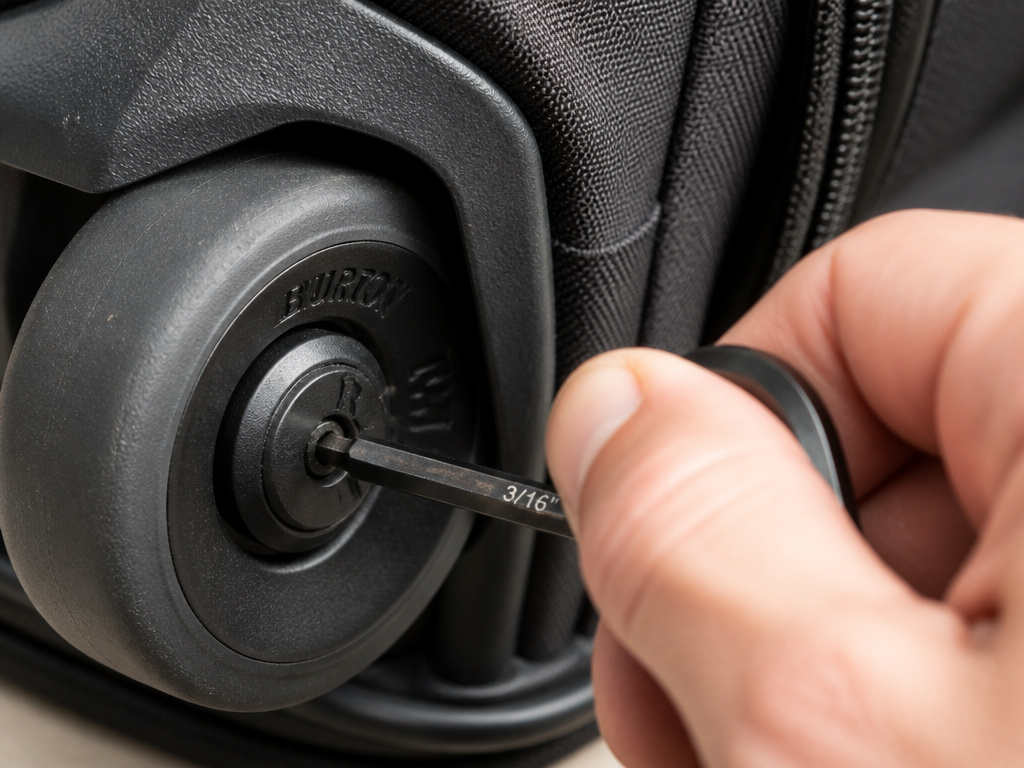
If you follow the universal guide above on a Burton bag, you will break it. Here are the deviations that matter.
Burton Luggage: The Reverse-Thread Rule
Burton marks the right-side axle head with an “R” and the left with an “L”. The “R” axle is reverse-threaded. You tighten it by turning the Allen wrench counter-clockwise. The left wheel tightens normally (clockwise). If you try to screw the “R” axle into the left side, the threads won’t engage properly. Forcing it strips the plastic housing, and you cannot re-tap those threads. The repair is now beyond DIY.
Patagonia Black Hole Duffel: The Salvage Scenario
The iFixit guide for this model notes an edge case. If the wheel is fine but the axle is bent, you can salvage the wheel. Use bolt cutters (with safety glasses) to cut the axle on either side of the wheel hub. This lets you slide the good wheel off the ruined axle. It’s a niche fix, but it saves you buying a whole new wheel-and-axle set.
Briggs & Riley: The Compatibility Window
Their Quick-Change Wheel Repair Kit contains two 2.75″ wheels, two axles, and one 3/16″ Allen key. The product page explicitly states it fits Baseline Carry-Ons from 2009 to March 2022. If your bag is newer, the kit likely won’t fit. This is a documented design change, a non-commodity fact you won’t find in a generic tutorial.
Travelpro Rollaboard: The Six-Step Shortcut
Travelpro’s own guide simplifies the process: remove the old wheel, insert the new one, replace the plate. It assumes you’re using their exact replacement part, which includes a pre-assembled axle and wheel. This is why manufacturer parts are faster, they eliminate the axle-and-nut separation.
Cotopaxi Coraza: The Beveled Side Out
Cotopaxi’s instructions include one visual cue: align the new wheel with the axle with the beveled side out. Getting this wrong can affect the wheel’s clearance against the housing.
Wheel Types, Sizes, and When to Upgrade
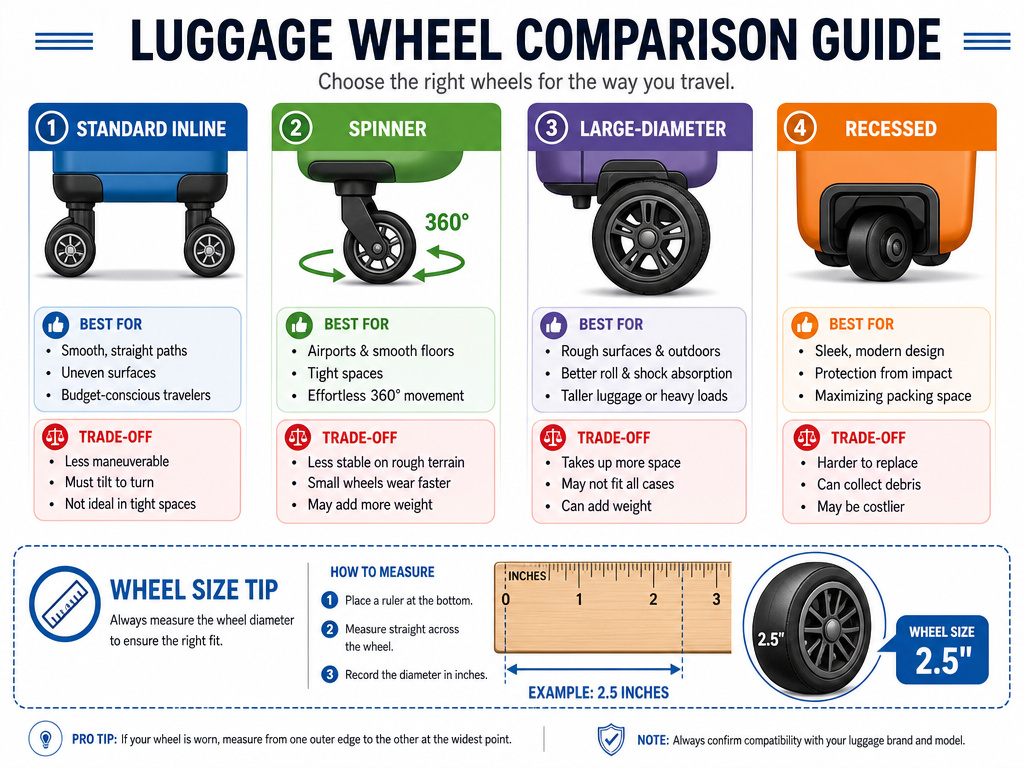
You’re not stuck with the exact same wheel your bag came with. If you can find a compatible part from the same brand, you can sometimes upgrade.
| Wheel Type | Best For | Trade-Off |
|---|---|---|
| Standard Inline Wheels (Two) | Traditional rollaboards, uneven pavement, high loads. | Less maneuverable in tight spaces than spinners. |
| Spinner Wheels (Four) | Airports, smooth floors, tight turns. The best wheels for spinner luggage use sealed bearings. | Smaller diameter wheels bog down on rough terrain like cobblestones. |
| Large-Diameter (3+ inch) Wheels | Rough terrain, gravel, curbs. Wheels for rough streets need a larger contact patch. | Can interfere with storage compartments or exceed airline size limits on carry-ons. |
| Recessed Wheels | Protection from impacts and snags. Luggage with recessed wheel designs keep the wheel tucked inside the profile. | Often smaller in diameter, which can reduce rolling performance over gaps. |
The diameter is printed on the side of the wheel. Measure it if it’s worn off. Going up one size (e.g., from 2.5″ to 2.75″) can improve roll, but only if the housing has enough clearance. Test the wheel’s full rotation before final tightening.
Easy to miss: Wheel hardness. Softer rubber wheels are quieter and grip better but wear faster on asphalt. Hard plastic wheels are loud but slide easily on smooth surfaces and last longer. Your replacement likely matches the original material.
Troubleshooting: When the Repair Doesn’t Work
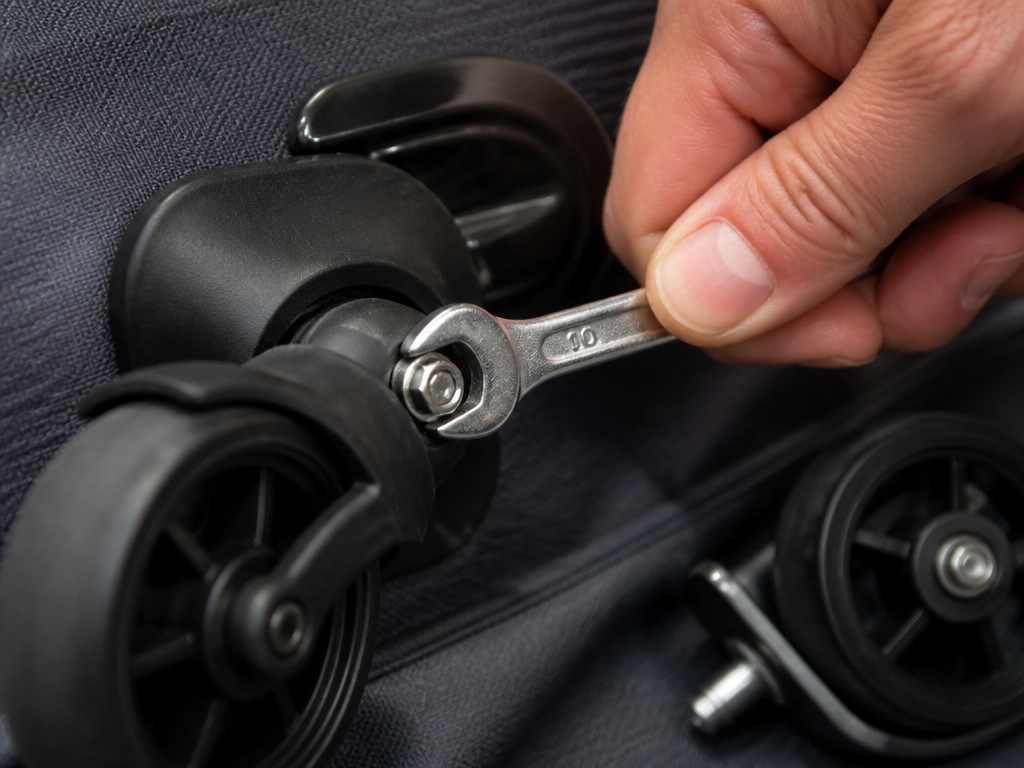
You followed the steps, but the wheel wobbles, squeals, or doesn’t spin. Here’s the likely cause and fix.
The wheel wobbles side-to-side.
The axle isn’t tight enough, or the new wheel’s hub is too wide for the housing. Re-tighten the axle with the internal wrench secured. If the wobble persists, the wheel is incompatible. You need a different replacement.
The wheel spins stiffly or not at all.
You overtightened the axle, compressing the bearing. Loosen it by a quarter-turn and test again. If it’s still stiff, the bearing might have been damaged during installation or was defective. You’ll need another new wheel.
The axle spins freely but won’t tighten.
The internal nut is spinning because your wrench isn’t gripping it. You may have rounded the nut’s corners. You’ll need to open the lining wider, use needle-nose pliers to grip the nut, and consider replacing it with a new one from a hardware store (match the thread pitch).
The new wheel rubs against the suitcase fabric.
The wheel is likely too large in diameter or the wrong offset. This is a compatibility issue. A smaller-diameter replacement spinner wheel might solve it, or you may need to file down the housing, a last resort.
Frequently Asked Questions
Can I use universal replacement wheels?
You can try, but the fit is rarely perfect. Universal wheels are designed to fit a range of axle diameters and housing widths, which means they often fit none of them securely. A loose fit causes wobbling and accelerates wear on the axle hole. For a reliable repair, source manufacturer-specific parts.
How do I know if I need to replace the axle too?
Inspect the axle after you remove it. Look for bends, deep scratches, or worn threads. If the wheel was wobbly because the axle was bent, you must replace both. A bent axle will never seat a new wheel squarely, causing the same wobble and premature wear.
My luggage lining isn’t zippered, how do I access the inside?
Some bags have a sewn-in lining behind the wheel. You’ll need to carefully cut the stitching with a seam ripper to create a flap. After the repair, hand-sew the flap closed or use a strong fabric glue. This is more invasive, which is why a feature-rich wheeled trolley suitcase designed for repair will have a zippered access panel.
Is it worth replacing wheels on cheap luggage?
It depends on the cost of the parts and your time. If the replacement wheels cost more than half the price of a new, better-quality bag, it’s probably not worth it. However, if the bag is otherwise in good shape and you can get cheap, exact-fit parts, a repair extends its life and keeps it out of a landfill.
Can I replace two-wheel luggage with spinner wheels?
Almost never. The frame and mounting points are completely different. Converting a two-wheel rollaboard into a four-wheel spinner would require extensive structural modification. If you want spinner maneuverability, look for a carry-on with four wheels designed from the ground up.
The Bottom Line
Replacing luggage wheels is a straightforward mechanical job if your bag was built with screws, not glue. The real skill isn’t in the turning of wrenches, it’s in the pre-repair detective work. Match the part number, respect reverse threads, and tighten to the spin test, not to brute force. A set of durable replacement wheels for spinner luggage or robust two-wheel replacements can add years to a suitcase that’s otherwise perfect. That beats buying a new bag every time a wheel cracks, which is how most people end up with a closet full of broken luggage and a lighter wallet.