A Guide to Measuring Your Suitcase: The ISO Handle Rule
This post contains affiliate links. As an Amazon Associate, we earn from qualifying purchases.
To measure a suitcase, you need three external dimensions: height (including wheels and extended handle), width at its widest point, and depth at its deepest point. Add these numbers together for the total linear dimensions. The international standard for baggage (ISO 12604-1:2017) sets a 1580 mm (62 inch) limit for this total, but explicitly excludes handles from the measurement, a fact most luggage retailers ignore, telling you to include them.
That gap between the technical standard and consumer advice is where airline gate agents live. They use the sizer bin, not a caliper. If your bag with its handle up doesn’t fit, you’re paying.
What follows is the method that works: how to find the numbers, what the ISO standard actually says, and the three mistakes that turn a compliant bag into an oversized fee before you even reach the counter.
Key Takeaways
- The ISO 12604-1:2017 standard for baggage sets a 1580 mm (62 inch) limit for total linear dimensions (height + width + depth) and excludes handles from this calculation.
- Luggage retailers like Delsey and Victorinox universally advise including wheels and handles in all measurements, creating a practical conflict with the technical standard.
- Always measure on a hard, flat surface; a carpet or bed can add a deceptive half-inch to each dimension.
- For checked bags exceeding 23 kg (50 lb), the ISO standard mandates special handling labels and procedures; over 46 kg (100 lb) it must be shipped as freight.
- Protruding straps, hooks, or an unstable shape can get your bag flagged as non-conveyable, requiring manual handling or repacking even if it meets size limits.
The One Rule Airlines Actually Enforce
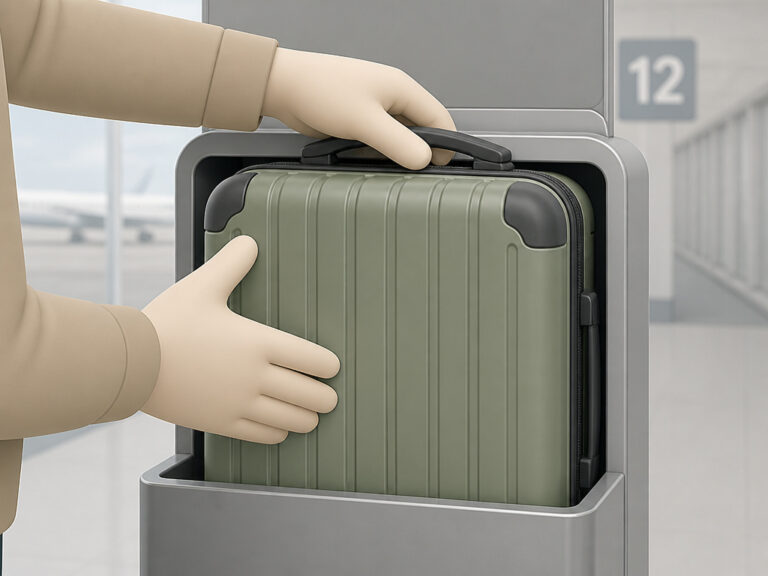
Forget the marketing copy on the suitcase tag. Airline baggage systems are built around one physical reality: a conveyor belt needs a stable, rectangular object to move. A bag that wobbles, snags, or tips jams the entire line. That’s why the sizer bin at the gate is the final judge, it’s a physical test of conveyability.
Your printed dimensions are just a prediction. If the bag fits in the bin, you pass. If it doesn’t, you’re negotiating a fee or gate-checking on the spot. The goal of measuring isn’t to win a debate with a PDF; it’s to guarantee your bag will pass that bin test every time.
Where this goes sideways: Measuring a softside suitcase empty. The fabric collapses, giving you a smaller number. Once packed, the depth expands by an inch or more, pushing you over the linear limit at the airport. Always measure it full.
The ISO Standard vs. Retailer Advice
Here’s the core conflict no generic guide mentions. The ISO 12604-1:2017(E) standard is the engineering blueprint for global baggage handling. It defines the “standard baggage” dimensions that automated systems are built to move.
| Specification | ISO 12604-1:2017(E) Standard | Retailer Advice (Delsey, Victorinox, IT Luggage) |
|---|---|---|
| Total Linear Dimensions (H+W+D) | ≤ 1580 mm (62 in) | ≤ 1580 mm (62 in) for checked bags |
| Handles Included? | No. The standard explicitly states dimensions are without handles. | Yes. “Always include wheels and handles.” |
| Wheels Included? | Implied (baggage standing on wheels). | Yes. |
| Purpose | Engineering standard for baggage system compatibility. | Consumer guideline to avoid airline fees. |
| Enforced by | Baggage handling system design. | Airline gate agent with a sizer bin. |
The standard exists to ensure a bag fits through scanners, onto carts, and into aircraft holds without manual intervention. It notes that even a bag meeting the size limit can be “non-conveyable” if it has loose straps, hooks, or lacks a flat surface.
Retailers, however, are giving you the pragmatic truth. The gate agent’s sizer bin includes the handle cavity. If your telescopic handle is up when they measure, it counts. Their advice, include everything, is designed to prevent that exact surprise at the checkpoint.
Bottom line: You must measure including wheels and the extended handle. The ISO standard tells you why the limit exists; the retailer tells you how to survive it.
The Tools You Actually Need
You don’t need a laser rangefinder. The right tool prevents the most common error: under-measuring curved or protruding parts.
A flexible measuring tape is the only correct choice. The kind used in sewing or tailoring conforms to the suitcase’s shape, wrapping around rounded corners and giving an accurate read over padded sections. A rigid ruler or yardstick will lie to you on any surface that isn’t perfectly flat.
If you don’t have one, the string-and-ruler method works. Wrap a non-stretch string around the bag, mark where it meets, and then lay the string flat against a ruler. It’s slower, but it’s accurate.
Common mistake: Using a retractable metal tape measure meant for construction. The hook snags on fabric, the blade doesn’t lie flat against soft sides, and the rigid curve over a wheel well gives a shorter measurement than the bag’s true profile.
Step-by-Step: Measuring Height, Width, and Depth
Follow this sequence on a hardwood or tile floor. Do not use a carpeted area or a bed, soft surfaces let the bag settle and distort all three dimensions.
- Prepare the Bag. Pack it as you would for travel. For softside luggage or any bag with an expansion zipper, ensure it’s fully expanded and packed. Extend the telescopic handle fully. Place the suitcase upright on its wheels on your hard, flat surface.
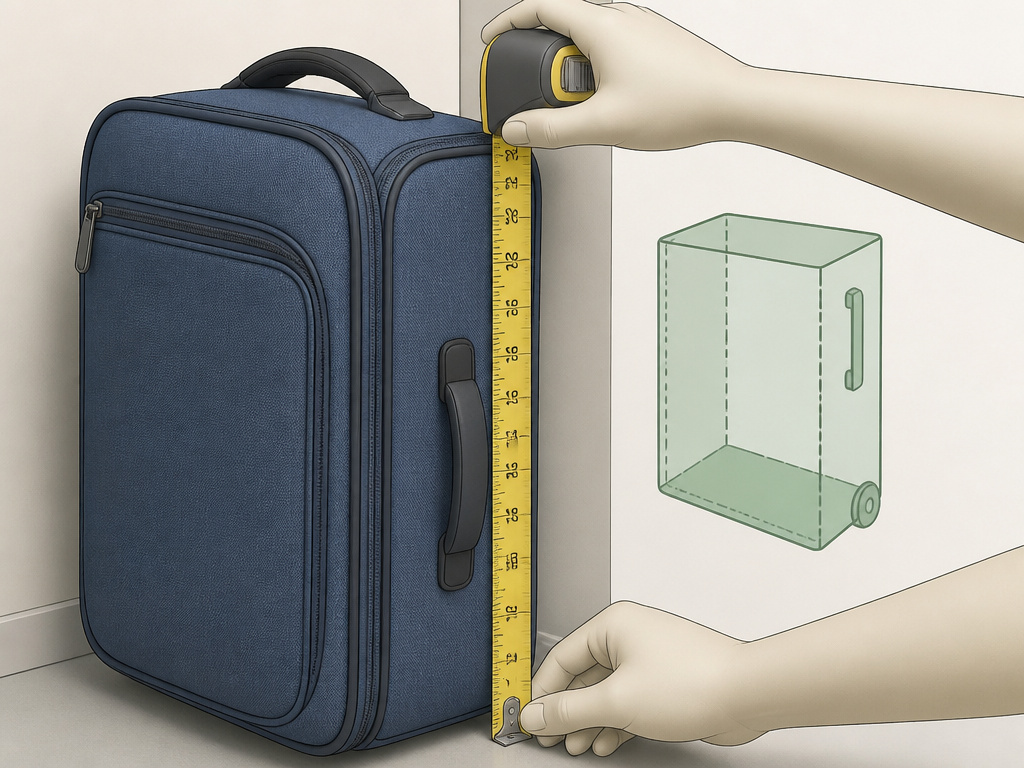
- Measure Height. Run the tape from the floor (bottom of the wheels) straight up to the very top of the extended handle. If your bag has a fabric carry handle that lies flat, measure to the top of the main shell. Record this number.
- Measure Width. Find the widest point. This is often at the side-mounted carry handles or the reinforced base. Don’t follow the taper; go side-to-side at the bulge. Record this number.
- Measure Depth. This is front to back. Include any external pockets bulging with contents. For a hard-shell spinner, it’s usually the box’s dimension. For a soft front pocket, press gently to simulate a full pack and measure at the furthest point.
Now, add the three numbers: Height + Width + Depth = Total Linear Dimensions.
This 58-inch total is your critical number for checked bags. For a standard carry-on bag, you’re typically looking at a 22″ x 14″ x 9″ maximum, but you still sum the dimensions to check against an airline’s specific linear inch rule.
What About Weight?
Dimensions are only half the battle. The ISO 12604-1:2017 standard also sets a mass limit of 23 kg (50 lb) for standard baggage. Exceed that, and the bag requires a special heavy-baggage label and manual handling. Cross 46 kg (100 lb), and it cannot be checked as baggage, it must go as air freight.
Weigh your packed bag with a digital luggage scale. Bathroom scales are notoriously inaccurate at lower weights; a $15 luggage scale hooks onto your handle and lifts the bag for a precise reading. Going over by even a pound can trigger a fee that’s often more expensive than the overweight charge.
Carry-On vs. Checked Bag: The Measurement Shifts
The process is identical, but the stakes and scrutiny change. A carry-on must fit in the overhead bin or under the seat, dimensions that are tighter and more strictly enforced.
| Bag Type | Typical Size Limit | Critical Measurement | Consequence of Failure |
|---|---|---|---|
| Carry-On | 22″ x 14″ x 9″ (varies) | All three dimensions individually. | Gate-check fee, loss of overhead space. |
| Checked Bag | 62 linear inches (H+W+D) | The sum, not individual dimensions. | Oversize fee ($100+). |
| Personal Item | Fits under seat | Depth (front-to-back) is the limiter. | Must be consolidated into carry-on. |
For a carry-on, the height is the usual culprit. That extended handle adds 3-5 inches that people forget. Airlines like Spirit and Frontier are notorious for using sizer boxes with no wiggle room; their published Spirit Airlines size restrictions are exactly what the bin measures.
If you’re using a travel backpack as your personal item, measure it fully packed and compressed. A half-empty backpack can slide under a seat; a full one might not.
When Your Bag is “Non-Conveyable”
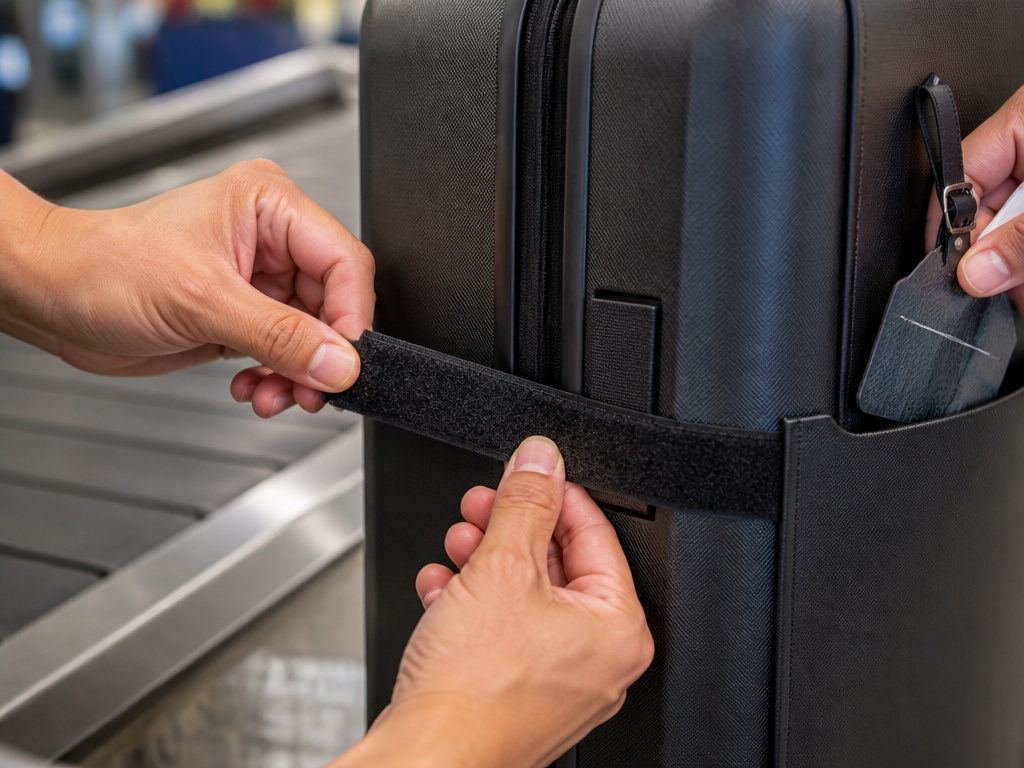
The ISO standard has a clause most travelers never see. Section 4.4.3 states that bags with protruding straps, loose hooks, or an unstable shape should be “reconditioned” (shrink-wrapped or put in an outer bag) to become acceptable for automated systems.
This isn’t theoretical. A duffel bag with long loose straps, a hiking backpack with an external ice axe loop, or a suitcase with a dangling tag can get pulled off the line for manual handling. In a busy hub, that can mean delays. In the worst case, a strap gets caught in a conveyor and tears.
Before you start: Secure all straps with rubber bands or Velcro ties. Remove any external hooks or carabiners that aren’t built-in. Tuck away dangling luggage tags. Make your bag a smooth, stable rectangle.
This also applies to very small or very light bags (under 2 kg / 5 lb). They can tumble or jam in automated systems. If you’re checking a nearly-empty small bag, consider padding it out.
Frequently Asked Questions
Do I measure the suitcase inside or outside?
Always measure the external dimensions. The interior capacity (in liters) tells you how much you can pack, but the outside dimensions determine if you can take it on the plane.
My suitcase is soft-sided and squishy. How do I measure it?
Pack it fully, as you would for travel. For bags with expansion zippers, measure with the expansion fully open. Apply gentle pressure to protruding pockets when measuring depth to simulate a full load. The measurement must reflect the bag’s maximum possible size.
The airline says 62 linear inches. Is that the same as 62 inches tall?
No. This is the most common point of confusion. Linear inches is the sum of height, width, and depth. A bag that is 28 inches tall, 20 inches wide, and 14 inches deep has 62 linear inches (28+20+14). A bag that is 62 inches tall would be enormous and not permitted.
Are airline sizer boxes accurate?
They are the final authority, but their dimensions can sometimes be more generous than the posted rules. A 2023 YouTube investigation found some airline sizers actually allowed an extra inch beyond their stated policy. However, you should never plan on this. Assume the posted dimensions are strict.
Can I bring a backpack and a carry-on suitcase?
Most airlines allow one carry-on suitcase and one personal item, which can be a backpack and carry-on combination. The backpack must fit under the seat. Budget carriers like Frontier and Spirit are stricter and may charge for anything beyond a single small personal item that fits in their specific sizer.
The Bottom Line
Measuring a suitcase isn’t about geometry. It’s about predicting how a piece of luggage will move through a billion-dollar automated system designed for uniform boxes. The ISO standard gives you the engineering limits; the retailer advice gives you the survival guide.
Use a flexible tape on a hard floor. Include every wheel, handle, and bulge. Add the three numbers. Keep that total under 62 inches for checked bags, and under the specific dimensional limits for your airline’s carry-on. Then, secure the straps and hope the guy ahead of you didn’t jam the sizer with his overstuffed bag.
That’s it. That’s the whole game.