TSA Rules: Can I Have Pins on My Backpack at the Airport?
This post contains affiliate links. As an Amazon Associate, we earn from qualifying purchases.
Yes, you can have pins on your backpack at the airport according to the TSA, but the final decision rests with the officer at the checkpoint. The unofficial but critical rule is the 6-centimeter (2.4-inch) limit for sharp points. Pins under that length, like most enamel pins, generally pass in carry-on and checked bags. Longer, sharper stick pins risk confiscation.
That officer discretion clause is the whole game. It’s not a loophole. It’s a non-negotiable line drawn by the person looking at your bag on the day you travel. The TSA’s official database says “yes” to stick pins, but a single officer can call a spiky pin a “potential puncture hazard” and take it.
What follows: the exact rule from the TSA’s own site, the 6cm measurement that decides most confiscations, a head-to-head on packing methods, and the international rules that flip the script entirely.
Key Takeaways
- The TSA’s official “Stick Pins” entry says “Yes” for both carry-on and checked bags, but officers have final, unreviewable discretion.
- An unofficial 6-centimeter (2.4-inch) rule is the practical threshold; sharp points longer than this are often treated as prohibited items.
- Pack pins in a hard case or pin book inside your carry-on, loose metal clusters look suspicious on X-rays and guarantee a hand search.
- For international travel to the UK, Australia, or EU countries, treat all pins as checked-baggage-only; their rules are stricter and less predictable.
- The FAA’s hazardous material rules are separate from TSA security rules; pins are a security item, not a hazmat concern.
The Official TSA Rule on Pins (and the Unofficial 6cm Limit)
The Transportation Security Administration publishes an alphabetical list of items. Under “Stick Pins,” it simply says “Yes” for carry-on and checked bags. That’s the entire official rule. There is no published length limit, no sharpness gauge, no quantity restriction.
The final decision rests with the TSA officer on whether an item is allowed through the checkpoint.
This sentence appears on the TSA’s main guidance page. It means the “yes” on the list is a starting point, not a guarantee. An officer assesses three things in real time: the pin’s length, the sharpness of its point, and its apparent intent. A 6-centimeter (about 2.4-inch) post length is the widely cited unofficial limit that guides most officers. If the sharp part exceeds that, it shifts from a decorative item to a potential weapon in their protocol.
Why does this measurement exist? It aligns with the general classification for prohibited sharp objects. Scissors with blades under 4 inches are allowed; over 4 inches, they are not. The 6cm rule for pins follows the same risk-assessment logic. A pin longer than a credit card is long enough to cause injury, which moves it into a discretionary category.
| Pin Type | Generally Allowed? | Key Risk Factor |
|---|---|---|
| Standard Enamel Pin (post < 6cm) | Yes, in carry-on or checked. | Metal clusters on X-ray may trigger inspection. |
| Stick / Hat Pin (post > 6cm) | At officer’s discretion. High confiscation risk. | Length and sharp point mimic a prohibited item. |
| Safety Pins / Bobby Pins | Yes, in any bag. | Quantity matters; a large loose pile looks odd on X-ray. |
The officer isn’t measuring with a ruler. They’re making a visual threat assessment. If your pin collection includes anything long, thin, and sharply pointed, assume it could be taken. Pack those in checked luggage, and sheath the points.
How Airport Security Scanners See Your Pins
Your backpack goes through an X-ray machine. The security officer sees a color-coded image: organic materials (like clothing) appear orange, metals are blue or black, and dense objects are green. A single enamel pin is a tiny blue speck. A dozen pins clustered on a strap become a solid, unexplained blue mass.
Where this goes sideways: Loose pins scattered in a bag pocket. On the X-ray, it looks like a handful of sharp, fragmented metal. That pattern is a textbook trigger for a bag search. Every pin will be inspected individually.
Metal pins can also trigger the walk-through metal detector. If you’re wearing a jacket covered in pins, you’ll likely alarm. The process then stops for a pat-down or a hand-wand inspection. The solution is simple: remove the jacket and send it through the X-ray machine in a bin. Better yet, pack the pinned jacket in your carry-on before you reach the checkpoint.
The goal is to make the security officer’s job easy. A clear, organized image gets a quick pass. A chaotic image of metal fragments gets a full stop.
Packing Pins: Carry-On vs. Checked Bag Strategy
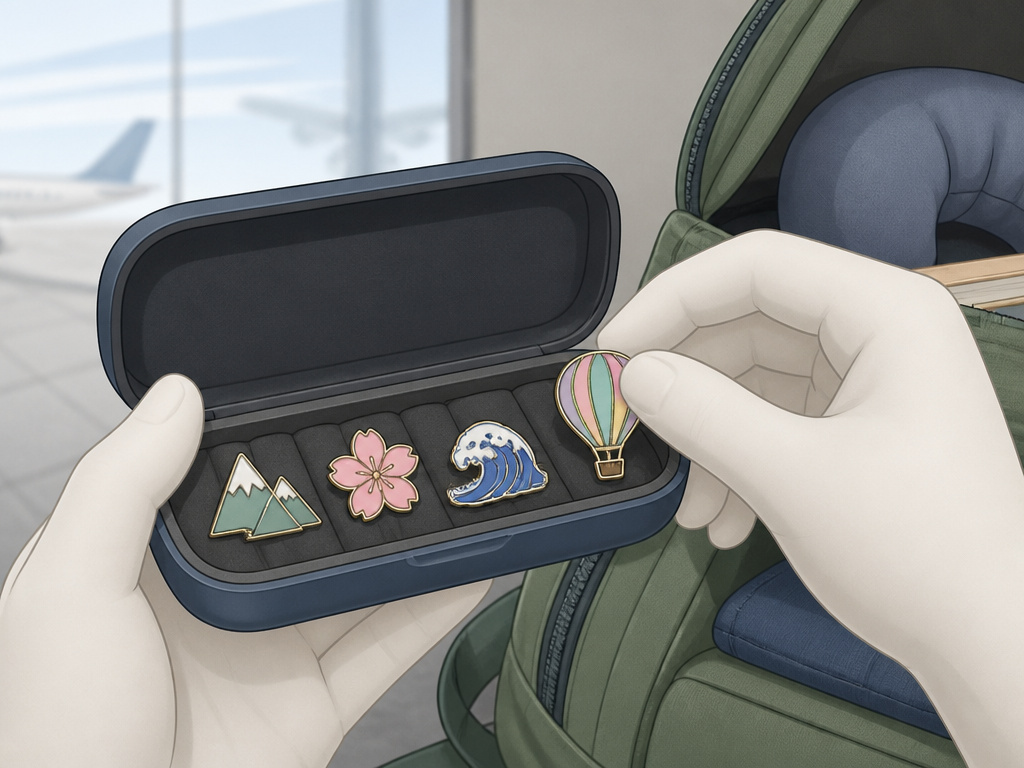
Your decision depends on the pin’s value and its sharpness. The trade-off is control versus risk.
Carry-On Bag (Recommended for valuable collections):
This is the move for sentimental, rare, or expensive pins. You retain control and prevent loss or damage from rough baggage handling. The method is non-negotiable: use a pin book, a hard-shell glasses case, or a small zippered pouch. Secure each pin with its rubber or metal backing. This keeps them organized, prevents points from scratching other items, and presents a single, intelligible object on the X-ray.
Checked Bag (For non-essential or very sharp pins):
The checked bag is a black box. It avoids the security checkpoint hassle but introduces risk of loss and damage. If you must pack sharp pins here, you must sheath the points. Push each pin into a wine cork, a piece of thick foam, or wrap the point tightly with painter’s tape. This protects baggage handlers and prevents pins from becoming projectiles if your bag is tossed.
Common mistake: Tossing loose pins into a checked bag. A sharp point can puncture a toiletry bag, stab a garment, or, in a worst-case scenario, injure a handler. The tape-or-cork step takes two minutes and prevents it.
International Travel: When the Rules Get Strict
The TSA’s “yes” means nothing once you leave the United States. Other countries have their own aviation security authorities, and their rules are often more stringent and less publicly detailed.
- United Kingdom: UK security is notoriously strict. Their guidelines prohibit items with sharp points in hand luggage. A pin of any length could be confiscated at their discretion.
- Australia: The Department of Home Affairs prohibits any item “that could be used to cause injury” in carry-on baggage. This is a broad rule that gives officers maximum leeway.
- European Union: Rules vary by member state, but the principle of officer discretion is universal. Enforcement can feel stricter in major hubs like Frankfurt or Amsterdam.
For any international flight, the safest protocol is to treat all pins as checked-baggage-only. Research the aviation security website for your destination country, but when in doubt, check them. The consequence of guessing wrong is surrendering a pin at the gate.
TSA vs. FAA: Understanding the Two Rulebooks
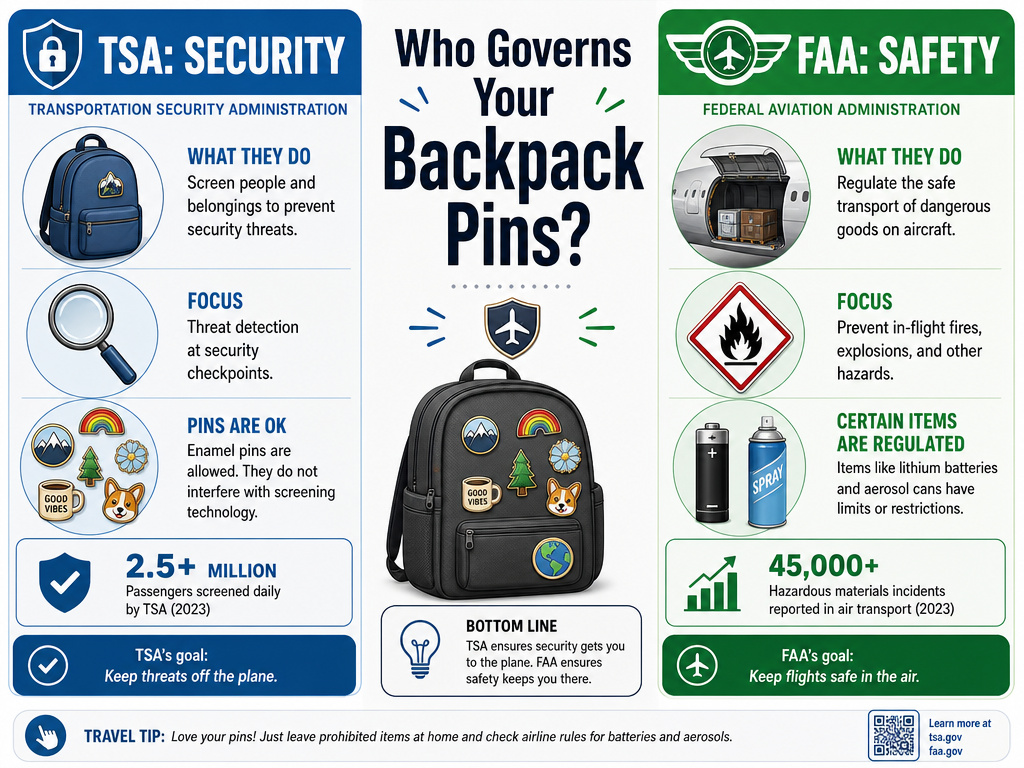
This is a critical distinction that most travelers miss. Two different federal agencies govern what’s in your bag, and they have different goals.
- TSA (Transportation Security Administration): Focuses on security threats, items that could be used as weapons in the cabin. Pins fall under their jurisdiction.
- FAA (Federal Aviation Administration): Focuses on safety threats, hazardous materials (hazmat) that could cause fires, explosions, or toxic leaks in the cargo hold. Pins are not a hazmat concern.
The FAA’s PackSafe for Passengers guide is about batteries, aerosols, and flammable liquids. You check it for your power bank, not your pin collection. The TSA’s interactive TSA carry-on item checker is where you look up pins, tools, and scissors. Knowing which agency handles what saves confusion.
Frequently Asked Questions
Can I wear my pinned backpack through security?
You can, but it’s not recommended. The metal will show as a dense cluster on the X-ray, guaranteeing a secondary inspection. You’ll be asked to remove the backpack, and the officer will likely hand-check each pin. Save time by placing your backpack in a bin before it enters the X-ray tunnel.
Are safety pins allowed on planes?
Yes, safety pins are allowed in both carry-on and checked bags according to the TSA. However, a large quantity of loose safety pins may look unusual on the X-ray and prompt a bag check. Keep them in a small container.
What happens if a TSA officer takes my pin?
If an officer deems a pin prohibited, you have three options: 1) Voluntarily surrender it, 2) Place it in your checked baggage (if you haven’t already checked it), or 3) Exit the security checkpoint and mail it to yourself. There is no appeals process at the checkpoint.
Do plastic or acrylic pins go through security easier?
Yes. Non-metal pins do not trigger metal detectors and present a less dense image on the X-ray. They are far less likely to attract additional scrutiny. If you have a valuable metal collection, consider traveling with acrylic alternatives.
How many pins are too many?
There’s no numerical limit. The issue is presentation. Twenty pins neatly arranged in a book will pass. Five pins loose at the bottom of a bag might trigger a search. It’s about the X-ray image, not the count.
The Bottom Line
You can fly with pins on your backpack. The system works if you follow the unwritten rules: keep sharp points under 6cm, organize metal in a solid case, and never assume international security plays by TSA’s book. For a domestic trip, a pin book in your carry-on is the answer. For anything overseas, check them, and wrap the points. The goal isn’t to beat security; it’s to move through it without becoming a story. Pack smart, and your collection lands with you.