Can a School Search Your Backpack Legally? Know the Limits
This post contains affiliate links. As an Amazon Associate, we earn from qualifying purchases.
A school can search your backpack if a school official has reasonable suspicion that the search will uncover evidence of a violation of school rules or the law. This standard, established by the Supreme Court, is lower than the probable cause required for police. The search must be justified at its start and reasonable in scope, considering the student’s age and the suspected infraction.
That “reasonable suspicion” clause is the load-bearing wall of student search law. It’s not a feeling or a hunch. It requires specific, articulable facts that would lead a reasonable person to suspect wrongdoing. The search’s scope must directly relate to those facts. Looking for a stolen calculator doesn’t justify rifling through a diary.
This guide walks through the legal precedent that created this exception to the Fourth Amendment, the hard limits the courts have since drawn, and the critical differences between a school administrator’s search and a police officer’s. You’ll see where state law can be stricter than federal rulings, what happens to property you leave behind, and the single type of search that is almost always unconstitutional.
Key Takeaways
- Schools need reasonable suspicion, not a warrant or probable cause, to search a student’s backpack.
- A search must be justified at its inception and reasonable in scope, looking for a large stolen textbook doesn’t justify inspecting a small pencil case.
- Strip searches are highly scrutinized and banned outright in states like Oklahoma; the Supreme Court ruled a strip search for ibuprofen unconstitutional.
- School property like lockers is different, students often have no expectation of privacy in lockers, desks, or other school-owned items.
- Unattended property can sometimes be searched under school safety protocols even without direct suspicion of the owner.
The Legal Standard: Reasonable Suspicion
The rule comes from a 1985 cigarette case. In New Jersey v. T.L.O., a student was caught smoking. When she denied it, an assistant principal searched her purse, found cigarettes, and then discovered rolling papers and marijuana. The Supreme Court had to balance a student’s Fourth Amendment rights against a school’s need to maintain order.
The legality of a search of a student should depend simply on the reasonableness, under all the circumstances, of the search. A search will be justified at its inception where there are reasonable grounds for suspecting it will turn up evidence of a rule or law violation. It will be reasonable in scope when the measures adopted are reasonably related to the objectives of the search and not excessively intrusive.
The Court created a two-part test. First, was the search justified at the start? Second, was the search as conducted reasonably related to those initial grounds? This “reasonable suspicion” standard is deliberately lower than the “probable cause” required for police. It acknowledges that teachers aren’t detectives and schools aren’t courtrooms, but it doesn’t give them carte blanche.
Reasonable suspicion is not a guess. It requires concrete facts. A teacher seeing a student use a phone in class provides reasonable suspicion to confiscate the phone. A rumor from an unreliable source that a student might have a phone does not. The Supreme Court T.L.O. Ruling is the bedrock. Everything else builds on it.
What Makes a Search Unreasonable?
A search that starts with reasonable suspicion can still cross the line. The scope is the battleground. The search must be logically tailored to find the suspected item without being unnecessarily invasive.
| Suspected Item | Reasonable Search Scope | Excessively Intrusive Scope |
|---|---|---|
| Stolen textbook | Inspecting main backpack compartment, checking under loose papers. | Reading personal journal entries, opening sealed makeup bag. |
| Cell phone (banned in class) | Confiscating phone from student’s hand or desk. | Patting down the student, demanding to empty pockets. |
| Prescription pills | Searching outer clothing pockets, backpack compartments. | Requiring removal of underwear or a strip search. |
The most famous case on intrusiveness is Safford Unified School District #1 v. Redding (2009). A 13-year-old was accused of possessing ibuprofen. After a search of her backpack and outer clothing found nothing, school officials subjected her to a strip search. The Supreme Court called it “excessively intrusive.” The nature of the infraction, possession of non-prescription pain relievers, did not justify such a severe invasion of privacy.
Where this goes sideways: Expanding a search beyond its original justification. In the T.L.O. Case, finding cigarettes gave reasonable suspicion to look for rolling papers or drugs, the items were logically connected. Finding a phone does not give reasonable suspicion to scroll through messages looking for evidence of bullying. That’s a new search requiring its own justification.
Some states have drawn even clearer lines. Oklahoma law explicitly states: “In no event shall a strip search of a student be allowed.” It also limits clothing removal during any warrantless search to cold-weather outerwear, shoes, and non-religious head coverings. A local school search policies manual will often spell out these prohibitions.
School Property vs. Your Property: A Critical Difference

The law treats your backpack and your school locker very differently. Your backpack is considered personal property. You have a legitimate expectation of privacy in it, which triggers the reasonable suspicion standard.
School lockers, desks, and laptops are usually considered school property. Many school policies, and some state laws, explicitly state that students have no reasonable expectation of privacy in these items.
- Oklahoma Statute §70-24-102: “Pupils shall not have any reasonable expectation of privacy towards school administrators or teachers in the contents of a school locker, desk, or other school property… May be opened and examined by school officials at any time and no reason shall be necessary for such search.”
- Texas School for the Deaf Policy: “Desks, lockers, school-provided technology, and similar items are the property of TSD… Students have no expectation of privacy in school property.”
This means a school official can open your locker without reasonable suspicion, especially if the school handbook says they can. However, your backpack inside that locker is still your property. To search the backpack itself, they likely still need reasonable suspicion. This dual standard trips up many students and parents.
When You’re Not There: Searches of Unattended Property

What if you leave your backpack in the cafeteria? The legal calculus shifts toward school safety. The 2017 Ohio Supreme Court case State v. Polk is key here. A school security officer searched an unattended book bag based on a general school protocol for checking abandoned bags for safety threats.
The court upheld the search. It ruled that the school’s compelling interest in protecting students from physical harm justified the protocol. The search was limited to that safety objective and was reasonable. This differs sharply from a search targeting a specific student based on suspicion.
Common mistake: Assuming leaving your bag unattended “waives” your rights. It doesn’t create a free-for-all. The search should still be tied to a legitimate safety protocol, not used as a pretext for a fishing expedition. A school couldn’t use an “unattended bag” protocol to systematically search every student’s backpack for gum or notes.
If your bag is left behind, school officials might first try to identify the owner. If they have reasonable suspicion about you, they could then search it. If they don’t, a search like in Polk might be allowed, but its scope should be narrow, looking for immediate safety threats like weapons, not reading your homework. The Ohio Supreme Court ruling details this balance.
School Officials vs. Police: Who Needs What?
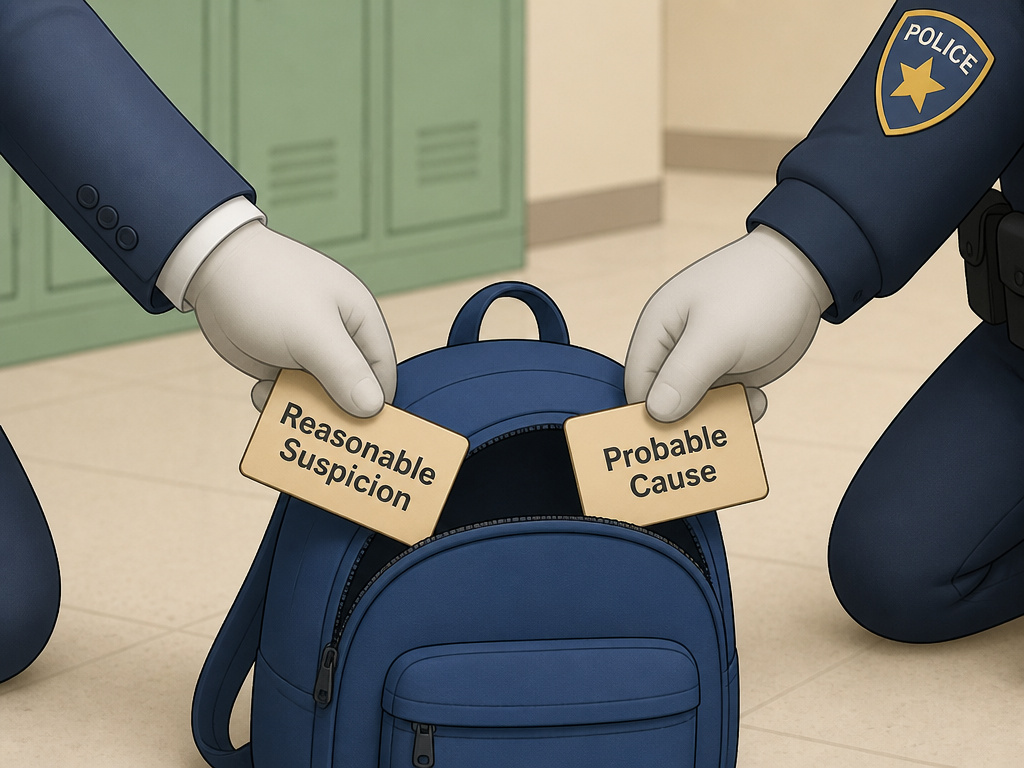
This is the most important practical distinction. The “reasonable suspicion” standard applies to school officials acting in their capacity as school authorities. This includes teachers, principals, and security personnel employed by the school district.
A School Resource Officer (SRO) or any sworn police officer working in a school is held to a higher standard. When they act as law enforcement, they typically need probable cause, a higher level of evidence, or a warrant to search. They cannot use the school’s lower standard as a shortcut.
- Scenario: A teacher smells marijuana coming from a student’s backpack. The teacher has reasonable suspicion to search the bag.
- Scenario: The same situation, but the teacher calls the SRO. The SRO cannot search the bag based solely on the teacher’s suspicion. The SRO needs their own probable cause or must get the student’s consent.
The line can blur, but the principle is clear. The special rules for schools exist because of the unique educational environment. They don’t extend to police. Knowing who is conducting the search tells you what legal standard applies.
Your Rights During a Search
You retain certain rights even under the reasonable suspicion framework. Exercising them calmly is crucial.
- Ask for the reason. You have the right to know why you are being searched. A legitimate official should be able to articulate the reasonable suspicion. “We received a report” or “I observed you hiding something” are valid starts. “Because I said so” is not.
- You can say, “I do not consent to this search.” This doesn’t physically stop the search if the official has reasonable suspicion, but it creates a clear record. It matters later if the search’s legality is challenged.
- Request a witness. Many school policies, and laws like Oklahoma’s, require searches to be witnessed by another authorized person, preferably of the same sex. You can ask for a witness to be present.
- Document everything immediately after. Write down who searched you, when, where, what they said they were looking for, what they did, and what they found. Memory fades; a contemporaneous note is powerful.
- Know the limits on intrusion. As established, strip searches and forced removal of most clothing are almost always unreasonable for minor infractions. Knowing the Congress.gov Constitution annotation on the Fourth Amendment’s application helps you understand the boundary.
If you believe a search was illegal, you or your parents can challenge it. Evidence obtained from an unreasonable search may be suppressed in a school disciplinary hearing and is inadmissible in juvenile court. You may also have grounds for a civil lawsuit for violation of your constitutional rights.
Frequently Asked Questions
Can a school search my backpack without any reason?
No. The Supreme Court requires at least “reasonable suspicion.” A random, suspicionless search of your personal backpack is unconstitutional. However, general safety screenings like walking through a metal detector or having a drug-sniffing dog sweep common areas are usually permitted.
What if I refuse to let them search my bag?
You can refuse. However, if the school official has reasonable suspicion, they can proceed with the search despite your refusal. Your refusal does not erase their legal justification. It may, however, lead to separate disciplinary action for disobedience.
Can they search my phone if they find it in my bag?
Maybe. Finding a phone in a bag during a lawful search doesn’t automatically justify scrolling through it. To search the digital contents, the official would need a new, separate reasonable suspicion that the phone contains evidence of a violation. The same two-part test applies.
Are the rules the same in every state?
The federal standard from New Jersey v. T.L.O. applies nationwide. However, individual states can pass laws that provide more protection to students, not less. Oklahoma’s ban on strip searches is an example of a stricter state rule. Always check your local theme park bag rules for analogous examples of how location-specific policies work.
The Bottom Line
A school’s authority to search your backpack is real but bounded. The key is “reasonable suspicion” tied to specific facts. That search must stay within the scope of those facts and respect your age and dignity. Your backpack is yours, but in the school environment, your privacy interest is balanced against the school’s duty to keep everyone safe.
Know the difference between your locker and your bag, between a teacher and a police officer, and between a reasonable search and an intrusive one. The rules exist to protect both safety and rights. Understanding them is the first step in making sure both are respected.