Can a Teacher Search Your Backpack? Legal Grounds & Limits
This post contains affiliate links. As an Amazon Associate, we earn from qualifying purchases.
A teacher can search your backpack if they have reasonable suspicion you violated a school rule or law, and the search is reasonable in scope. This is a lower standard than the “probable cause” police need. School-owned property like lockers can be searched at any time with no suspicion.
That’s the legal baseline. The real friction happens in the specifics: what counts as “reasonable,” what makes a search “excessively intrusive,” and when a school’s policy overrides individual rights. State laws like Iowa’s Code 808A.2 and Oklahoma’s Title 70 carve out clear lines, and Supreme Court cases like Safford v. Redding set the outer boundaries.
The rest breaks down the legal standard, the practical rules for different types of property, and what you can actually do if a search feels wrong. By the end, you’ll be able to read any school handbook’s search policy and know exactly where its authority comes from and where it might be bluffing.
Key Takeaways
- The legal threshold is reasonable suspicion, a specific, articulable reason to believe a search will find evidence of a rule or law violation. A hunch isn’t enough.
- School-owned property like lockers and desks can be inspected at any time without suspicion, as students have no expectation of privacy there.
- A search must be reasonable in scope, more invasive searches require stronger justification and must be less intrusive for younger students.
- Strip searches are almost universally banned by state law and Supreme Court precedent unless there’s an immediate threat of serious harm.
- Schools must publish their search policies in student handbooks, and these policies cannot grant more power than state and federal law allows.
The Legal Standard: Reasonable Suspicion vs. Probable Cause
Forget what you see on TV. Police need probable cause, a high degree of certainty, to get a warrant. In school, the bar is lower. The U.S. Supreme Court established in New Jersey v. T.L.O. that school officials only need reasonable suspicion to search a student or their personal belongings.
A school official may search individual students and individual protected student areas if the official has reasonable grounds for suspecting that the search will produce evidence that a student has violated or is violating either the law or a school rule or regulation. The search must be reasonably related to the objectives of the search and not excessively intrusive.
This two-part test from the Congress Constitution Annotated essay is the national framework. Reasonable suspicion means a moderate chance of finding evidence, based on facts, not a rumor or a gut feeling. The second part is the scope: searching for a stolen phone doesn’t justify a strip search.
Where this goes sideways: A teacher hears a phone vibrate in a bag during a test. That’s a specific fact tied to a rule violation (no phones). It likely justifies looking in the bag. If the same teacher, based on a vague “feeling,” empties every student’s backpack after class, that’s a hunch. It wouldn’t hold up.
What Does “Excessively Intrusive” Mean?
The more personal the search, the stronger the justification needed. The Supreme Court’s 2009 decision in Safford Unified School Dist. #1 v. Redding is the textbook example. A 13-year-old girl was strip-searched based on a classmate’s claim she was hiding ibuprofen. The Court ruled the search unconstitutional, looking for pills did not justify that level of intrusion.
The ruling underlined that the nature of the suspected infraction dictates the permissible scope. Searching for a weapon reported in a specific backpack is one thing. Using that report to justify pat-downs of every student in the hallway is another.
School Property vs. Your Property: Two Different Rulebooks

The law draws a bright line between what the school owns and what you own. This distinction changes everything.
School-Owned Property: Lockers, Desks, and School-Issued Tech
According to the Iowa student search statute, the school board retains exclusive control. Providing a locker is a “courtesy,” and it “shall not give rise to an expectation of privacy.” This means: – Schools can conduct periodic, random inspections without any suspicion. – They must notify students and parents of this policy in the handbook each year. – Even if you use your own lock, it doesn’t create privacy rights in the eyes of the law.
Your Personal Property: Backpacks, Purses, Phones, and Clothing
This is where the “reasonable suspicion” standard fully applies. Your backpack is considered an extension of your person. A school official needs that specific, articulable reason to look inside it.
| Type of Property | Privacy Expectation | Search Standard | Typical Justification Needed |
|---|---|---|---|
| School Locker | None | No suspicion needed | Routine inspection, random check |
| Student Backpack | High | Reasonable suspicion | Specific tip, visible bulge, suspicious behavior |
| Student’s Person (Clothing) | Very High | Reasonable suspicion (higher bar) | Strong, direct evidence of concealment |
| Cell Phone / Device | High | Reasonable suspicion or warrant | Often requires individual suspicion, not blanket policy |
The practical takeaway? Don’t treat your locker as a safe. It isn’t. Your backpack, on your person, has much stronger protection. Knowing the difference helps you understand where a teacher’s authority starts and stops during a school backpack search.
When “No Reason” Is Actually a Reason: Unattended Bags and Safety Protocols
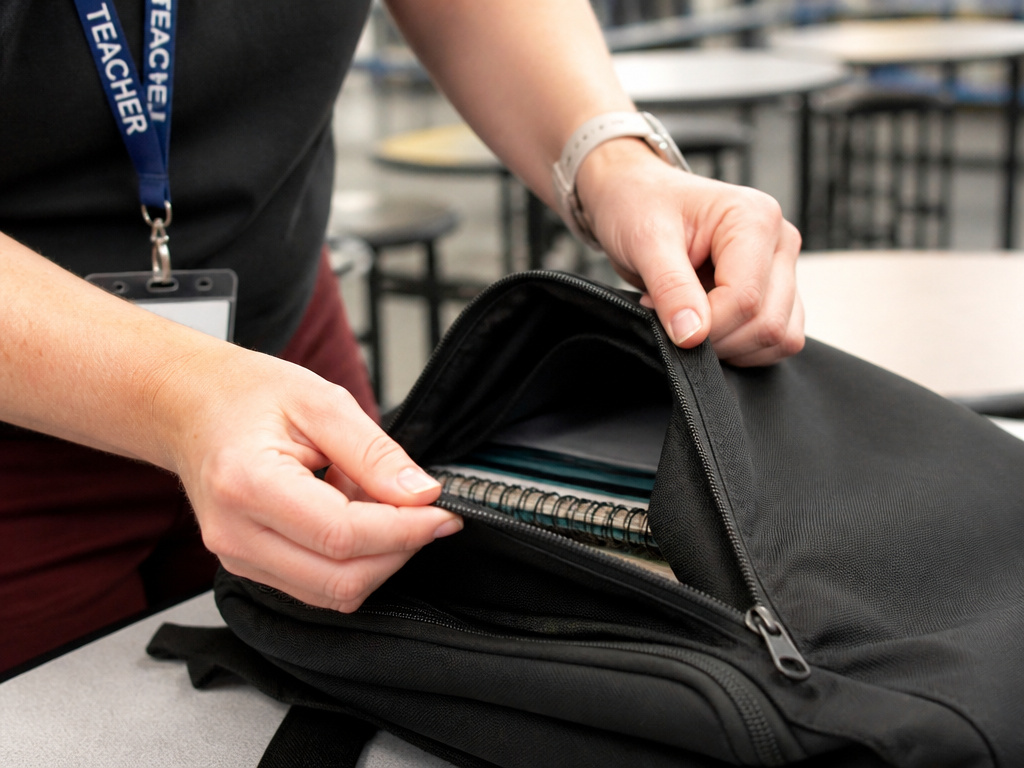
What about a bag left alone in the cafeteria? This is a critical edge case. The Ohio Supreme Court ruling in State v. Polk tackled it directly. The court upheld a school’s search of an unattended book bag under a pre-existing safety protocol designed to find weapons or drugs.
The logic was compelling government interest. An unattended bag could pose an immediate threat. A blanket policy to search all such bags, applied neutrally, can be reasonable even without individualized suspicion. This isn’t a teacher picking on you; it’s a safety procedure applied to every unclaimed bag.
The part nobody mentions: This exception is narrow. It applies to genuinely unattended property in a common area under a written, known protocol. A teacher cannot use “it was unattended” as a pretext to rifle through your bag on your desk while you’re at the pencil sharpener. The bag must be truly abandoned in a public space, and the policy must exist to address a specific safety threat.
What a Legal Search Looks Like (And What Crosses the Line)

Let’s get concrete. A legal search follows a progression: it starts with the least intrusive method and escalates only if justified.
- The Initial Question or Observation. A teacher sees a student acting nervously, clutching their 30-liter backpack tightly after a series of locker thefts. Or they smell smoke and trace it to a specific student.
- The Request. The teacher asks the student to open the bag. They can refuse, but refusal itself can sometimes strengthen reasonable suspicion.
- The Search. If the student complies or the official has sufficient grounds, they may open the bag. They should do so with the student present, ideally with another staff member as a witness. The search should be targeted, looking for a large stolen textbook doesn’t mean reading personal diaries found inside.
- The Outcome. If something is found, it’s seized. The student must be informed. If nothing is found, the search ends. The process should be documented.
Common mistake: Emptying every single item from a backpack onto a public table to find a single missing pen. The scope is wildly disproportionate to the alleged infraction. This turns a minor inquiry into a humiliating and likely unlawful display.
Strip searches are in a category of their own. Both Iowa and Oklahoma law explicitly ban them. The Supreme Court’s Redding decision made it clear: strip searches are “excessively intrusive” for all but the most dire threats, like a reported firearm or explosive. Even then, the search must be conducted by someone of the same sex, in private, with another adult witness present. In practice, it should almost never happen without law enforcement involvement.
Your Rights and Realistic Responses
Knowing the law is one thing. Knowing what to do in the moment is another. You have rights, but exercising them requires tact.
- You can ask for the reason. A simple, calm “Can you please tell me why you need to search my bag?” is legitimate. It forces the official to articulate their reasonable suspicion. If they can’t, the search is shaky.
- You can refuse consent. This is your right. However, be aware that refusal may lead to escalation, detention, calling parents, or even involving school resource officers. The official may then need to decide if their suspicion is strong enough to proceed without your consent.
- You have the right to be present. For a search of your personal property, you should be there. For a locker search, you may not be, but you must be notified after the fact.
- Document everything. Write down the date, time, official’s name, the reason given, what was searched, and what, if anything, was taken. This record is crucial if you need to challenge the search later with a parent or administrator.
What you shouldn’t do: physically resist, become belligerent, or lie. That turns a legal discussion into a disciplinary issue. The goal is to understand the legal grounds for a search while protecting your privacy, not to win an argument on the spot.
Think of your backpack as a personal item with strong, but not absolute, protection. Just as TSA has rules for airport security, your school has rules for its hallways. The key is knowing where those rules are written, in the law, not just in a teacher’s discretion.
Frequently Asked Questions
Can a teacher search my backpack without me present?
Yes, but it’s legally riskier for them. For a personal item like a backpack, best practice and many district policies require the student’s presence. If you’re not there, the official must have a very good reason (like an immediate threat) and must inform you of the search as soon as practicable afterward.
What about my cell phone? Can they search that?
This is a gray area getting clearer. Your phone has high privacy expectations. A school generally needs reasonable suspicion that the phone contains evidence of a specific, serious violation (like threats, harassment, or drug deals) to search it. They can’t just confiscate it and scroll through your messages because you were using it in class. Some states now require warrants for law enforcement to search phones, which influences school policy.
My school handbook says they can search anything, anytime. Is that legal?
Not exactly. A handbook can inform you of the rights the law already gives them. It cannot grant the school more power than state and federal law allows. A policy claiming unlimited search authority is likely overbroad and wouldn’t hold up in a challenge. The handbook must align with the legal standards of reasonable suspicion and scope.
Can they use drug-sniffing dogs on our backpacks?
On lockers or unattended bags in empty classrooms? Often yes, as part of a random, neutral security procedure. On your person or the backpack you are carrying? That’s a significant intrusion. According to one Texas school district policy, a dog sniffing a student directly constitutes a search requiring individualized reasonable suspicion. The dog can’t be used as a shortcut to bypass your rights.
Before You Go
A teacher’s authority to search your backpack isn’t unlimited. It’s anchored in reasonable suspicion, bounded by the scope of the infraction, and heavily influenced by whether the property is yours or the school’s. State laws like Iowa’s Code 808A.2 provide the fine print, and Supreme Court cases draw the bright red lines, especially around strip searches.
Your best defense is knowledge. Read your school’s handbook policy on searches. Understand that a locker is not private space. Know that you can calmly ask for the reason behind a search of your backpack as carry-on. This isn’t about defeating school rules; it’s about ensuring those rules are applied fairly, lawfully, and with respect for the privacy rights that follow you through the schoolhouse gate.