What Is a Bug Out Bag | The Kit That Actually Works
This post contains affiliate links. As an Amazon Associate, we earn from qualifying purchases.
A bug out bag is a portable, pre-packed kit designed to sustain you for at least 72 hours during a mandatory evacuation from a disaster. Its core purpose is rapid departure, not long-term wilderness survival, and its contents must match your specific region, transportation plan, and the harsh reality that most official packing lists are impractical under actual evacuation pressure.
That last point isn’t a guess. A 2018 study in Prehospital and Disaster Medicine flatly states that kits built from common civilian agency guides become unworkable when you actually have to move. Your bag isn’t a camping checklist. It’s a calculated balance between weight, utility, and not drawing a target on your back in a stressed crowd.
What follows is a breakdown of the 72-hour rule, the non-negotiable essentials, and the one style decision that matters more than any fancy gadget. By the end, you’ll know how to build a bag that works for a car-bound family evacuation or a solitary trek, based on what people who have actually used them say they needed.
Key Takeaways
- The 72-hour timeframe comes from disaster relief timelines, not human endurance. It’s the window you assume you’re on your own.
- Location dictates gear. An urban evacuation bag looks different from a wilderness bug-out bag; mixing them is the first mistake.
- Most agency checklists are too bulky. A peer-reviewed study calls them “impractical” for real evacuation scenarios.
- Concealment (“Gray Man”) often beats tactical looks. In a crisis, a flashy military-style pack can make you a target.
- Your vehicle is your primary bug-out asset. Planning a long-distance hike ignores family, pets, and the simple math of carrying weeks of supplies.
What Is a Bug Out Bag, Really?
A bug out bag is your lifeline, condensed into a backpack or duffel. Its other names, 72-hour kit, GOOD bag (Get Out Of Dodge), go-bag, all point to the same function: a grab-and-go repository for the absolute essentials needed to survive the first three days after you’re forced to leave home.
The 72-hour standard isn’t arbitrary. Disaster management organizations note it can take that long for coordinated relief to reach affected areas. Your bag bridges that gap.
A 2018 study in the journal Prehospital and Disaster Medicine analyzed civilian emergency kit guidelines and concluded: “A large number of civilian agencies have published guides… However, the kits resulting from following these guidelines are impractical, particularly in the event evacuation becomes necessary.”
This is the central tension. Official lists like the comprehensive Ready.gov emergency kit guide provide a vital baseline, one gallon of water per person per day, non-perishable food, prescriptions. But they can balloon into a 50-pound load meant for sheltering in place, not moving quickly. Your job is to edit ruthlessly for mobility.
The bag’s origin is military, evolving from “bail-out bags” for aviators and “bug out” retreat protocols. The civilian adaptation sometimes misses the point. It’s not about thriving in the woods; it’s about surviving the journey to safety.
What Goes in a Bug Out Bag?
This is where most guides dump a 100-item checklist and call it a day. Don’t start there. Start with the four pillars: Water, Food, Shelter, and Security. Every item must serve at least one pillar, and ideally two. Weight is your enemy; redundancy is your friend, but only if it’s lightweight.
Common mistake: Packing for every possible scenario. You end up with a bag too heavy to run with and no clear plan for any single disaster.
Here’s a lean, priority-sorted framework. The specific products named are examples that appear consistently in real-user kits and expert reviews.
Water (The Non-Negotiable)
You need one gallon per person per day. Carrying three gallons (24 pounds) is impossible. The solution is a hybrid approach: carry some, treat more. – Carry: A 3-liter hydration bladder (like a CamelBak reservoir) is better than bulky bottles. It sipps hands-free and fits in most packs. – Treat: A Sawyer Squeeze water filter is the default pick for a reason. It filters to 0.1 microns, weighs ounces, and screws onto standard plastic bottles. Pair it with a few AquaTabs tablets as a chemical backup. If you’re in a city with uncertain water access, the filter is your single most important item.
Food (Calories, Not Cuisine)
Forget cans. Think calorie-dense, stable, and requiring minimal preparation. – Main: 2,000+ calorie emergency food bars (like Datrex or Mayday) pack flat and last years. MREs are heavier but provide heat-and-eat meals. – Boost: Electrolyte packets and caffeine pills weigh nothing and fight fatigue better than trying to brew coffee. – Tool: A single-wall stainless steel bottle (like a Klean Kanteen) can boil water over a fire if needed.
Shelter & Comfort (Regulate Temperature)
Hypothermia and heatstroke don’t wait. – Core: An emergency Mylar blanket (or better, a bivvy sack) reflects 90% of your body heat and packs to the size of a deck of cards. A cheap poncho is a waterproof layer. – Upgrade: A lightweight backpacking tarp (like the Aqua Quest Guide) and paracord can create a quick shelter. – Critical Extras: A change of wool socks, moisture-wicking base layer, and a beanie. Wet feet stop a journey faster than anything.
First Aid & Tools
This is not a full medicine cabinet. It’s for stabilizing a situation until you can get help. – Kit: A compact adventure medical kit focused on bleeding control (tourniquet, gauze, hemostatic agent), wound cleaning, and blister care. – Tools: A Leatherman Skeletool combines pliers, knife, and driver. Trauma shears cut clothing and gear. A Bic lighter and ferrocerium rod provide fire. – Light: A Fenix PD35 or similar high-lumen headlamp is safer than a flashlight, leaving your hands free.
| Category | Essential Item | Why It’s Non-Negotiable | If You Skip It… |
|---|---|---|---|
| Water | Sawyer Squeeze Filter | Provides safe water from virtually any source; 100,000-gallon lifespan. | You become dependent on carried water, which runs out in <2 days. |
| Shelter | Mylar Bivvy Sack | Reflects body heat, waterproof, packs tiny. Prevents hypothermia in wet conditions. | A cold rain soaks you; core temperature drops within hours, leading to dangerous fatigue. |
| Tools | Multi-tool & Lighter | Fixes gear, prepares resources, starts fire for warmth/water purification. | Simple breakdowns become major obstacles; cold food and untreated water. |
| First Aid | Tourniquet & Gauze | Stops catastrophic bleeding—the leading cause of preventable death in trauma. | A deep cut from broken glass or debris becomes a life-threatening emergency in minutes. |
| Comfort | Wool Socks & Beanie | Retains warmth when wet; prevents heat loss through extremities and head. | Wet feet lead to blisters and immobility; cold stress drains energy reserves rapidly. |
The Gray Man vs. Tactical Look: Why Your Backpack Matters
Your bag’s appearance is a strategic decision. The “tactical” look, molle webbing, camouflage, aggressive styling, signals preparedness. In a collapsed-scenario fantasy, that might be good. In a real evacuation to a public shelter or through panicked crowds, it marks you as a resource-rich target.
The Gray Man principle is about blending in. You want your bag to look ordinary, even a bit worn. A used Osprey Atmos or Gregory Baltoro hiking pack is ideal, it’s high-quality and comfortable for long carries, but looks like any other tourist or hiker gear. A bright red “EMERGENCY” bag is the opposite of Gray Man.
This isn’t theoretical. Users on prepper forums who have evacuated to shelters report anxiety over “cool-guy” gear attracting unwanted attention. One recounted switching to a Minecraft-themed school backpack for peace of mind.
The right pack needs a load-bearing hip belt. It transfers weight from your shoulders to your pelvis, allowing you to carry 30+ pounds without crippling yourself in a day. Many general-use backpacks lack this. For a bag that must be carried any distance, a proper hiking backpacks frame is non-negotiable.
Urban Evacuation vs. Wilderness Bug Out: Two Different Kits
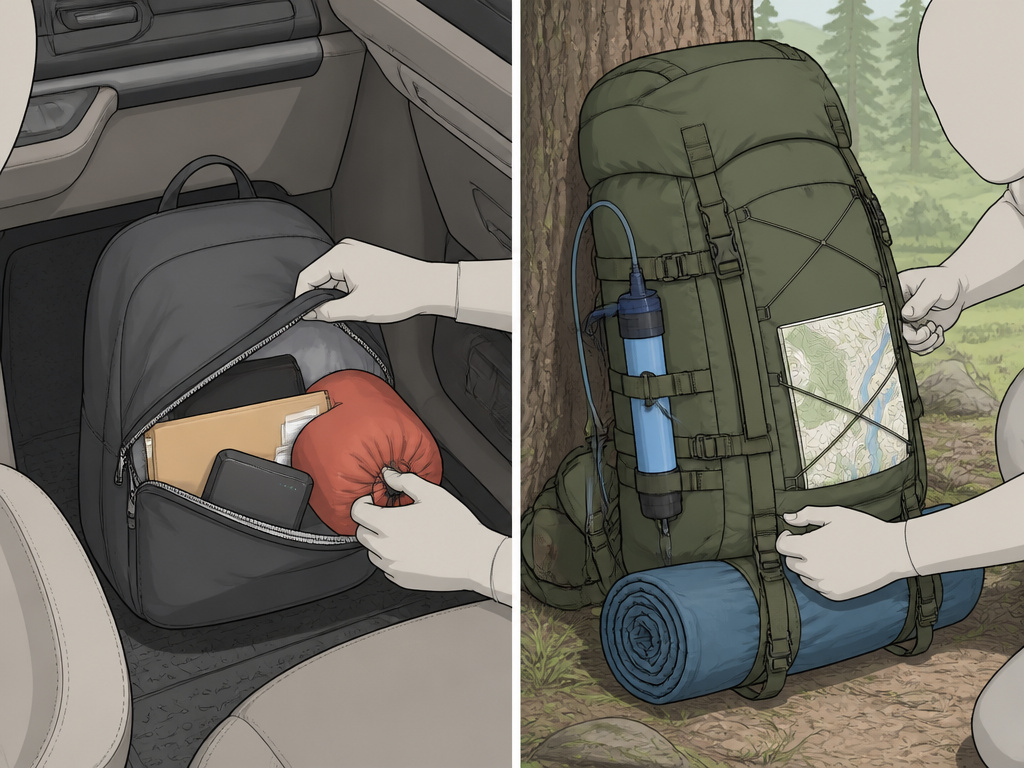
The single biggest determinant of your contents is your bug-out plan. Where are you going? The fantasy of hitting the trail for a remote cabin is statistically unlikely for most people. The reality is a drive to a hotel, family’s house, or public shelter.
The Urban/Suburban Evacuation Bag (The Realistic One)
This is for getting out of a city during a hurricane, wildfire, or flood. Your car is your primary asset. – Focus: Documents, cash, communication, comfort. – Key Items: Physical maps (GPS fails), cash in small bills, power bank for phones, photocopies of IDs/insurance, a list of important contacts. – Shelter: Less about tents, more about sleeping bags or blankets suitable for a gym floor shelter. – The Bag: A carry-on backpacks sized bag that fits in your car’s footwell, not a massive expedition pack.
The Wilderness Bug-Out Bag (The Contingency Plan)
This is for a true “walking away” scenario where roads are impassable or your vehicle is gone. – Focus: Water procurement, shelter-building, long-distance mobility. – Key Items: Heavy-duty water filter (Sawyer Squeeze), topographic maps, compass, more substantial shelter (tarp/bivvy), fishing line/snares for food, more robust first aid. – The Bag: A larger capacity, expedition-ready backpacking backpacks with a robust frame. A 50-liter backpack capacity is a common target for this load.
Most people need the urban kit. Building the wilderness kit without the fitness, skills, and destination to match is a fast track to failure.
Where the Official Checklists Fail (And What to Do Instead)

The Ready.gov emergency kit guide is a starting point, not a finished packing list. Its recommendations to store items in “easy-to-carry containers such as plastic bins or a duffel bag” gloss over the reality of carrying that weight over uneven ground or in a frantic rush.
The academic critique is blunt. The peer-reviewed bug-out bag study calls these kits impractical for evacuation. The problem is volume and weight. A family-of-four kit per Ready.gov can easily fill multiple bins, impossible to carry.
The fix is modular packing. Build a core personal bag (your 72-hour kit) that you can carry. Then, have supplemental bins in the car with extra water, food, and comfort items. Your backpack gets you through the first critical hours if you’re on foot; the car cache supports a longer vehicular evacuation.
Another gap: official lists rarely discuss regional adaptation. A kit for hurricane territory needs waterproof gear and bug repellent. A kit for earthquake country needs a dust mask and sturdy gloves. A winter climate kit needs extreme cold-weather gear. Your local risks should edit the generic list.
The 72-Hour Myth: Can You Actually Walk 100 Miles?

A persistent meme suggests your bug-out bag should support a 100-mile trek over three days. The math is seductive: 100 miles / 72 hours = 1.4 mph, a slow walk. The reality is brutal.
- Weight: A 35-pound pack slows pace dramatically, especially over hills or rough terrain.
- Fitness: The average person is not a conditioned backpacker. Blisters, chafing, and exhaustion set in quickly.
- Terrain: Roads may be blocked, bridges out. Cross-country travel is exponentially slower.
- The Obvious: As a Reddit user bluntly put it, you likely have family, pets, or elders who cannot make that hike.
The 72-hour clock is for sustenance, not distance. It’s the food, water, and medical supplies to keep you alive for three days while you seek safety, which overwhelmingly means using a vehicle until it’s absolutely impossible. Your planning should center on where you’ll drive, not how far you’ll walk.
Frequently Asked Questions
What is the difference between a bug out bag and a survival kit?
Bug out bag is for evacuation, getting you from point A to point B after a disaster. A survival kit is for long-term sustenance in a fixed or wilderness location. Your bug-out bag might have a smaller survival kit inside it, but its goal is mobility, not indefinite off-grid living.
How heavy should my bug out bag be?
Aim for 20-25 pounds maximum for a basic 72-hour urban kit. A wilderness-focused kit might hit 30-35 pounds for someone in good shape. Anything over 35 pounds becomes a mobility liability for most people. You must test-walk with your loaded bag for at least a mile to know if it’s manageable.
Should I buy a pre-made bug out bag or build my own?
Build your own. Pre-made bags are often filled with low-quality, generic items to hit a price point. They lack personalization for your medications, regional needs, and family size. The process of building it teaches you what each item is for and where it’s packed.
Where should I keep my bug out bag?
Ideally, in three places: Home (by the exit you’d use), Vehicle (a get-home bag), and Work (a smaller 24-hour kit). You don’t know where you’ll be when disaster strikes. The university bug-out chapter PDF emphasizes this multi-location planning.
What do people most regret not packing in a real evacuation?
Real-world accounts from evacuees consistently mention comfort items: a familiar blanket, clean underwear, hard candy, a book, a deck of cards. In a stressful shelter environment, small comforts provide immense psychological relief. Many also wish they’d packed more cash in small denominations and less “tactical” gear that drew nervous looks.
Before You Go
A bug out bag is a tool for a specific job: buying you time and options when your normal life is upended. Its value isn’t in the gear itself, but in the calm it provides before a storm and the concrete help it offers during one. Start with the core four, water, food, shelter, first aid, packed into a comfortable, nondescript top-rated backpacks. Practice carrying it. Tailor it to the disasters your region actually faces.
Then, focus on the plan. A bag without a destination is just heavy luggage. Know where you’ll go, how you’ll get there, and what you’ll do when the 72-hour clock starts ticking. That plan, more than any gadget in your pack, is what gets you through.