Backpacks at Wrigley Field: Are They Allowed? Policy & Tips
This post contains affiliate links. As an Amazon Associate, we earn from qualifying purchases.
You cannot bring a backpack of any kind into Wrigley Field. The Chicago Cubs’ official policy explicitly prohibits all backpacks, including clear backpacks. The only bags allowed must be smaller than 16 inches by 16 inches by 8 inches, and they cannot be a backpack-style design. This rule is absolute, with no on-site storage available for prohibited items.
That 16x16x8 inch box is your only container. It covers wallets, purses, fanny packs, drawstring bags, lunch bags, briefcases, and soft-sided coolers. The policy exists because of physical space constraints in the century-old concourses and a league-wide shift toward faster, touchless security screening. A backpack’s deep compartments and straps slow down the inspection line for everyone behind you.
What follows is the breakdown of that policy, the exact items that will get you turned away, the smart alternatives that fit, and how the entry process actually works on a game day.
Key Takeaways
- Backpacks are completely banned at Wrigley Field, regardless of size, material, or transparency.
- The maximum allowed bag size is 16 inches long, 16 inches high, and 8 inches deep.
- Hard-sided coolers and any bag larger than the size limit are also prohibited.
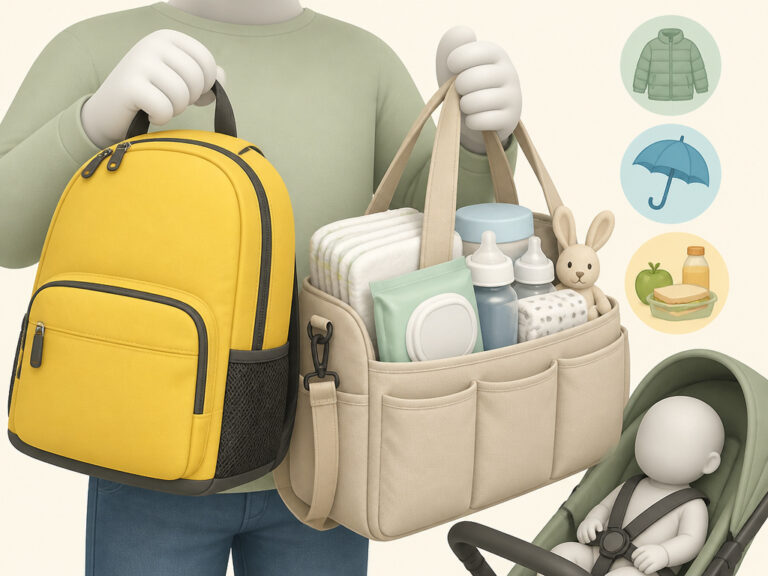
- Exceptions are made only for medically necessary bags and diaper bags accompanying infants.
- There is no bag storage or check service at the ballpark; you will be turned away with a prohibited bag.
The Short Answer: Backpacks Are Not Permitted
The policy from the Chicago Cubs leaves no room for interpretation. The official security page states: “Backpacks (including clear backpacks), hard-sided coolers (regardless of size) and bags larger than 16 x 16 x 8 inches are NOT permitted at Wrigley Field.”
The term “backpack” is defined by its design: a bag with two shoulder straps intended to be carried on the back. Stadium security does not make exceptions for small, transparent, or collapsible versions. This is a stricter rule than some other venues. For example, Fenway Park allows bags meeting a specific size limit, while Yankee Stadium has its own distinct set of bag rules. Wrigley’s rule is a flat ban.
The 16x16x8 inch dimension is not a suggestion, it’s a hard ceiling. A bag that measures 16.5 inches in any direction will be refused at the gate. Bring a tape measure to your closet before you pack.
The rationale is operational. Narrow, historic concourses get clogged. A backpack’s multiple zippers and compartments require a longer, hands-on search. The Cubs have moved to a touchless screening system to speed up entry for tens of thousands of fans. A standard backpack defeats that system’s entire purpose.
What Bags Are Allowed at Wrigley Field?
Your carrying options are defined by the 16x16x8 inch size limit and the approved bag-type list. Think low-profile and simple.
The permitted list includes: wallets, purses, fanny packs, drawstring bags, lunch bags, briefcases, and soft-sided coolers. The common thread is that they are generally single-compartment and easy to inspect visually or with a quick hand-scan.
A drawstring bag is the most common and practical substitute. It holds a jacket, a water bottle, and snacks without violating the rules. A fanny pack worn around the waist or across the chest is even faster for security. For families, a small, soft-sided cooler that fits under the seat is acceptable for drinks and food.
| Bag Type | Permitted at Wrigley? | Key Consideration |
|---|---|---|
| Backpack (any) | No | Absolute prohibition, no exceptions. |
| Drawstring Bag | Yes | Must be under 16x16x8 inches. The go-to alternative. |
| Fanny Pack | Yes | Worn on the body, it bypasses the “bag” line. |
| Soft-Sided Cooler | Yes | Must meet size limit; hard-sided are banned. |
| Small Purse | Yes | Clutches and crossbody bags are ideal. |
| Diaper Bag | Yes (with child) | An explicit exception to the backpack rule. |
| Medical Bag | Yes | An explicit exception with necessary contents. |
Where this goes sideways: Assuming a “small” backpack is okay. Security staff are trained on the design, not subjective size. A child’s mini-backpack with two straps will be turned away just as fast as a hiking pack. The rule is about the design’s impact on screening, not its capacity.
Prohibited Items Beyond Backpacks
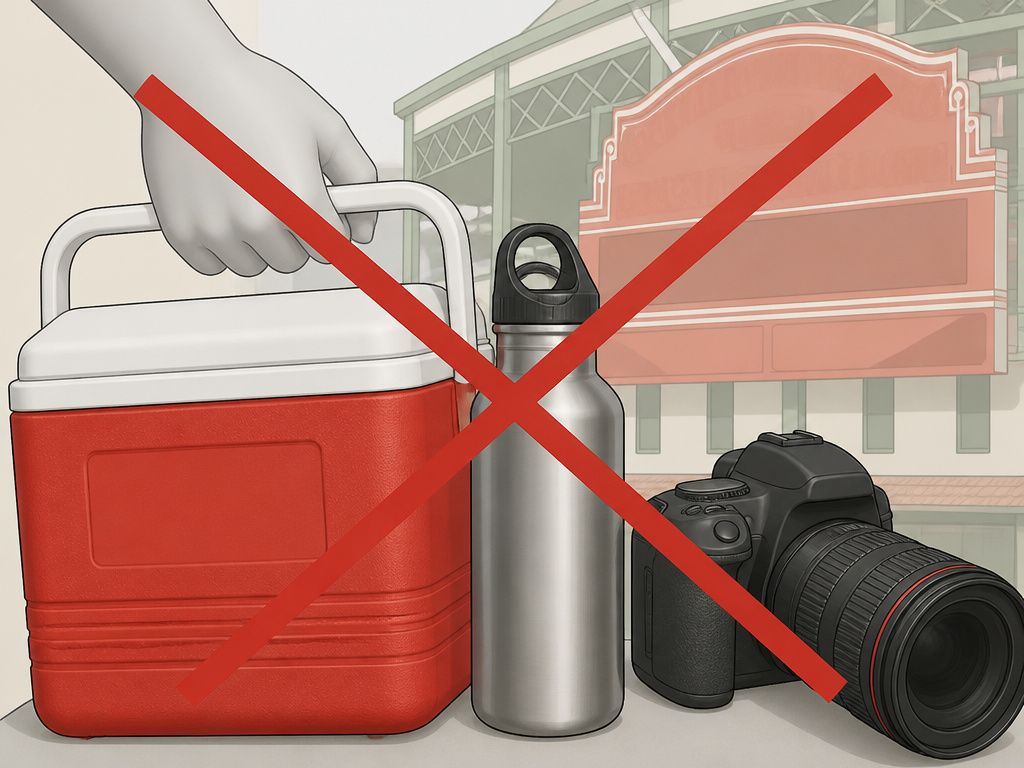
The backpack ban is part of a broader list designed for safety and crowd management. Knowing the full list prevents a last-minute walk back to your car.
Hard-sided coolers are prohibited regardless of dimensions. This includes classic plastic picnic coolers and small, rigid lunch boxes. Glass containers, metal bottles, and aluminum cans are also banned. You can bring factory-sealed plastic water bottles (one liter or less) or empty reusable plastic bottles to fill at drinking fountains.
Other notable prohibited items include: * Professional cameras with detachable lenses or tripods. * Umbrellas with metal tips or larger than 10 inches in diameter. * Selfie sticks, drones, or any noisemaking devices like air horns. * Weapons of any kind, including pocket knives. * Alcohol not purchased inside the ballpark.
Before you start: The Cubs offer no storage for prohibited items. There are no lockers or claim checks. If you bring a banned item, your choices are to return it to your vehicle (if you drove) or discard it. Plan accordingly to avoid losing an item or missing first pitch.
This no-storage policy is critical. It’s different from some theme park bag rules or amusement park bag rules where lockers may be available for rent outside the gates. At Wrigley, you’re in a residential neighborhood with no commercial storage facilities nearby.
Gate Entry & The Touchless Screening Process
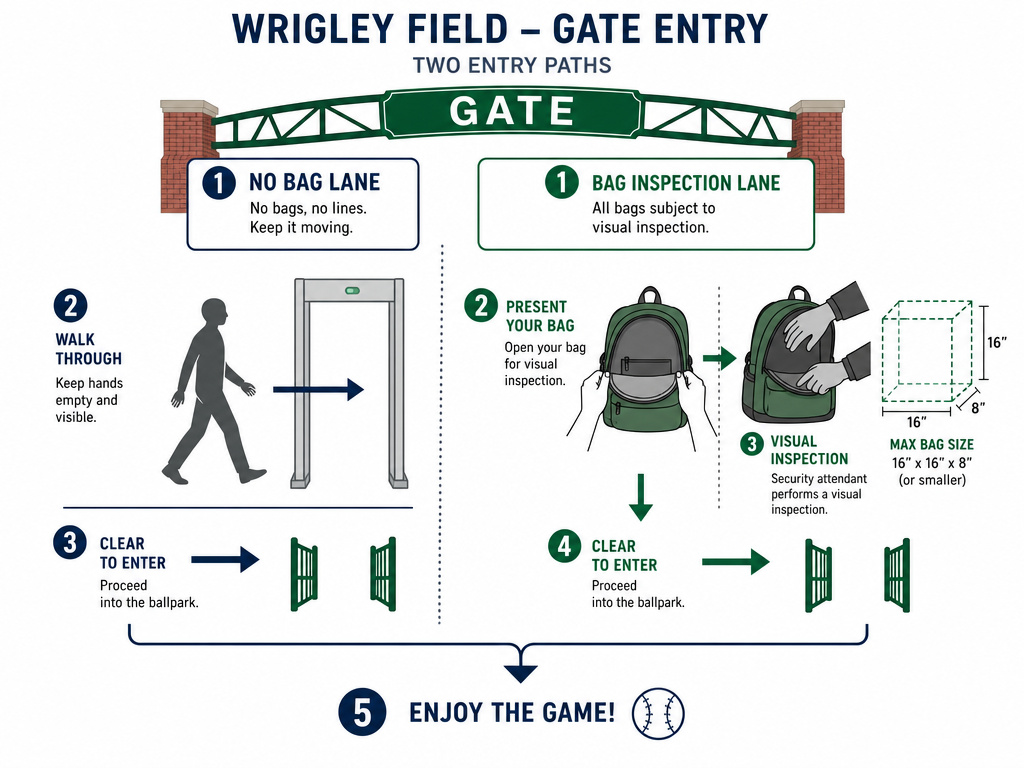
Wrigley Field uses a touchless screening system. Understanding it makes entry predictable and fast.
Gates open 90 minutes before first pitch for most games. For Opening Day, Saturday games, and special events, gates open two hours prior. Your mobile ticket in the MLB Ballpark app will specify an assigned entry gate, use it to avoid the busiest main gates.
The process is designed for speed. You do not need to remove your phone, wallet, or keys from your pockets. If you have no bag, you can proceed directly through the designated “No Bag” lines at each gate, which are significantly faster.
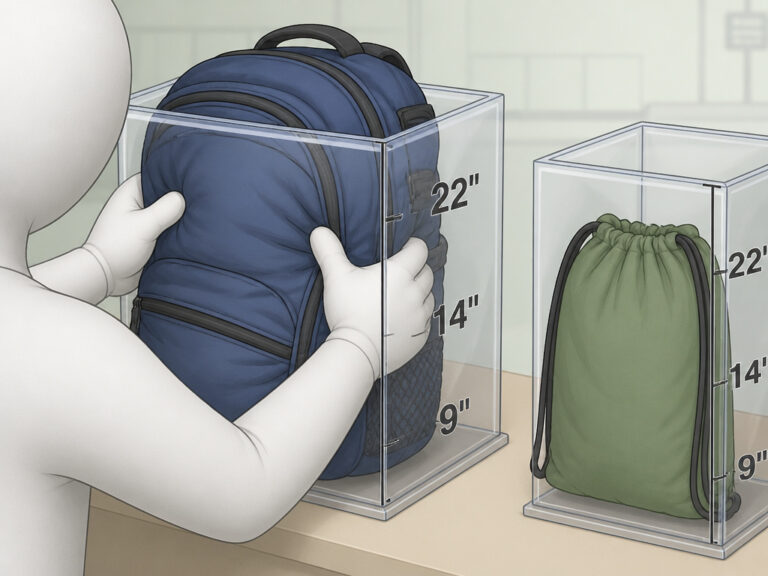
If you have a permitted bag, you’ll join the bag-check line. A security attendant will visually inspect the bag’s contents, possibly using a wand or by having you open the main compartment. The 16x16x8 size limit is often enforced with a sizing box at the gate; your bag must fit inside it.
The touchless system relies on advanced metal detectors. Large metal objects like big cameras or thermoses will trigger an alert, leading to a secondary screening and delays. Stick to plastic and you’ll walk right through.
This system is similar to modern arena bag rules but can be more restrictive than general airline backpack policies. The goal is the same: move people safely without turning the gate into a bottleneck.
Practical Alternatives: What to Carry Instead

You need a system to carry your essentials, phone, tickets, wallet, sunscreen, a layer for cooler evenings, without a backpack. Here is the field-tested kit.
The Drawstring Bag Default. A simple, single-compartment drawstring bag is the unanimous fan favorite. It meets the size rule, is cheap to replace, and security can see everything inside in two seconds. Brands like Nike or Under Armour make durable ones. Load it with a sealed water bottle, a Cubs hat, and a lightweight windbreaker.
The Fanny Pack Power Move. For ultimate speed, wear a fanny pack. It doesn’t count as a “bag” in the screening line, so you can use the express “No Bag” lanes. It forces you to pack minimally: phone, cards, keys, lip balm. You’ll be in your seat before others have unzipped their first compartment.
The Family Logistics Plan. With kids, you are allowed a diaper bag. Use a tote bag or a dedicated diaper bag that isn’t a backpack-style. Pack snacks in a small, disposable grocery bag (which is explicitly allowed per the food policy). Remember, soft-sided coolers under the size limit are okay for juice boxes and fruit.
What about everything else? Wear your jersey or Cubs sweater. Put your credit card and ID in your phone case. Buy the sunscreen at a concession stand inside. The goal is to walk in with your hands nearly free.
This minimalist approach is a different mindset than packing a carry-on backpack for a flight. It’s about necessity, not possibility.
How Wrigley’s Policy Compares to Other MLB Parks
Wrigley Field is on the stricter end of the MLB bag policy spectrum. This table shows where it stands.
| Ballpark | Backpacks Allowed? | Bag Size Limit | Notes |
|---|---|---|---|
| Wrigley Field | No (any type) | 16″ x 16″ x 8″ | Hard-sided coolers also banned. |
| Fenway Park | Yes (if under size limit) | 16″ x 16″ x 8″ | A more common “size-restricted” model. |
| Yankee Stadium | No | 16″ x 16″ x 8″ | Similar to Wrigley, but allows soft backpacks for medical/child needs. |
| Oracle Park | Yes (if under size limit) | 16″ x 16″ x 8″ | Oracle Park’s policy is notably fan-friendly. |
| Citi Field | No | 16″ x 16″ x 8″ | Citi Field’s policy mirrors the clear bag trend, allowing only single-compartment bags. |
The trend across MLB is toward smaller, simpler bags. Wrigley’s total backpack ban is a step further, driven by its specific infrastructure. It’s not an outlier, but it is a leader in restrictive policies.
If you’re visiting multiple parks, never assume the rules are the same. Check each one. The consequence for being wrong isn’t a gentle reminder, it’s a missed inning.
Frequently Asked Questions
Can I bring a clear backpack into Wrigley Field?
No. The policy explicitly states “backpacks (including clear backpacks)” are not permitted. The ban is on the backpack design itself, not the opacity of the material. A clear tote bag or clear drawstring bag that meets the size requirements would be allowed, but if it has two shoulder straps, it’s prohibited.
What if I have a medical device that needs a bag?
Medically necessary bags are an explicit exception to the backpack and size rules. You should be prepared to explain the contents to security personnel. It’s advisable to have any relevant medical identification readily available. Contact Cubs Fan Services at 800-THE-CUBS ahead of time if you have specific concerns.
Where can I store my backpack if I can’t bring it in?
The Chicago Cubs do not provide any bag storage, luggage check, or lockers at Wrigley Field. This is clearly stated in their guide. Your only options are to return it to your vehicle or to your accommodation. There are no commercial storage facilities in the immediate residential neighborhood around the ballpark.
Can I bring food and drinks?
Yes, within limits. You may bring a personal amount of food in a small, disposable bag. For drinks, only factory-sealed plastic water bottles (1 liter or less) are allowed. You may also bring an empty reusable plastic bottle to fill inside. Glass, metal, aluminum cans, and alcohol are prohibited.
Are the rules different for concerts or other events at Wrigley?
Yes. The prohibited items list for Chicago Cubs games is specific to baseball. For concerts, wrestling events, or other non-baseball events, the policy is set by the event organizer, not the Cubs. Always check the event’s official website or contact the promoter for the specific bag policy before you go.
Before You Go
Wrigley Field’s bag policy is strict for a reason. The 16x16x8 inch rule and backpack ban are about moving 41,000 fans safely through a historic venue. Your compliance means a faster entry for you and everyone behind you.
Pack a drawstring bag or wear a fanny pack. Leave the backpack at home or in the car, there is no backup plan. Double-check your bag dimensions and leave the hard cooler behind. With the right bag, you’ll walk through the touchless screening in seconds and be in your seat with time to soak in the atmosphere of the Friendly Confines before the first pitch.