Smithsonian Backpack Policy: Can You Bring One Inside?
This post contains affiliate links. As an Amazon Associate, we earn from qualifying purchases.
Yes, you can bring a backpack into the Smithsonian, but it must pass a hand-check or X-ray screening and you may be asked to wear it on your front. Large backpacks and suitcases are prohibited in gallery spaces. Lockers are available at some museums, but not all, and metal detectors are required at several major locations.
That “yes” comes with four non-negotiable conditions that change how you pack and move through the day. The policy isn’t uniform. The National Museum of American History has lockers. The Smithsonian American Art Museum does not. The Renwick Gallery screens bags by hand, while its main building uses walk-through metal detectors.
What follows is a breakdown of the official rules, the museum-by-museum variations that trip people up, and a clear list of what you can and cannot bring inside. You’ll know exactly how to pack for a smooth visit.
Key Takeaways
- All bags are subject to a thorough hand-check or X-ray at entry. Pack light to speed up the line.
- Large backpacks and suitcases are not allowed in gallery spaces. Security may ask you to hand-carry a smaller pack or wear it on your front.
- Metal detectors are mandatory at the Air & Space Museum, African American History Museum, American History Museum, Natural History Museum, and others.
- Locker availability is spotty. The American History Museum has them; the American Art Museum and Natural History Museum do not. Never assume storage is available.
- Food and drink rules vary. Sealed containers are generally okay inside a bag, but consumption is restricted to designated areas or courtyards.
Yes, but with these four rules.
The Smithsonian’s official visitor guidelines frame the backpack policy around security and preservation. Your bag is allowed, but it becomes a managed object the moment you walk in.
First, every bag gets screened. This is a hand-check by security personnel or an X-ray machine scan. The line moves faster if you have fewer items to inspect.
Second, size matters for the art. “Suitcases, large umbrellas, and large backpacks are not allowed in the galleries,” states the Smithsonian American Art Museum’s guidelines. A “large” backpack is one you’d use for multi-day hiking, not a standard daypack. If your pack is borderline, security has discretion.
Third, you lose control of how you carry it. To prevent accidental damage to artifacts, officers will often ask you to hand-carry your backpack or wear it on your front. This isn’t a suggestion. It’s a condition of entry in the galleries.
Common mistake: Assuming “yes” means you can wear your pack normally. Swinging a loaded backpack in a crowded gallery is how a $10,000 vase gets a new crack. You’ll be corrected within the first two rooms.
Fourth, you are responsible for your belongings all day. You cannot leave a bag at one museum and pick it up later. Storage is limited and unreliable.
What actually happens at security?
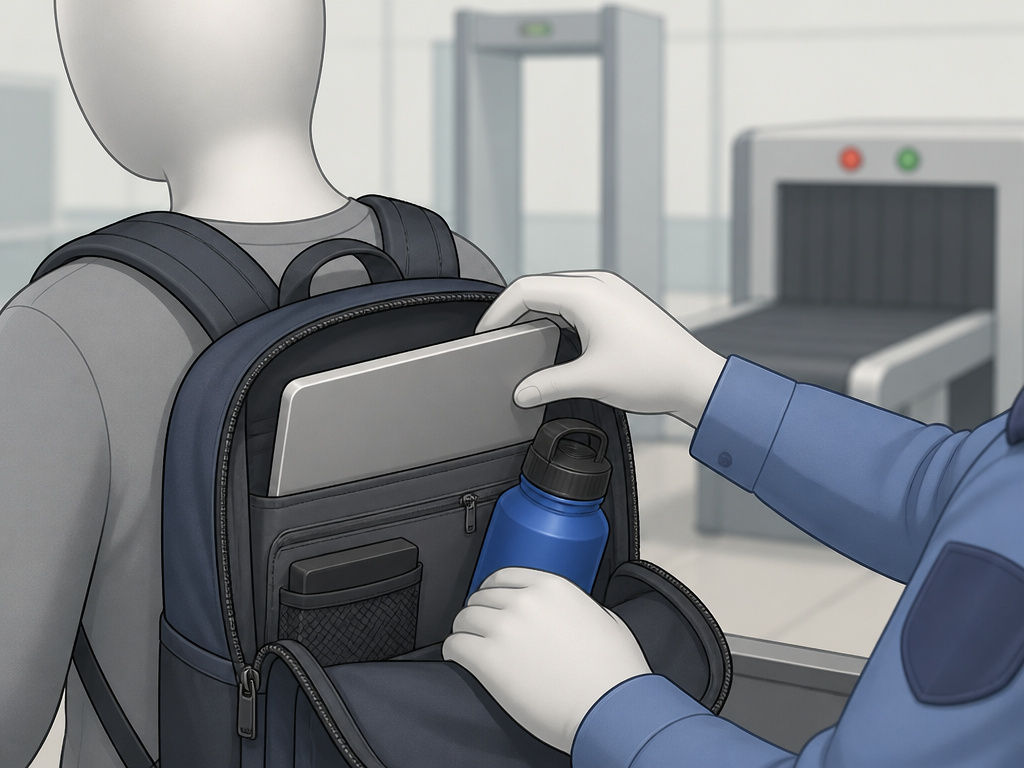
You will encounter one of two procedures: a walk-through metal detector with an X-ray belt for bags, or a security officer conducting a manual hand-check.
The Smithsonian American Art Museum’s main building requires all visitors to pass through a metal detector at its G and F Street entrances. The Renwick Gallery, its sister location, uses hand-screening for bags instead. This split under a single institution shows why checking your specific destination’s website is non-optional.
At a hand-check station, you’ll be asked to open all compartments. The officer will look inside, often moving items aside. They are searching for the prohibited items list, not judging your packing skills. Having your bag organized – with liquids and electronics easy to access – shaves minutes off the process.
If you set off a metal detector, you’ll be wanded. This is standard. The entire sequence, from joining the line to getting your bag back, takes between two and ten minutes. Peak times are weekends and school holidays.
The locker situation: assume “no.”
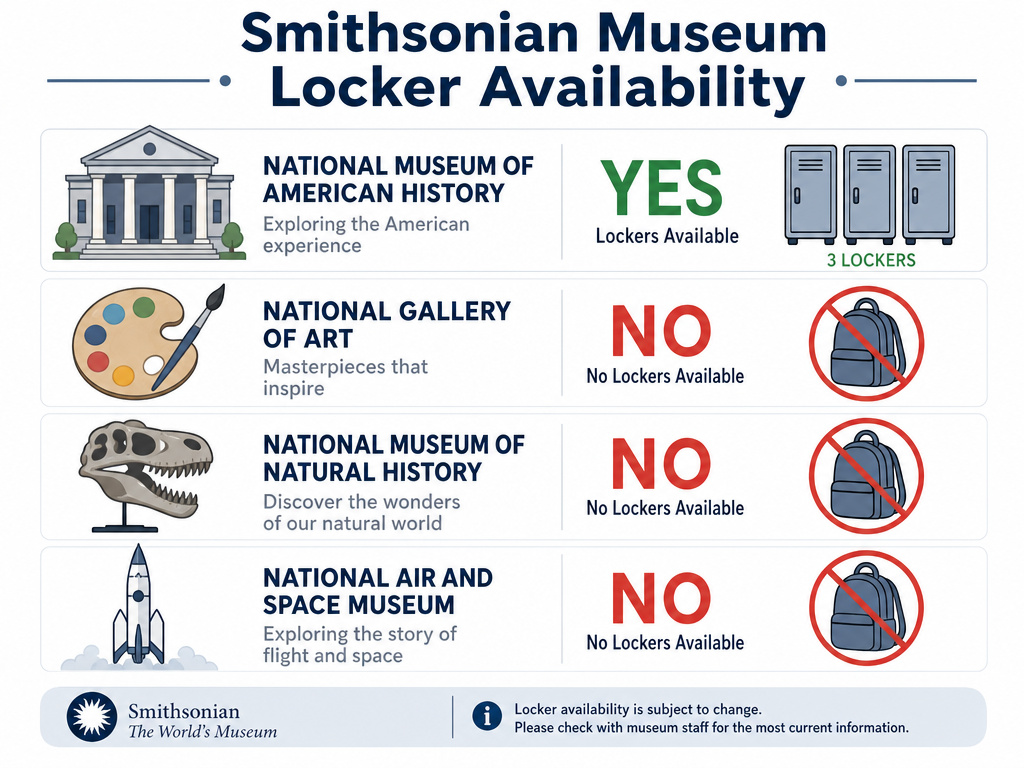
This is the biggest day-ruiner for unprepared visitors. The availability of lockers, coat check, or any bag storage is wildly inconsistent across the Smithsonian’s two dozen museums and galleries.
| Museum | Lockers Available? | Coat Check? | Notes |
|---|---|---|---|
| National Museum of American History | Yes, limited quantity | No | First-come, first-served. Small, medium, and large sizes. |
| Smithsonian American Art Museum / Renwick Gallery | No | No | “Small lockers in each lobby are not available at this time.” |
| National Museum of Natural History | No | No | “The museum does not have coat check or lockers available.” |
| National Air & Space Museum (DC) | No (info likely outdated) | No | Security guidelines focus on screening, not storage. |
The National Museum of American History is the notable exception. It offers three locker sizes, but the supply is limited. If you arrive at 11 a.m. On a Saturday, they will be gone. The large locker measures 34″ tall by 12″ wide by 16″ deep – enough for a packed overnight bag, but not a full suitcase.
The blunt takeaway: plan to carry everything you bring. If you cannot comfortably carry your backpack on your front for four hours, you brought the wrong bag. This policy mirrors the strict Palace of Versailles policy for historic sites, where large bags are a non-starter.
What can you bring in your backpack?
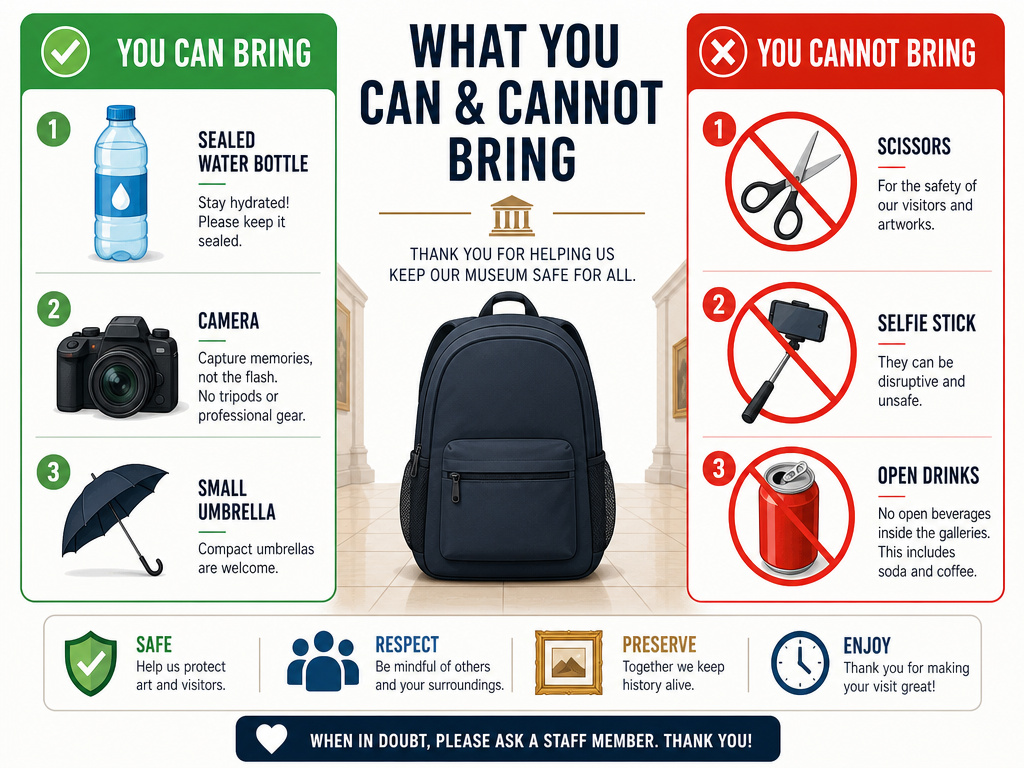
Packing for a Smithsonian visit is about knowing the “no” list. The permitted items are straightforward; the prohibited ones will get your bag turned away.
You CAN bring:
- Sealed food and beverages (consumption in designated areas only)
- Water bottles (must be closed)
- Cameras and phones (no flash where posted)
- Mobility aids (wheelchairs, walkers, canes)
- Diaper bags
- Small umbrellas
- Necessary medical equipment
You CANNOT bring:
- Firearms, weapons, or explosives
- Knives (including pen knives) or scissors
- Aerosol cans (pepper spray, Mace)
- Tripods, monopods, or selfie sticks
- Open containers of food or drink
- Alcohol
- Pets (service animals only)
- Large signs, banners, or placards
The National Museum of American History security page explicitly lists “scissors” and “tools” as not permitted. A small multi-tool in your backpack’s hidden pouch is still a tool. It will be found and you will be asked to leave it or leave the museum.
Food is a special case. You can pack snacks and a lunch in sealed containers. You cannot eat them in the galleries. The American History Museum forbids consumption inside. The American Art Museum allows it only in the Kogod Courtyard. Your backpack becomes a mobile pantry you cannot use until you find the correct bench.
Which museums require metal detectors?
Not all Smithsonian entrances are equal. The security level is tied to the museum’s collection and building design.
The official Smithsonian guidelines mandate walk-through metal detectors at: * National Air and Space Museum (DC and Udvar-Hazy Center) * National Museum of African American History and Culture * Smithsonian American Art Museum (main building) * National Museum of American History * National Museum of Natural History * National Portrait Gallery * National Postal Museum * National Museum of the American Indian (DC and NY)
If you cannot go through a metal detector for medical reasons, you will be hand-screened with an electronic wand. The process takes a bit longer, but the staff is trained for it.
The presence of a metal detector usually means your bag goes on an X-ray belt. This is faster than a hand-check. It also means any questionable item inside your pack will be flagged, and you’ll then get a hand-check anyway. The security procedures for backpacks at major venues like concert halls follow this same two-step logic: scan first, inspect if needed.
Backpacks vs. Other bags: a quick comparison.
You have options beyond a traditional backpack. The best choice minimizes hassle at security and fatigue on your shoulders.
| Bag Type | Pros at the Smithsonian | Cons & Considerations |
|---|---|---|
| Small Backpack (<20L) | Hands-free, even weight distribution. | May be asked to wear on front. Must remove for screening. |
| Crossbody Bag / Messenger Bag | Easy to open for hand-checks. Stays close to body. | Can become heavy on one shoulder after hours. |
| Tote Bag | Opens wide for easy inspection. | No weight distribution; strains shoulders. Items are less secure. |
| Clear Bag | Speeds up visual inspection dramatically. | Offers no padding or organization. Uncommon for all-day touring. |
A crossbody bag is often the smoothest experience. You can swing it around for the officer to look inside without taking it off. It also avoids the “wear on front” directive that slows you down in crowds.
Think of it like preparing for TSA backpack guidelines. The goal is to get through the checkpoint with minimal unpacking and repacking. A cluttered backpack with a tangled charging cable at the bottom fails that test.
The one step everyone skips (and regrets).
You have the policy. You’ve packed a smart bag. There’s still a failure point that catches more visitors than any prohibited item: not checking the specific museum’s website the morning of your visit.
The Smithsonian updates hours, closes galleries, and changes access procedures. The American Art Museum’s lobby lockers are “not available at this time.” That phrase means they could reopen next month, or remain closed for a year. The only way to know is to look.
A five-minute review of your target museum’s “Visit” page prevents a half-day of frustration. It tells you the exact entrance procedure, whether the cafe is open, and if any special exhibitions have timed entry tickets. This is the same diligence required for understanding the Yankee Stadium bag policy or the Getty Center backpack policy – rules are localized and can change.
Where this goes sideways: Assuming the Smithsonian is one monolithic entity with one rulebook. The American History museum FAQ says lockers exist. The Natural History museum’s page says they do not. Showing up with a plan that requires a locker at the wrong museum means you’re carrying a heavy bag all day.
Frequently Asked Questions
Can I bring a backpack into the Air and Space Museum?
Yes, backpacks are allowed but subject to X-ray screening and a walk-through metal detector, which is required at this location. Large packs may be restricted. There is no bag storage, so plan to carry it.
Are there size restrictions for Smithsonian backpacks?
There are no published inch-by-inch dimensions. The rule is functional: if security deems it a “large backpack” or suitcase, it will not be permitted in the galleries. A standard school-style backpack or daypack is the safe benchmark.
Can I bring food and water?
Yes, in sealed containers inside your bag. You cannot consume food or drinks inside the exhibition galleries. Designated areas like courtyards or cafés are for eating. Water fountains are available to refill bottles.
What do I do with my backpack if there are no lockers?
You carry it. This is the default assumption for most Smithsonian museums. Use a comfortable bag you can wear on your front if asked. Do not leave belongings unattended; they will be treated as a security concern.
Are there any Smithsonian museums that don’t allow backpacks?
No major Smithsonian museum outright bans backpacks. However, the enforcement of the “no large backpacks in galleries” rule means a oversized pack may be denied entry to exhibition spaces, effectively barring you from the museum unless you can store it elsewhere – which is unlikely.
The Bottom Line
Pack a small, organized backpack and wear comfortable shoes. That’s the recipe for a good Smithsonian day.
Assume every pocket will be opened, you’ll walk through a metal detector, and you’ll have to carry everything you bring from opening to closing. The official answer is “yes,” but the real experience is defined by security lines and sore shoulders. Check your specific museum’s page for the final word on lockers and entrance procedures. Then you can focus on the dinosaurs, the spacecraft, and the art – not on your bag.