How Big Is a Carry On Suitcase Allowed to Be? Find Out Now
This post contains affiliate links. As an Amazon Associate, we earn from qualifying purchases.
A carry on suitcase is typically 22 inches tall, 14 inches wide, and 9 inches deep (56x36x23 cm) for most major US airlines like Delta and American. The more universal “fits-all” size is 21.7 x 15.7 x 7.9 inches (55x35x20 cm), which clears 97% of global airlines. Always measure including wheels, handles, and any external pockets.
That 22x14x9 number is a baseline, not a guarantee. Your ticket’s fine print and the gate agent’s sizer box are the final arbiters.
What follows: the two competing size standards, how to measure any bag correctly, the airlines that enforce the strictest rules, and the real-world luggage models that hit the mark.
Key Takeaways
- The 22″ x 14″ x 9″ US standard fails on many international and budget airlines. Target 55 x 35 x 20 cm (21.7″ x 15.7″ x 7.9″) for near-universal acceptance.
- Always measure your bag’s overall dimensions, including wheels and handles. A suitcase that fits empty often exceeds limits when packed.
- US airlines rarely weigh carry-ons; European and Asian carriers routinely enforce 7-10 kg (15-22 lb) weight limits.
- Linear inches (height + width + depth) is a separate limit used by airlines like Delta and Air Canada. A bag with one oversized dimension might still pass if its linear total is under.
- Gate-check fees for oversized bags start at $35 domestically and can exceed $80 on European low-cost carriers.
The Two Universal Carry On Sizes (And Why They Exist)
You are shopping for two different suitcases. The first fits the overhead bin on your regular domestic flight. The second fits on every plane you might ever board, including a last-minute budget trip to Europe. They are not the same bag.
The 22″ x 14″ x 9″ (56x36x23 cm) dimension is the US domestic standard. It’s published by American, Delta, United, and Alaska. This size works because US mainline jets have relatively uniform overhead bins. It’s a comfortable size, often holding 40-45 liters.
The more restrictive “universal” carry-on size is 55 x 35 x 20 cm (21.7″ x 15.7″ x 7.9″). Data from 109 airlines shows a bag this size is accepted by 106 of them, a 97% clearance rate. The common “cabin approved” 56x45x25 cm bags sold in stores fit only 13 of those 109 airlines.
The tighter standard exists for two reasons. Older Airbus A320 and Boeing 737 bins on short-haul European routes are physically smaller. Budget airlines like Ryanair and easyJet also use strict size limits as a revenue stream, charging high fees for non-compliant bags at the gate.
| Size Standard | Dimensions (H x W x D) | Best For | Airlines That Enforce It |
|---|---|---|---|
| US Domestic | 22″ x 14″ x 9″ (56x36x23 cm) | Frequent US travel on major carriers | American, Delta, United, Alaska, JetBlue |
| Universal “Fits-All” | 21.7″ x 15.7″ x 7.9″ (55x35x20 cm) | International travel, budget airlines, multi-carrier trips | Ryanair, easyJet, Qatar Airways, Emirates, most European & Asian carriers |
The Travelpro Optima Compact Carry-On is built to the US standard at 22x14x9 inches. The Victorinox Carry-On Hardside Case targets the international spec at 21.3″ x 15.7″ x 7.9″. Choose the one that matches your most common route.
Bottom line: If you only fly within the US, 22x14x9 is fine. If your itinerary includes Europe or you use budget airlines, buy the 55x35x20 cm size.
How to Measure Your Carry On (The Right Way)
Your tape measure and the airline’s sizer box must agree. They often don’t, because people measure the empty shell, not the packed article.
The correct method measures overall external dimensions. Place your fully packed suitcase on the floor. Run the tape from the floor to the very top of the extended handle. That’s the height. Measure across the widest point, including any side pockets or compression straps. That’s the width. Measure from the front to the back, including the wheel housing. That’s the depth.
Common mistake: Measuring the hard case alone. Wheels and handles add 1-3 inches in each direction. A bag that measures 20″ tall empty can hit 22.5″ with the handle up.
Airlines use the same method. The sizer box at the gate is a metal frame representing their maximum carry-on dimensions. Your bag must slide in without force, no pushing, no squeezing. This is where overpacking fails. A soft-sided bag that fits empty will bulge past its stated dimensions when full.
If your airline uses linear inches, add your three dimensions: Height + Width + Depth. Delta and Air Canada, for example, use a 45 linear inch limit for carry-ons. A bag measuring 24 x 16 x 8 inches totals 48 linear inches and fails. One measuring 22 x 14 x 9 inches totals 45 linear inches and passes.
Airline Carry On Rules: A Reality Check
Published rules and enforced rules live on different planets. US carriers are generally lenient on size if the bag looks close. International and budget carriers treat their limits as absolute.
US Airlines (American, Delta, United)
The 22x14x9 inch rule is real, but gate agents rarely use the sizer unless a bag is visibly oversized. Weight limits are almost never checked. The real limit is the bin space on a full flight. If bins fill up, later boarding groups get gate-checked for free.
European Budget Airlines (Ryanair, easyJet, Wizz Air)
This is a different game. Agents pre-screen bags at the gate with sizers. Fees for non-compliance are steep, often €50-€80 ($55-$88). Their limits are smaller: Ryanair’s is 21.7 x 15.7 x 7.9 inches (55x40x20 cm). They are strict because baggage fees are a core part of their business model.
Major International Carriers (Emirates, Qatar, Lufthansa)
These airlines often have stricter carry-on weight limits, typically 7-10 kg (15-22 lbs). They will weigh your bag at check-in or the gate. Qatar Airways has one of the smallest size allowances at 19.7 x 14.6 x 9.8 inches. They enforce both dimensions and weight.
Where this goes sideways: Assuming a “cabin approved” tag means universal approval. That tag is often a marketing term based on the US standard. It means nothing to a Ryanair agent in Dublin.
Your boarding pass and fare class also matter. Basic economy tickets on United or JetBlue often restrict you to a personal item only. Trying to bring a full-size carry-on will result in a hefty gate-check fee. Always check your ticket’s baggage terms.
Sizer Boxes, Gate Checks, and How to Avoid Fees
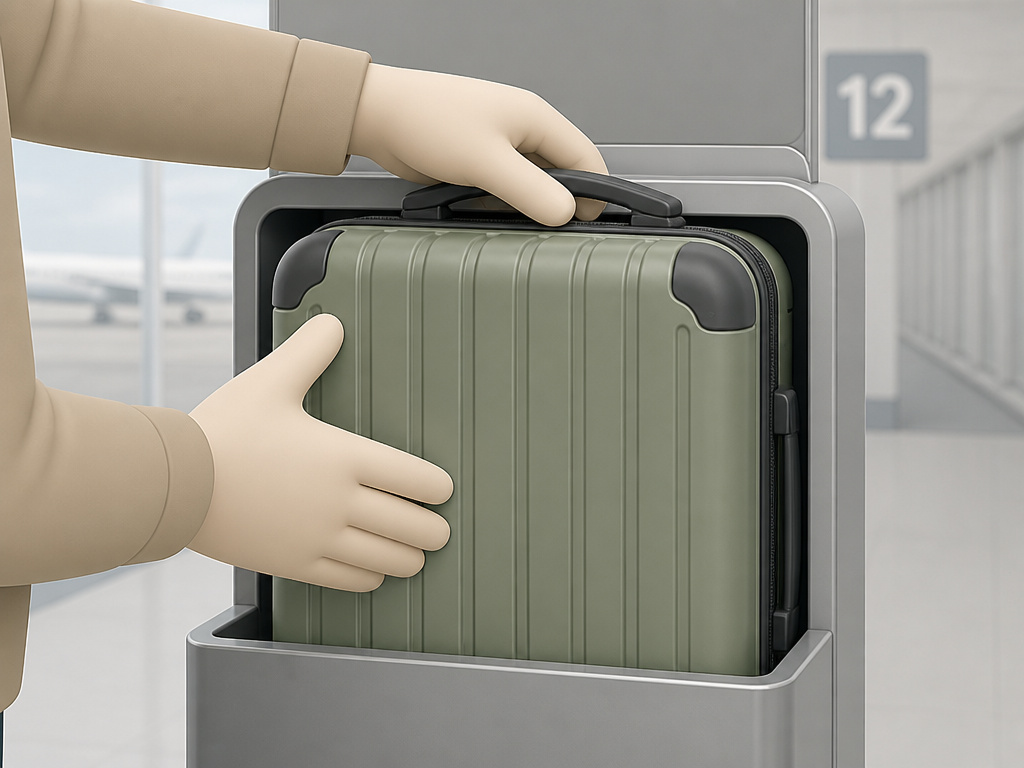 The sizer box is the moment of truth. It’s a simple plastic or metal frame at the jet bridge. If your bag doesn’t fit, you pay.
The agent’s instruction is “it must fit without force.” This means you cannot push, shove, or compress the bag to get it in. The Reddit story of the traveler putting on five layers of clothing to reduce his bag’s bulk is a classic workaround. It worked because the bag’s frame was within limits, the contents were just overstuffed.
Skip this if: You have status or are in an early boarding group. Gate agents typically only sizer-check bags from later boarding groups or when bins are obviously full.
If you are forced to gate-check, the process is usually free on US mainline carriers but expensive on budget airlines. Your bag gets a tag and is placed in the plane’s cargo hold. You collect it at baggage claim, not the jet bridge. This defeats the purpose of carrying on.
To avoid the box entirely, follow these steps: 1. Choose the right bag. Start with a suitcase built to the correct carry-on luggage dimensions, like the Delsey Paris Cadence at 22.8″ x 15″ x 10″. 2. Pack with room to spare. Leave at least an inch of empty space in the main compartment so the shell doesn’t bulge. 3. Board early. The earlier your boarding group, the less likely bins are full and agents are checking. 4. Be ready to rearrange. If asked to sizer-check, be prepared to quickly shift items to your personal item or wear a jacket.
Carry On Weight Limits (The Silent Rule)
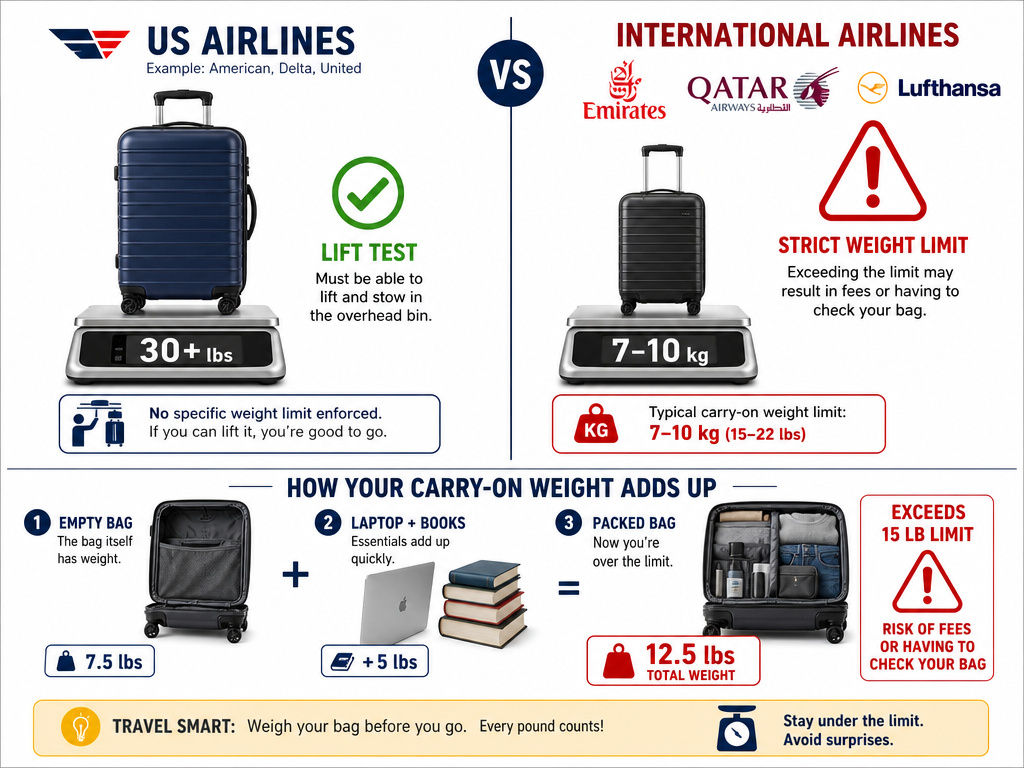 For US flyers, weight is an afterthought. For everyone else, it’s a hard stop.
Most major US airlines. Delta, American, United, do not publish a carry-on weight limit. The unofficial rule is “if you can lift it into the bin, it’s fine.” This is why you see people struggling with 30-pound rolling bags.
International airlines impose clear limits. British Airways is generous at 51 lbs. Most European and Asian carriers restrict you to 7-10 kg (15-22 lbs). Lufthansa’s limit is 17.6 lbs; Qatar Airways and Emirates allow just 15 lbs.
| Airline Type | Typical Weight Limit | Enforcement Likelihood |
|---|---|---|
| US Major (Delta, American) | Not specified / “Lift-test” | Very Low |
| European Full-Service (Lufthansa, Air France) | 8-10 kg (17.6-22 lbs) | High at check-in |
| European Budget (Ryanair, easyJet) | 10 kg (22 lbs) | Very High at gate |
| Middle Eastern / Asian (Emirates, Qatar, Singapore) | 7 kg (15.4 lbs) | Extremely High |
These limits include everything in your bag. A laptop, camera, and a few hardcover books can add 5-6 lbs instantly. A packed Away Travel Carry-On weighs 7.5 lbs empty, leaving you only 7.9 lbs of contents on Qatar Airways.
Weigh your bag at home before you leave. Use a handheld luggage scale. If you’re over, wear your heaviest shoes and jacket, or move dense items like books to your personal item.
Recommended Carry On Suitcases That Fit
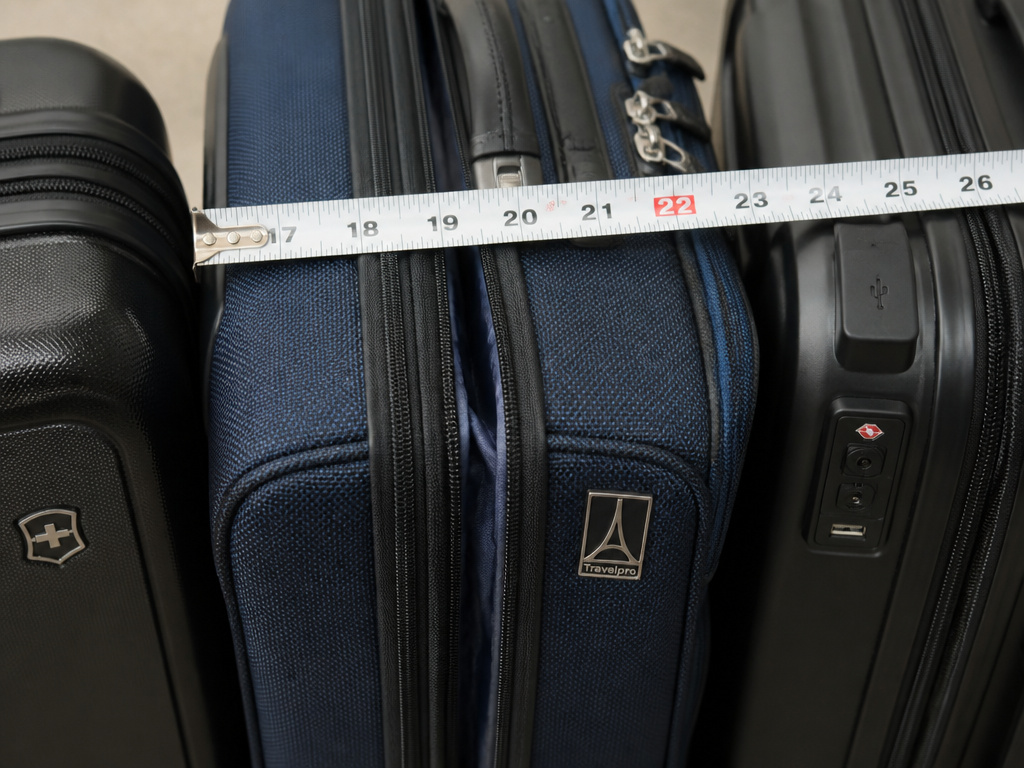 A recommendation must name a real product. These three cover the major use cases.
For US-focused travel, the Travelpro Optima Expandable Compact Carry-On is the default. Its 22″ x 14″ x 9″ dimensions comply with published US airline rules, and the expandable zipper gives an extra 2 inches of depth when you need it. The polypropylene shell is light and durable.
For international and budget airline travel, the Victorinox Carry-On Hardside Case is the one to beat. At 21.3″ x 15.7″ x 7.9″ (54x40x20 cm), it clears the strict Ryanair and Qatar Airways sizers. It’s also light, at just 6.6 lbs, leaving more of your weight allowance for belongings.
For a best-of-both-worlds option, consider the Delsey Paris Cadence Carry-On Plus. At 22.8″ x 15″ x 10″, it’s slightly larger than the universal spec but includes a TSA lock, a USB port, and an expansion system. It’s a gamble on strict airlines but a great bag for less restrictive routes.
Check the current reviews on Amazon for any model before buying. Wheel quality and handle sturdiness are the first things to fail.
Frequently Asked Questions
What if my carry on is slightly too big?
If it’s 1-2 inches over in one dimension, you might get away with it on a US airline if the flight isn’t full. On a budget or international airline, you will almost certainly be caught and charged a fee at the gate. The risk is high.
Do wheels and handles count in carry on size?
Yes. Always. Airline carry-on size limits explicitly state “including wheels and handles.” You must measure from the bottom of the wheels to the top of the extended handle.
What is the largest carry on size allowed?
The most generous published limit is from Frontier Airlines: 25″ x 16″ x 10″ (61x46x25 cm). Southwest is close at 24″ x 16″ x 10″. These are outliers. Do not buy a bag this size expecting it to work on other airlines.
How strict are airlines about carry on size?
Strictness follows a spectrum. US majors: lenient. European full-service: moderate. Budget airlines (Ryanair, Frontier, Spirit): very strict. Assume strict enforcement if your airline charges separately for carry-ons.
Can a carry on be too small?
Technically, no. But the ISO 12604-1 standard for checked baggage notes that very small, light pieces can jam automated baggage systems. For carry-ons, the only downside is less packing space.
The Bottom Line
A carry on suitcase is not one size. It’s two: 22x14x9 inches for your regular US flights, and 55x35x20 cm for everything else. The second number is the one that keeps you from paying a surprise €60 fee at a foreign gate.
Measure your bag packed, not empty. Know your airline’s weight limits before you zip it up. And when in doubt, buy the smaller, internationally-compliant suitcase. The peace of mind is worth the slight loss of space. Your wallet will thank you at the jet bridge.