Is 20 Inch Luggage Carry On | The Hidden Expandable Trap
This post contains affiliate links. As an Amazon Associate, we earn from qualifying purchases.
A 20-inch suitcase is typically designed for carry-on use, but its actual approval hinges on three specifics: whether the manufacturer’s stated dimensions include the wheels and handle, if it has an expansion zipper you’ve used, and the exact weight limit of the airline you’re flying. A bag sold as “20-inch” can still be forced into checked baggage if any of these three points fail.
That gap between design intention and gate-agent enforcement is where trips get expensive. Manufacturers measure the case shell; airlines measure everything that sticks out. An expansion zipper adds two inches in seconds. And a 10-pound bag meets no standard if your carrier’s limit is 7 kg (15.4 lbs).
What follows: the real dimensions you need to check on the product page, the one sentence from Travelpro that explains why expandable bags get gate-checked, and the airline table that shows a 20-inch bag is never a universal pass.
Key Takeaways
- A “20-inch” label refers to the height of the case body, not the total size including wheels and telescoping handle, which can add 2-3 inches.
- Using an expansion zipper on “expandable carry-on” luggage almost always pushes the bag beyond airline size limits for the overhead bin.
- International and budget airlines often enforce strict weight limits (commonly 7-10 kg) that a fully packed 20-inch bag can easily exceed.
- Always verify the “overall dimensions” on the product spec sheet, not just the “case dimensions,” and compare them directly to your airline’s published carry-on policy.
- Sizer bins at the gate don’t lie, if your bag doesn’t fit, you’re checking it, often for a fee.
The 20-Inch Carry-On Standard That Isn’t Standard
A 20-inch suitcase is the default carry-on size. But “20-inch” is a manufacturer’s measurement of the case body itself, taken from the bottom of the shell to the top, excluding the wheels and the retracted handle. Airlines measure everything.
For a 20-inch spinner, the overall height including wheels and handle is typically 22 to 22.5 inches. The Travelpro Platinum Elite 20” Business Plus Carry-On Spinner lists a case dimension of 20 inches tall, but its overall dimension, what the airline measures, is 22.5 inches.
That extra 2.5 inches is the difference between sliding into the sizer bin and getting flagged at the gate. The Samsonite Straren Spinner 55/20 is another example: its case is 21.65 inches, but its full external footprint is what matters for the overhead bin. This is why you must look for “overall dimensions” or “includes wheels and handles” on the product page.
Where this goes sideways: Buying a bag based solely on the “20-inch” label without checking the overall dimensions. You end up with a bag that’s technically an inch or two over before you even pack it.
| Bag Model | Case Dimensions (H x W x D) | Overall Dimensions (H x W x D) | Key Takeaway |
|---|---|---|---|
| Travelpro Platinum Elite 20” | 20 x 14 x 9 in | 22.5 x 14.5 x 9 in | Wheels and handle add 2.5 inches of height. |
| Xiaomi Metal Carry-on 20 | 19.1 x 14 x 8 in | 21.7 x 15.3 x 8 in | Shell is compact, but extended components push limits. |
| Samsonite Straren 55/20 | 21.65 x 15.75 x 9.84 in | Not specified; assume +2 in | Without published overall size, you’re guessing at compliance. |
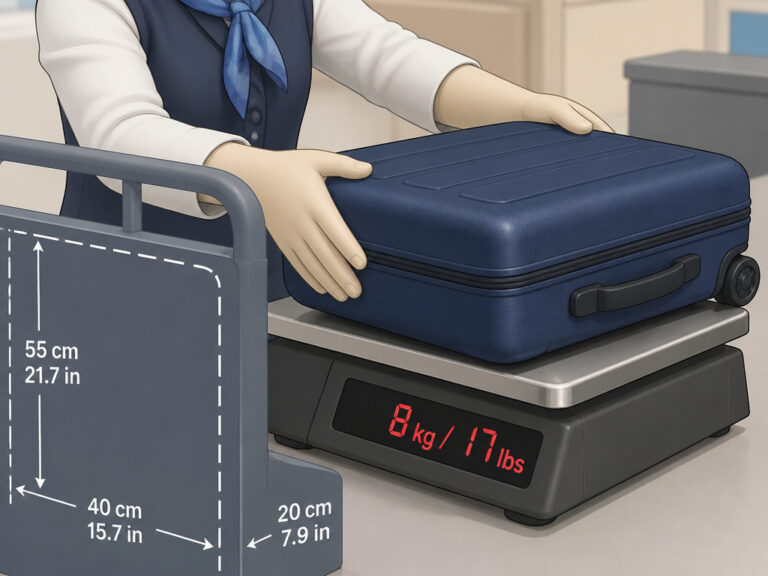
The standard U.S. Domestic airline limit is 22 x 14 x 9 inches. A bag with 22.5-inch overall height is already half an inch over that common benchmark. For most major U.S. Carriers, a friendly gate agent might let it slide. On a packed flight or with a strict international airline, that half-inch is your bag’s ticket to the cargo hold.
The Expandable Zipper Trap
Expandable luggage is a selling point for a reason. An extra two inches of packing depth means you can bring home souvenirs or pack a bulkier jacket. It’s also the fastest way to guarantee your carry-on becomes a checked bag.
Travelpro states it plainly on the product page for its Platinum Elite 20-inch spinner: “Fully expanded Carry-On may not meet airline restrictions.” That’s not a suggestion; it’s a direct cause-and-effect warning. When you unzip that expansion section, you are voluntarily voiding the bag’s carry-on compliance.
The mechanism is simple. A standard 9-inch depth becomes 11 inches. That extra width won’t fit into the airline’s sizer bin, a metal frame at the gate with fixed dimensions. You can’t argue with a metal box.
The part nobody mentions: Even if you don’t fully expand the bag, overpacking the main compartment can cause the expansion panels to bow out slightly. That subtle bulge might be enough to catch a gate agent’s eye and warrant a sizer check.
If your bag has an expansion zipper, treat it as a last-resort emergency feature, not a packing tool. Using it assumes you are willing to check the bag. For reliable carry-on travel, look for a bag with a fixed depth, like the BAGSMART Odyssey or the non-expandable version of the DELSEY Cruise 3.0.
Airline Rules: Weight is the Silent Killer
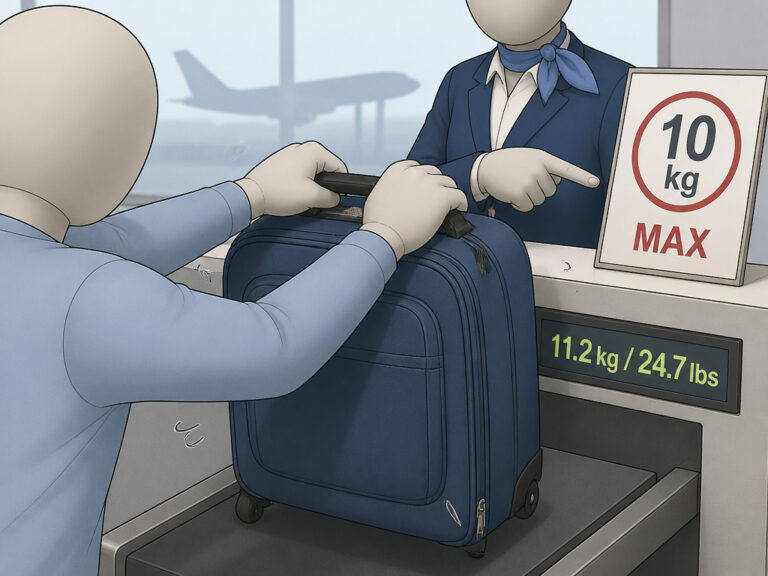
Dimensions get the attention, but weight is the enforcement tool for many airlines outside the United States. You can have the most perfectly proportioned 20-inch suitcase in the terminal, but if it weighs 12 kg and you’re flying Air Canada, you’re paying a checked bag fee.
| Airline | Typical Carry-On Size Limit | Typical Weight Limit | The Risk for a 20-Inch Bag |
|---|---|---|---|
| U.S. Domestic (Delta, United, American) | 22 x 14 x 9 in | None (or generous) | Low risk if dimensions are correct. |
| Air Canada | 21.5 x 15.5 x 9 in | 10 kg (22 lbs) | A fully packed 20-inch bag can hit 12-14 kg easily. |
| European Budget (EasyJet, Ryanair) | Varies, often 45-55 cm height | 7-10 kg (15-22 lbs) | Weight is strictly enforced at the gate with scales. |
| Asian Carriers (Cathay Pacific, ANA) | Varies, often 56 cm height | 7 kg (15.4 lbs) | The lightest 20-inch bags start at 3-4 kg empty, leaving little room for contents. |
The math is unforgiving. A Travelpro Platinum Elite 20-inch bag weighs 3.71 kg (8.2 lbs) empty. Pack just 6 kg (13.2 lbs) of clothes and a laptop, and you’re at 9.71 kg, under Air Canada’s limit but over the 7 kg limit common in Asia and on budget European lines. This is why frequent international travelers often choose ultralight bags like the Xiaomi Classic Pro, which weighs only 3.2 kg empty.
Do you actually know what your packed bag weighs right now? Most people don’t, and that’s the whole problem. A cheap handheld luggage scale is a more valuable travel tool than an expansion zipper.
How to Guarantee Your 20-Inch Bag is Carry-On Approved

The process isn’t complicated. It’s about checking three numbers in the right order and then not sabotaging your own plan.
- Find the Overall Dimensions. Before you buy or before you pack, locate the “overall dimensions” or “includes wheels and handles” spec on the manufacturer’s website. This is your baseline number. If they only list “case dimensions,” add at least 2 inches to the height and 1-2 inches to the depth for the wheels.
- Check Your Airline’s Exact Policy. Go to your airline’s website, find the “carry-on baggage” page under “Travel Info,” and note the exact size (in inches or centimeters) and weight limit. Do not rely on generic Google summaries, policies change.
- Weigh and Measure Your Packed Bag. Use a tape measure to verify the packed bag’s height, width, and depth. Use a luggage scale to confirm it’s under the weight limit. If you’re using an expandable bag, measure it in its normal, unexpanded state.
- Leave a Margin for Error. Aim for your bag to be at least half an inch smaller and a kilogram lighter than the maximums. This accounts for overzealous gate agents, uneven sizer bins, and the extra magazine you buy at the airport.
Skip the “airline approved” marketing tag. It’s meaningless without a specific airline named. A bag like the Travelpro Optima Compact Carry-On is more honest: it’s “sizer bin tested to accommodate overhead bin space on most major US airlines.” That’s a specific, testable claim.
Frequently Asked Questions
Is a 20-inch suitcase a personal item or carry-on?
20-inch suitcase is a carry-on, designed for the overhead bin. A personal item is smaller, typically a backpack, purse, or briefcase that must fit under the seat in front of you. You cannot use a 20-inch suitcase as both.
Will a 20-inch carry-on fit on all airlines?
No. While it fits most major U.S. Airlines, many international and regional carriers have smaller carry-on limits. For example, some European budget airlines have maximum heights of 45-55 cm (17.7-21.6 inches), which a 22-inch-tall bag would violate. Always check your specific airline’s rules.
What if my 20-inch bag is slightly over the size limit?
It depends on the gate agent and how full the flight is. If the overhead bins are crowded, agents are more likely to be strict and use the sizer bin. If your bag is visibly overstuffed or obviously too tall, you will likely be asked to check it, often for a fee. You cannot “borrow” an inch from one dimension to cover another.
Are hard-shell or soft-sided 20-inch bags better for carry-on?
Hard-shell bags (polycarbonate or ABS) protect their contents better and maintain their shape when packed, which helps with consistent sizing. Soft-sided bags can be more forgiving if you need to squeeze them into a tight sizer bin, but they also bulge more easily and can exceed limits if overpacked. For reliable compliance, a structured hard-shell is often the safer choice.
The Bottom Line
A 20-inch suitcase is built for the overhead bin, but its boarding pass isn’t guaranteed. The label is a starting point, not a pass. Your job is to verify the real numbers, the overall dimensions from the manufacturer and the exact limits from your airline, and then pack within them. Treat expansion zippers as a check-in trigger, not a feature. And never forget that a digital scale at the check-in counter weighs more than your opinion.
For one answer: if you fly mostly within the U.S. And avoid overpacking, a standard 20-inch spinner like the Travelpro Optima Compact will work. If you frequently fly internationally or on budget carriers, you need to look at the specs of every single bag and every single flight. There is no universal 20-inch carry-on. There’s only the bag that fits the rules you’re flying under today.